Understanding Valleys in the Conduction Band

Click For Summary

Discussion Overview

The discussion focuses on understanding the valleys in the conduction band of GaAs, specifically the r-valley and L-valley, and the energy required for electrons to transition between these valleys. Participants explore concepts related to band structure, effective temperature, and the role of phonons in electron movement.

Discussion Character

  • Exploratory
  • Technical explanation
  • Debate/contested

Main Points Raised

  • One participant expresses confusion about the conduction band valleys in GaAs and the energy required for electrons to transition between them.
  • Another participant notes that while energy can be calculated for an electron to jump from the valence band to the conduction band, associating this energy directly with temperature using E=kT is not straightforward due to the Fermi distribution.
  • A participant confirms their calculation of the effective temperature needed for an electron to move from the r-valley to the L-valley, arriving at approximately 3600 K.
  • A later reply challenges the physical validity of this temperature, suggesting that at 3600 K, GaAs would likely be vaporized and that phonon assistance is required for electron transitions between lattice points.

Areas of Agreement / Disagreement

Participants do not reach consensus on the physical implications of the calculated effective temperature, with some agreeing on the mathematical correctness while others challenge the physical feasibility of such a temperature.

Contextual Notes

The discussion highlights the complexity of electron behavior in solid-state physics, including the influence of temperature and phonons on electron transitions, but does not resolve the assumptions or dependencies involved in these calculations.

cr2504life
Messages
6
Reaction score
0
Hi and thanks for reading,

I don't really understand the valleys in the conduction band, in the E vs. k diagram, there is the L-valley, r-valley and X-valley. Each has a different momentum... and are at different energy levels.

I understand that at any temperature above absolute zero, a small fraction of electrons will acquire enough energy to jump to the conduction band (overcome the energy gap Eg).

The GaAs bandstructure here:
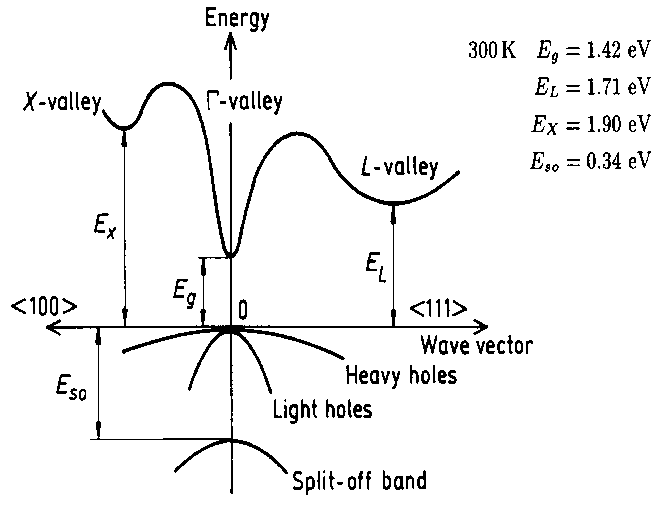
421.gif

http://www.ioffe.ru/SVA/NSM/Semicond/GaAs/bandstr.html

I assume most electrons which acquire enough energy will jump to the lowest valley in the conduction band (r-valley for GaAs).

Ive been trying to determine what is the 'effective' temperature necessary to move an electron from the r-valley to the L-valley, the difference is 0.29 eV in GaAs.
Is the additional thermal energy coming from E = kT ?
... therefore T = 0.29eV*q/(k) ? this is a large temperature ... this seems too large ~3,600 °K.

How do the electons move between valleys ? And how does one find the required energy for this to take place ?
Thanks for any help you can provide.
 
Last edited:
Physics news on Phys.org


Although you can tell the required amount of energy an electron needs to jump from valance band top to the conduction band top, you cannot straightforward associate a temperature for this using E=kT. The electrons in a solid are distributed according to Fermi distribution function. And even in the room temperature (kT=0.026meV) a portion of the the Fermi function will reach conduction band. Hence quite handful of electrons will occupy above the conduction band.
http://en.wikipedia.org/wiki/Fermi–Dirac_statistics


I see from the solution now that the 'effective' temperature of an electron which moves from the r-valley to the L-valley is equal to T = 0.29eV*q/k ~ 3600 K, I had done this correctly.


cr2504life said:
I see from the solution now that the 'effective' temperature of an electron which moves from the r-valley to the L-valley is equal to T = 0.29eV*q/k ~ 3600 K, I had done this correctly.

Math correct, physics wrong. Think about it, 3600 K, most likely GaAs is a vapour at that temperature, the melting point is 1240 C (1530 K). For an electron to move between the \Gamma-point and L-point of a lattice requires a phonon assist.
 

Similar threads

  • · Replies 4 ·
Replies
4
Views
3K
  • · Replies 0 ·
Replies
0
Views
846
  • · Replies 1 ·
Replies
1
Views
2K
  • · Replies 1 ·
Replies
1
Views
3K
  • · Replies 2 ·
Replies
2
Views
6K
  • · Replies 6 ·
Replies
6
Views
3K
  • · Replies 1 ·
Replies
1
Views
2K
  • · Replies 2 ·
Replies
2
Views
4K
  • · Replies 6 ·
Replies
6
Views
12K
  • · Replies 3 ·
Replies
3
Views
5K