Universal gas constant R= Cp-Cv

Click For Summary
SUMMARY

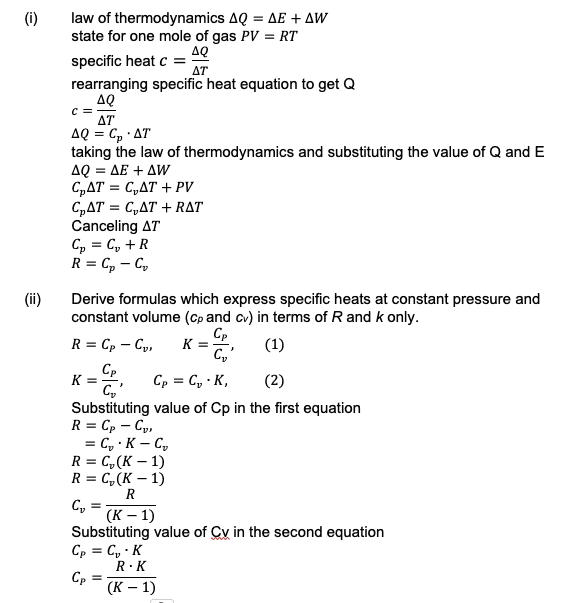
The discussion centers on the universal gas constant R, specifically the relationship R = Cp - Cv. Participants debated whether to use delta (Δ) or differential (d) notation in their equations, concluding that the choice does not significantly impact the outcome. Additionally, there was uncertainty regarding the necessity of substituting specific values for R, K, Cv, and Cp, with a consensus that leaving the values as they are is acceptable.

PREREQUISITES
  • Understanding of thermodynamic principles, specifically the concepts of heat capacity (Cp and Cv).
  • Familiarity with the universal gas constant (R) and its applications in thermodynamics.
  • Knowledge of differential and delta notation in mathematical expressions.
  • Basic grasp of the ideal gas law and its implications in physical chemistry.
NEXT STEPS
  • Research the derivation and applications of the universal gas constant R in thermodynamics.
  • Study the differences between heat capacities at constant pressure (Cp) and constant volume (Cv).
  • Learn about the implications of using differential (d) versus delta (Δ) notation in thermodynamic equations.
  • Explore practical examples of calculating R, Cp, and Cv in real-world scenarios.
USEFUL FOR

This discussion is beneficial for students and professionals in thermodynamics, physical chemistry, and engineering fields, particularly those focusing on heat transfer and gas laws.

Sabra_a
Messages
33
Reaction score
6
Homework Statement
1) Using the first law of thermodynamics ∆Q=∆E+∆W (Q – heat added to the system, E – internal energy of the system, W – work done by the system), the equation of state for one mole of gas PV=RT (P - pressure, V – volume, R - universal gas constant, T - temperature), and the definition of the specific heat c=∆Q/∆T derive the following equation for universal gas constant: R= cp- cv (cp and cv are specific heats at constant pressure and constant volume correspondingly).

2) The specific heats ratio or adiabatic exponent is equal by definition to k= cp/cv. Derive formulas which express specific heats at constant pressure and constant volume (cp and cv) in terms of R and k only.
Relevant Equations
First law of thermodynamics
Ideal gas equation
Specific heat
In the first question should I remove the delta and put d or that doesn't make a difference and on the second question should I substitute the values of R, K, Cv and Cp or that's not required I'm not really sure how correct is my answer to the second question
Screen Shot 2019-11-07 at 3.21.38 PM.png
 

Attachments

  • Screen Shot 2019-11-07 at 3.20.43 PM.png
    Screen Shot 2019-11-07 at 3.20.43 PM.png
    14.6 KB · Views: 1,424
Physics news on Phys.org
Leave it alone. It looks fine.
 
  • Like
Likes   Reactions: Sabra_a
Thank you
 

Similar threads

  • · Replies 2 ·
Replies
2
Views
930
  • · Replies 7 ·
Replies
7
Views
7K
Replies
5
Views
3K
  • · Replies 2 ·
Replies
2
Views
3K
  • · Replies 1 ·
Replies
1
Views
2K
  • · Replies 8 ·
Replies
8
Views
2K
  • · Replies 19 ·
Replies
19
Views
3K
  • · Replies 4 ·
Replies
4
Views
4K
Replies
4
Views
2K
Replies
3
Views
7K