How Do You Calculate Capacitance in a DC Circuit with a Fully Charged Capacitor?

  • Thread starter Thread starter Lambda96
  • Start date Start date
  • Tags Tags
    Capacitor Circuit
Click For Summary
SUMMARY

The discussion focuses on calculating capacitance in a DC circuit with a fully charged capacitor, specifically using a resistor value of ##R=100 \Omega##. The impedance formula for a parallel circuit is given as $$|Z|=\frac{1}{\sqrt{R^{-2}+\omega^2 C^2}}$$, leading to the capacitance calculation $$C=\frac{R^2-Z^2}{R \omega Z}$$. Initially, the calculated capacitance was ##C=9.7 \cdot 10^{-4}F##, but after correcting the frequency to angular frequency (##\omega=2\pi f##), the accurate capacitance value is ##C=0.015 F##.

PREREQUISITES
  • Understanding of DC circuit theory
  • Familiarity with impedance in electrical circuits
  • Knowledge of angular frequency and its calculation
  • Proficiency in using LaTeX for mathematical expressions
NEXT STEPS
  • Study the relationship between frequency and angular frequency in electrical circuits
  • Learn about the role of capacitors in DC circuits
  • Explore advanced impedance calculations in parallel circuits
  • Practice writing mathematical equations using LaTeX
USEFUL FOR

Electrical engineers, physics students, and anyone involved in circuit design or analysis will benefit from this discussion on calculating capacitance in DC circuits.

Lambda96
Messages
233
Reaction score
77
Homework Statement
What does the circuit look like and what are the values of resistor ##R## and capacitance ##C##?
Relevant Equations
none
Hi,

I am not sure if I have calculated the task correctly
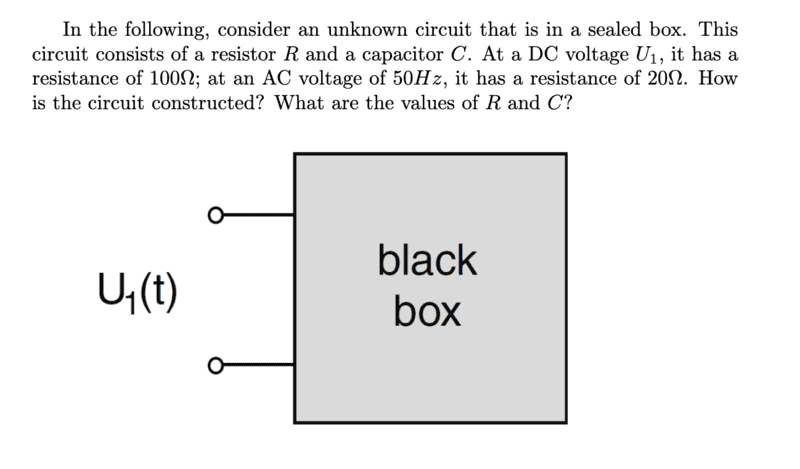
Bildschirmfoto 2023-06-07 um 12.53.12.png

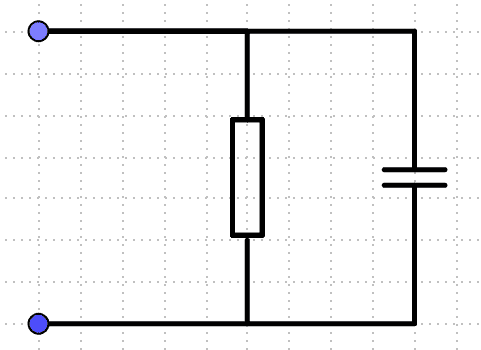
I have now assumed that the capacitor does not need to be charged and is therefore fully charged. In a DC circuit, a capacitor acts like an infinitely large resistor or like an open switch, so I assumed that it is a parallel circuit and that it looks like this.
Bildschirmfoto 2023-06-11 um 11.59.27.png


The resistor then has the following value ##R=100 \Omega##.

Using the impedance and the value for ##R##, I can then calculate the value for ##C##.

The value for the impedance in parallel circuit is

$$|Z|=\frac{1}{\sqrt{R^-2+\omega^2 C^2}}$$

##C## can then be calculated as follows

$$C=\frac{R^2-Z^2}{R \omega z}$$

If I now substitute all the values into the above formula, I get the following ##C=9.7 \cdot 10^{-4}F##.
 
Physics news on Phys.org
Lambda96 said:
ƒHomework Statement: What does the circuit look like and what are the values of resistor ##R## and capacitance ##C##?
Relevant Equations: none

Hi,

I am not sure if I have calculated the task correctly

View attachment 327711
I have now assumed that the capacitor does not need to be charged and is therefore fully charged. In a DC circuit, a capacitor acts like an infinitely large resistor or like an open switch, so I assumed that it is a parallel circuit and that it looks like this.

View attachment 327712

The resistor then has the following value ##R=100 \Omega##.

Using the impedance and the value for ##R##, I can then calculate the value for ##C##.

The value for the impedance in parallel circuit is

$$|Z|=\frac{1}{\sqrt{R^-2+\omega^2 C^2}}$$

##C## can then be calculated as follows

$$C=\frac{R^2-Z^2}{R \omega z}$$

If I now substitute all the values into the above formula, I get the following ##C=9.7 \cdot 10^{-4}F##.
It looks like you used frequency, ƒ, rather than angular frequency. Remember, ##\omega=2\pi f ## .

LaTeX tip:
To write ##R^{-2}## rather than ##R^-2##, place the ##-2## in braces { }, e.g. ##\{ -2 \}## .
 
  • Like
Likes   Reactions: Lambda96 and berkeman
Thanks SammyS for your help and for looking over my calculation, thanks also for the tip on how to write ##R^{-2}## in latex 👍 👍👍

You are right, unfortunately I used the frequency of ##50Hz## in the calculation instead of ##\omega=2 \pi 50Hz##. Then the result for ##C## is as follows, ##C=0.015 F##
 
Lambda96 said:
Thanks SammyS for your help and for looking over my calculation, thanks also for the tip on how to write ##R^{-2}## in latex 👍 👍👍

You are right, unfortunately I used the frequency of ##50Hz## in the calculation instead of ##\omega=2 \pi 50Hz##. Then the result for ##C## is as follows, ##C=0.015 F##
The decimal point is in the wrong place.

Simply divide your original answer by ##2\pi## .
 
  • Like
Likes   Reactions: Lambda96

Similar threads

  • · Replies 3 ·
Replies
3
Views
2K
  • · Replies 21 ·
Replies
21
Views
1K
  • · Replies 4 ·
Replies
4
Views
2K
Replies
9
Views
2K
Replies
20
Views
2K
Replies
6
Views
1K
  • · Replies 8 ·
Replies
8
Views
2K
  • · Replies 4 ·
Replies
4
Views
2K
Replies
15
Views
2K
  • · Replies 6 ·
Replies
6
Views
3K