Unraveling the Mysteries of Gravity: From Light Bulbs to Spiral Galaxies

  • Context: Undergrad 
  • Thread starter Thread starter Dan Nixon
  • Start date Start date
  • Tags Tags
    Gravity
Click For Summary

Discussion Overview

The discussion explores the relationship between gravity and light, specifically how gravity can affect the visibility of light emitted from a bulb. Participants also consider the implications of supermassive black holes on the structure of spiral galaxies and the observational challenges of measuring cosmic expansion from within a galaxy.

Discussion Character

  • Exploratory
  • Technical explanation
  • Conceptual clarification
  • Debate/contested

Main Points Raised

  • Some participants inquire about the amount of gravity required to dim a light bulb and whether such an experiment could be conducted.
  • There is a suggestion that gravitational redshift could be a factor in dimming light, with one participant noting that any mass, including that of a light bulb, causes some gravitational redshift, though it may not be detectable with current technology.
  • One participant proposes a hypothetical device that could create artificial mass or gravity and questions how much gravity would be needed for the light from a bulb to become invisible from a distance.
  • Another participant discusses the differences in light output from various types of bulbs and how this could affect the perceived visibility of light under gravitational influence.
  • Mathematical relationships are presented to estimate the gravitational effects on light, including equations involving gravitational constant, mass, and radius from the center of mass of the bulb.
  • Participants discuss the role of supermassive black holes in the structure of galaxies, with one arguing that the mass of the galaxy has a more significant impact on its structure than the black hole itself.
  • There is a query about whether there are observable phenomena, aside from gravitational lensing, that demonstrate gravity's ability to affect light to the extent that it cannot escape.

Areas of Agreement / Disagreement

Participants express multiple competing views regarding the effects of gravity on light and the structure of galaxies. The discussion remains unresolved, with no consensus reached on the specific mechanisms at play or the feasibility of proposed experiments.

Contextual Notes

Participants highlight limitations related to the detectability of gravitational effects on light and the complexities involved in measuring gravitational influence, including variations in gravity with altitude and the specific characteristics of different light sources.

Dan Nixon
Messages
7
Reaction score
0
How much gravity is needed to dim a light bulb?
Could this exsperiment ever actuly be created?

Also is the shape of a spiral galaxy like ours due to the effect of the supper massive black hole at its center has on all the other stuff in the galaxy ? Or is it because of the effect the black hole has on spacetime all the other stuff is just falling inwardly?
From an observatinal stand point since we are in a spiral gallixy looking outwardly under the abouves inplyed effect wouldn't from our perspective the univurs seem to be expanding ?? Woulnt we need to be in a place in the univurs that is as far away from any mass as possible in order to make an observatinal messurment of exspantion and time dielation?
 
Last edited by a moderator:
Astronomy news on Phys.org
Dan Nixon said:
How much gravity is needed to dim a light bulb?
Could this exsperiment ever actuly be created?

By "dim" do you mean red shift? Any amount of mass (including the light bulb) causes some gravitational redshift. The redshift from the mass of a lightbulb would not be detectable with current tech.

If the bulb is inside the event horizon of a black hole then none of the photons escape. If a very tiny black hole existed the hawking radiation could be brighter than the bulb. P= 3.562×1032 W kg2/M2 = 100W so M = 1.9 x 10¹⁵ kg. Any black hole smaller than 1.9 x 10¹⁵ kg will be brighter than the light bulb.

Dan Nixon said:
...
Also is the shape of a spiral galaxy like ours due to the effect of the supper massive black hole at its center has on all the other stuff in the galaxy ? Or is it because of the effect the black hole has on spacetime all the other stuff is just falling inwardly?...

The mass of the galaxy effects its structure much more than the black hole. The Milky Way has a relatively small black hole. There is 1012 solar mass in the galaxy and at most 4.5 x 10⁶ in the black hole. 1/200,000 is not enough to dominate the structure.
 
  • Like
Likes   Reactions: Dan Nixon
I was thanking if I built a device that could create artificial mass/ gravity as strong or as weak as I needed .. Put a bright light bulb on top. And from some distance away how much gravity would it take for from my prospective I could no longer see the lightbuld light??
And any thoughts on how such an exsperiment could be pulled off??
 
Dan Nixon said:
...how much gravity would it take for from my prospective I could no longer see the lightbuld light??
And any thoughts on how such an exsperiment could be pulled off??

Does shifting the visible light to infrared count. You would not be able to see infrared with your eyes. It can be detected.

The type of light bulb makes a difference. The light from a standard incandescent (Edison type) bulb is not the same as a compact fluorescent or LED bulb. Typical street lights in the United States are high pressure sodium bulbs. Halogen bulbs and mercury vapor are also common. Wikipedia has a list of light sources.

Incandescent bulbs can be tungsten, carbon or others. The power of a bulb effects the filament temperature and therefore it's light output. HPS bulbs give off a lot of 590 nm radiation which makes it easier for this question[assuming I understood the question]. Most human eyes cannot see 750 nm red.
z = (750-590)/590 = 0.27
So maybe you want to know how to "cause a red-shift of 0.27"?

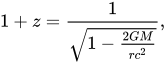
"How much gravity?" is more complicated than it sounds. Earth has a fairly constant mass but force of gravity changes with altitude. But you can plug that into the equation:
32281ba5d64b16f8f2379257d6c1182af6c7481e

2GM/(rc2) = (1+z)-2-1 = 0.38
GM/r = 1.7 x 10¹⁶
M/r= 2.5 x 1026
r = 2.5 x 1026/M

G is gravitational constant
M is mass of object creating gravity. (probably what was meant by "amount of gravity")
c is speed of light
r is radius from center of mass of bulb

So, for example, at 1 meter radius from an object with 2.5 x 1026 kg mass the light from sodium vapor bulb will to redshift to infra red. Not likely to find an object with that mass and a radius less than 1 meter. If the Sagitarius A* black hole has mass 8.6 x 1036 kg then a 400 watt HPS bulb at 3.4 x 10¹⁰ m or 34 million km will shine in infrared and would not be visible to human eyes.

[check arithmetic, is late and i am tired]
 
stefan r said:
Does shifting the visible light to infrared count. You would not be able to see infrared with your eyes. It can be detected.

The type of light bulb makes a difference. The light from a standard incandescent (Edison type) bulb is not the same as a compact fluorescent or LED bulb. Typical street lights in the United States are high pressure sodium bulbs. Halogen bulbs and mercury vapor are also common. Wikipedia has a list of light sources.

Incandescent bulbs can be tungsten, carbon or others. The power of a bulb effects the filament temperature and therefore it's light output. HPS bulbs give off a lot of 590 nm radiation which makes it easier for this question[assuming I understood the question]. Most human eyes cannot see 750 nm red.
z = (750-590)/590 = 0.27
So maybe you want to know how to "cause a red-shift of 0.27"?

"How much gravity?" is more complicated than it sounds. Earth has a fairly constant mass but force of gravity changes with altitude. But you can plug that into the equation:
32281ba5d64b16f8f2379257d6c1182af6c7481e

2GM/(rc2) = (1+z)-2-1 = 0.38
GM/r = 1.7 x 10¹⁶
M/r= 2.5 x 1026
r = 2.5 x 1026/M

G is gravitational constant
M is mass of object creating gravity. (probably what was meant by "amount of gravity")
c is speed of light
r is radius from center of mass of bulb

So, for example, at 1 meter radius from an object with 2.5 x 1026 kg mass the light from sodium vapor bulb will to redshift to infra red. Not likely to find an object with that mass and a radius less than 1 meter. If the Sagitarius A* black hole has mass 8.6 x 1036 kg then a 400 watt HPS bulb at 3.4 x 10¹⁰ m or 34 million km will shine in infrared and would not be visible to human eyes.

[check arithmetic, is late and i am tired]
stefan r said:
Does shifting the visible light to infrared count. You would not be able to see infrared with your eyes. It can be detected.

The type of light bulb makes a difference. The light from a standard incandescent (Edison type) bulb is not the same as a compact fluorescent or LED bulb. Typical street lights in the United States are high pressure sodium bulbs. Halogen bulbs and mercury vapor are also common. Wikipedia has a list of light sources.

Incandescent bulbs can be tungsten, carbon or others. The power of a bulb effects the filament temperature and therefore it's light output. HPS bulbs give off a lot of 590 nm radiation which makes it easier for this question[assuming I understood the question]. Most human eyes cannot see 750 nm red.
z = (750-590)/590 = 0.27
So maybe you want to know how to "cause a red-shift of 0.27"?

"How much gravity?" is more complicated than it sounds. Earth has a fairly constant mass but force of gravity changes with altitude. But you can plug that into the equation:
32281ba5d64b16f8f2379257d6c1182af6c7481e

2GM/(rc2) = (1+z)-2-1 = 0.38
GM/r = 1.7 x 10¹⁶
M/r= 2.5 x 1026
r = 2.5 x 1026/M

G is gravitational constant
M is mass of object creating gravity. (probably what was meant by "amount of gravity")
c is speed of light
r is radius from center of mass of bulb

So, for example, at 1 meter radius from an object with 2.5 x 1026 kg mass the light from sodium vapor bulb will to redshift to infra red. Not likely to find an object with that mass and a radius less than 1 meter. If the Sagitarius A* black hole has mass 8.6 x 1036 kg then a 400 watt HPS bulb at 3.4 x 10¹⁰ m or 34 million km will shine in infrared and would not be visible to human eyes.

[check arithmetic, is late and i am tired]

Sure it counts becouse you just made my random thought interesting thank you..
 
Dan Nixon said:
Sure it counts becouse you just made my random thought interesting thank you..
Besides gravitational lensing is there any other proof that gravity can effect light to the exstreem that it can not escape? Is there any other process that can be directly observed .. Is there any possible way to prove that a black hole can't be seen becouse gravity? And not another process that dousnt allow light escape?
 
Dan Nixon said:
Besides gravitational lensing is there any other proof that gravity can effect light to the exstreem that it can not escape? Is there any other process that can be directly observed .. Is there any possible way to prove that a black hole can't be seen becouse gravity? And not another process that dousnt allow light escape?
There's the Pound-Rebka experiment confirming gravitational redshift.
 
  • Like
Likes   Reactions: Dan Nixon
No such machine exists, as far as I know, to create artificial gravity.
 

Similar threads

  • · Replies 5 ·
Replies
5
Views
3K
  • · Replies 12 ·
Replies
12
Views
2K
  • · Replies 9 ·
Replies
9
Views
11K
  • · Replies 30 ·
2
Replies
30
Views
5K
  • · Replies 15 ·
Replies
15
Views
6K
  • · Replies 1 ·
Replies
1
Views
2K
  • · Replies 1 ·
Replies
1
Views
4K
  • · Replies 1 ·
Replies
1
Views
2K
  • · Replies 4 ·
Replies
4
Views
2K
Replies
1
Views
2K