MHB Upper and Lower Linits (lim sup and lim inf) - Denlinger, Theorem2.9.6 (b) ....

  • Thread starter Thread starter Math Amateur
  • Start date Start date
Click For Summary
The discussion centers on understanding the proof of Theorem 2.9.6 (b) from Denlinger's "Elements of Real Analysis," specifically how it leads to the conclusion that the limit of the upper limit sequence, $$\lim_{n \to \infty} \overline{x_n} \leq B$$. It is established that since the sequence $$\overline{x_n}$$ is bounded above by $$B$$ for all $$n$$, its limit cannot exceed $$B$$. A more rigorous argument is proposed, assuming the limit is greater than $$B$$, leading to a contradiction. This contradiction reinforces the conclusion that $$\lim_{n \to \infty} \overline{x_n} \leq B$$ holds true. The conversation emphasizes the need for a formal proof to satisfy skeptics regarding this conclusion.
Math Amateur
Gold Member
MHB
Messages
3,920
Reaction score
48
I am reading Charles G. Denlinger's book: "Elements of Real Analysis".

I am focused on Chapter 2: Sequences ... ...

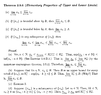
I need help with the proof of Theorem 2.9.6 (b)Theorem 2.9.6 reads as follows:View attachment 9245
View attachment 9246
In the above proof of part (b) we read the following:

" ... ... Then $$B$$ is an upper bound for every $$n$$-tail of $$\{ x_n \}$$, so $$\overline{ x_n } = \text{sup} \{ x_k \ : \ k \geq n \} \leq B$$. Thus $$\lim_{ n \to \infty } \overline{ x_n } \leq B$$ ... ... "My question is as follows:

Can someone please explain exactly how it follows that $$\lim_{ n \to \infty } \overline{ x_n } \leq B$$ ... that is, how it follows that $$\overline{ \lim_{ n \to \infty } } x_n \leq B$$ ...
(... ... apologies to steep if this is very similar to what has been discussed recently ... )
Hope someone can help ...

Peter
===============================================================================
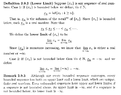
It may help MHB readers to have access to Denlinger's definitions and notation regarding upper and lower limits ... so I am providing access to the same ... as follows:
View attachment 9247
View attachment 9248Hope that helps ...

Peter
 

Attachments
  • Denlinger - 1 - Theorem 2.9.6 - PART 1 ... .png
    Denlinger - 1 - Theorem 2.9.6 - PART 1 ... .png
    23.8 KB · Views: 168
  • Denlinger - 2 - Theorem 2.9.6 - PART 2 ... .png
    Denlinger - 2 - Theorem 2.9.6 - PART 2 ... .png
    6.2 KB · Views: 172
  • Denlinger - 1 - Start of Section 2.9  - PART 1 ... .png
    Denlinger - 1 - Start of Section 2.9 - PART 1 ... .png
    23.2 KB · Views: 138
  • Denlinger - 2 - Start of Section 2.9  - PART 2 .png
    Denlinger - 2 - Start of Section 2.9 - PART 2 .png
    22.5 KB · Views: 146
Last edited:
Physics news on Phys.org
Hi Peter,

Peter said:
Can someone please explain exactly how it follows that $$\lim_{ n \to \infty } \overline{ x_n } \leq B$$ ... that is, how it follows that $$\overline{ \lim_{ n \to \infty } } x_n \leq B$$ ...

The newly defined sequence $\left\{\overline{x_{n}}\right\}_{n=1}^{\infty}$ satisfies $\overline{x_{n}}\leq B$ for all $n$. Hence the limit of this sequence cannot exceed the value of $B$. Does this answer your question?
 
GJA said:
Hi Peter,
The newly defined sequence $\left\{\overline{x_{n}}\right\}_{n=1}^{\infty}$ satisfies $\overline{x_{n}}\leq B$ for all $n$. Hence the limit of this sequence cannot exceed the value of $B$. Does this answer your question?

Thanks for the help GJA ...

... your argument gives a plausible account of why $$\overline{ x_n } = \text{sup} \{ x_k \ : \ k \geq n \} \leq B$$ implies that $$\lim_{ n \to \infty } \overline{ x_n } \leq B$$ ... ...

But does your argument constitute an explicit, formal and rigorous argument/proof that a skeptic would accept ...

What do you think ... am I being too extreme or particular ...

Can you help/comment further ...?

Peter
 
Last edited:
A more concrete "proof" would go something like this:

Suppose the limit of the sequence is $L$ and that $L>B$. Let $\varepsilon =\dfrac{L-B}{2}$ and choose $N$ such that $|\overline{x_{n}}-L|<\varepsilon$ for all $n\geq N$. Then $\overline{x_{n}}>L-\varepsilon=\dfrac{L+B}{2}>B$ for all $n\geq N$. This, however, contradicts $\overline{x_{n}}\leq B$ for all $n$.
 
GJA said:
A more concrete "proof" would go something like this:

Suppose the limit of the sequence is $L$ and that $L>B$. Let $\varepsilon =\dfrac{L-B}{2}$ and choose $N$ such that $|\overline{x_{n}}-L|<\varepsilon$ for all $n\geq N$. Then $\overline{x_{n}}>L-\varepsilon=\dfrac{L+B}{2}>B$ for all $n\geq N$. This, however, contradicts $\overline{x_{n}}\leq B$ for all $n$.

Thanks for all your help on this issue GJA ...

Peter
 
We all know the definition of n-dimensional topological manifold uses open sets and homeomorphisms onto the image as open set in ##\mathbb R^n##. It should be possible to reformulate the definition of n-dimensional topological manifold using closed sets on the manifold's topology and on ##\mathbb R^n## ? I'm positive for this. Perhaps the definition of smooth manifold would be problematic, though.

Similar threads

Replies
2
Views
2K
Replies
2
Views
2K
  • · Replies 2 ·
Replies
2
Views
2K
  • · Replies 5 ·
Replies
5
Views
3K
  • · Replies 2 ·
Replies
2
Views
3K
Replies
4
Views
2K
  • · Replies 13 ·
Replies
13
Views
4K
  • · Replies 2 ·
Replies
2
Views
2K
  • · Replies 2 ·
Replies
2
Views
2K
  • · Replies 2 ·
Replies
2
Views
3K