Use Excel to find the similarity between functions.

  • Thread starter Thread starter 24forChromium
  • Start date Start date
  • Tags Tags
    Excel Functions
Click For Summary
SUMMARY

This discussion focuses on quantitatively assessing the similarity between a predictive function and actual experimental readings using Excel. Key methods mentioned include performing a χ2 test and calculating the R2 value for linear regression. The importance of confidence intervals for the slope and intercept of the regression line is emphasized, as they help determine the validity of the theoretical parameters against the experimental data. The consensus suggests that the hypothetical relationship may not adequately support the experimental results.

PREREQUISITES
  • Understanding of linear regression analysis
  • Familiarity with statistical tests, specifically the χ2 test
  • Knowledge of R2 value interpretation in model fitting
  • Basic proficiency in using Excel for data analysis
NEXT STEPS
  • Learn how to perform a χ2 test in Excel
  • Study the calculation and interpretation of R2 values in regression analysis
  • Explore confidence intervals for regression parameters
  • Investigate the concept of goodness of fit in statistical modeling
USEFUL FOR

Researchers, data analysts, and students involved in statistical modeling and data analysis, particularly those using Excel to validate predictive models against experimental data.

24forChromium
Messages
155
Reaction score
7
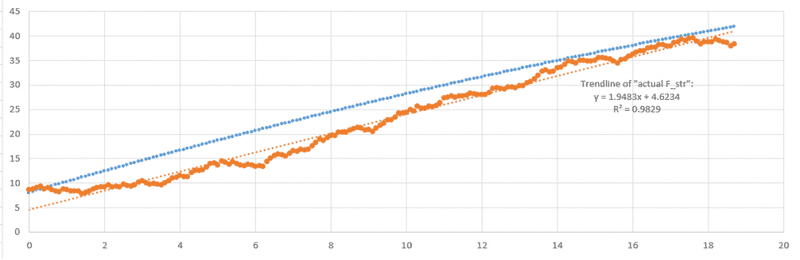
I am writing a paper and I came up with a function that uses a hypothetical relationship to predict the value of one variable at different points in time, I graphed it, and then graphed the actual readings from an experiment. How can quantitatively describe how close the two trends are? In other words, how can I quantitatively describe the amount of support the hypothetical relationship get from the experiment? See image for more ideas, predictive function gives values in blue, actual readings are orange.
Screenshot 2015-09-15 21.39.28.png
 
Computer science news on Phys.org
You could perform a χ2 test. You can also calculate the R2 for your model, since you already have the value for the linear regression.

If you don't know what any of that means, you can start with https://en.wikipedia.org/wiki/Goodness_of_fit
 
You can get the confidence intervals for the slope and intercept of the regression line. For a given confidence level, your theoretical parameters will be in or out of the confidence interval. Just eyeballing the data, the regression line, and your theoretical line, I think there is something missing from your theory. I think it is likely to be statistically rejected.
 

Similar threads

  • · Replies 1 ·
Replies
1
Views
3K
Replies
10
Views
6K
  • · Replies 5 ·
Replies
5
Views
2K
  • · Replies 4 ·
Replies
4
Views
3K
  • · Replies 2 ·
Replies
2
Views
2K
  • · Replies 61 ·
3
Replies
61
Views
5K
  • · Replies 3 ·
Replies
3
Views
2K
  • · Replies 9 ·
Replies
9
Views
2K
  • · Replies 1 ·
Replies
1
Views
2K
  • · Replies 2 ·
Replies
2
Views
2K