Use of i and j in complex numbers

Click For Summary
SUMMARY

The discussion centers on the use of "i" and "j" in complex numbers, highlighting the conventions adopted by different fields. Electrical engineers typically use "j" to avoid confusion with current, while physicists may use "j" for current density. The conversation emphasizes that these conventions can lead to misunderstandings, particularly for those new to the subject. Notably, the discussion references Steinmetz notation, which simplifies the representation of complex numbers in electrical engineering.

PREREQUISITES
  • Understanding of complex numbers and their representations
  • Familiarity with electrical engineering terminology, specifically current and current density
  • Knowledge of mathematical notation and conventions
  • Awareness of Steinmetz notation and its application in circuit analysis
NEXT STEPS
  • Research the differences between "i" and "j" in various scientific disciplines
  • Explore Steinmetz notation and its applications in electrical engineering
  • Study the implications of notation in mathematical communication
  • Read Feynman's Lectures on Physics, particularly the sections on notation
USEFUL FOR

Students and professionals in mathematics, electrical engineering, and physics who seek clarity on the conventions of complex numbers and their applications in different fields.

chwala
Gold Member
Messages
2,828
Reaction score
421
Homework Statement
See attached
Relevant Equations
complex numbers
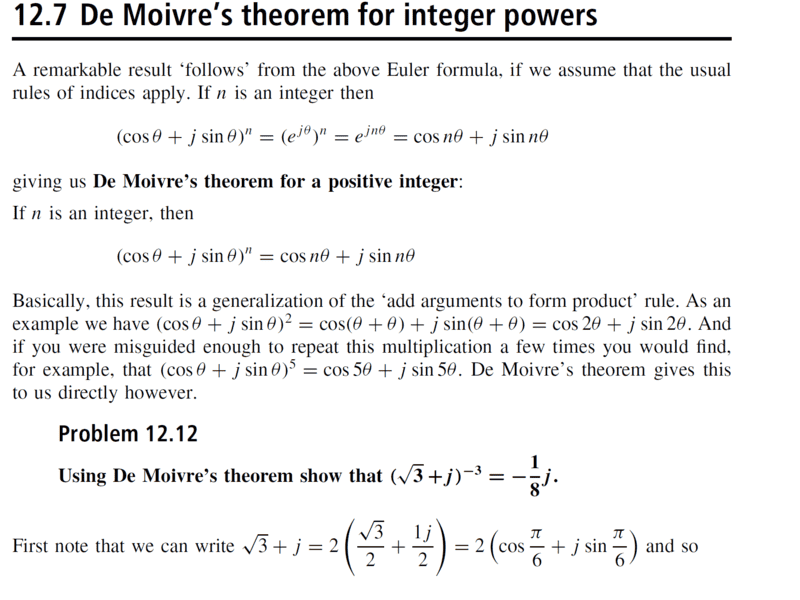
Is there any particular reason as to why certain texts use ##j## and others ##i## when looking at complex numbers? Maths is a relatively easy subject but at times made difficult with all this mix-up... i tend to use a lot of my time in trying to understand author's language and this is also evident on the convention used on argument, an area that is pretty easy/straightforward to me...this is akin to the mix up/confusion on the standard way of expressing derivatives noting that the two great mathematicians :Sir Isaac Newton and Leibnitz had different notations...

anyway, which is the standard way of expressing complex numbers?
1689566187560.png
 
Last edited:
Physics news on Phys.org
Electrical engineers tend to use j so it is not confused the current in a circuit.
 
  • Like
  • Informative
Likes   Reactions: PhDeezNutz, Steve4Physics, berkeman and 2 others
chwala said:
Homework Statement: See attached
Relevant Equations: complex numbers

Is there any particluar reason as to why certain texts use j and others i when looking at complex numbers?
It's a pretty meaningless convention IMO. Why are is e used as the base of natural logarithms, π the ratio of diameter to circumference?

I will say EEs like to use ##j## since we use ##i## for current. OTOH physicists use ##j## for current density. But it wouldn't have to be that way.
 
  • Informative
Likes   Reactions: chwala
DaveE said:
It's a pretty meaningless convention IMO. Why are is e used as the base of natural logarithms, π the ratio of diameter to circumference?

I will say EEs like to use ##j## since we use ##i## for current. OTOH physicists use ##j## for current density. But it wouldn't have to be that way.
Agreed, but at times the convention may in away create some mix-up. On a pretty straightforward concept. Like this for example,

1689567084038.png
 
chwala said:
Agreed, but at times the convention may in away create some mix-up. On a pretty straightforward concept. Like this for example,

View attachment 329352
OK, LOL. That isn't confusing to me, but that's just because I'm used to seeing it. BTW, I never really liked that "angle" symbol (∠). To me that's ##2e^{-j\frac{\pi}{6}}##. So personal preference is sometimes at play too.

One thing you will find as you continue in the physical sciences is that different people write stuff with different conventions; what they like, or how they learned things. It can be quite annoying at times, but part of the work is translating nomenclature. Context is key in deciphering this stuff.

As an aside, I'd like to shout out Born & Wolf "Principles of Optics", a text that everyone says is a classic, but I found nearly unreadable because they never used the same variable names I was taught. I hated that book simply for these reasons. You'll figure out your own favorite way and your own favorite texts, I'm sure. If you are too weird in your definitions, you'll have a hard time explaining stuff to others.

I guess I'm pretty amazed at how much standardization there is.
 
  • Haha
  • Like
Likes   Reactions: hutchphd and chwala
chwala said:
Agreed, but at times the convention may in away create some mix-up. On a pretty straightforward concept. Like this for example,

View attachment 329352
That's called Steinmetz notation (after the electrical engineer Steinmetz, by many considered the father of modern electrical engineering) and it is just the polar form of a complex number. It's quite ingenious, for one only needs the angles in electric circuit algebra. Well, Steinmetz was indeed a genius.

Inventing or using clever notation is a huge help in creative thinking. All great scientists introduced notations of their own in their work. Take, for instance, Einstein's notation of partial derivatives with commas; or better index notation in linear algebra. Or Feynman's, which perhaps are too many to mention. (One of his first novel notations was with trigonometric functions in his junior high school years.)

As a matter of fact, Feynman used to emphasize the usefulness of good notation. He also talked about that in his Lectures on Physics (for instance, Vol. I, Chapter 17, Section 17-5; read the passage---you will find it quite illuminating).
 
  • Informative
Likes   Reactions: chwala

Similar threads

  • · Replies 3 ·
Replies
3
Views
1K
Replies
2
Views
3K
  • · Replies 3 ·
Replies
3
Views
3K
  • · Replies 45 ·
2
Replies
45
Views
8K
Replies
8
Views
5K
  • · Replies 12 ·
Replies
12
Views
3K
  • · Replies 21 ·
Replies
21
Views
2K
  • · Replies 11 ·
Replies
11
Views
5K
  • · Replies 3 ·
Replies
3
Views
3K
  • · Replies 13 ·
Replies
13
Views
3K