Use the gradient vector to find out the direction

Click For Summary
To find the direction to the coolest point, the gradient vector -∇f(x,y) indicates the steepest descent. The value of 'k' in the temperature function is not essential for determining direction; instead, focus on the gradient defined as T = k/√(x²+y²). The ant should move away from the origin, specifically in the direction of the vector (3,2), which maximizes the rate of cooling. Calculus is not necessary for this determination, as the optimal path is straightforward.
daphnelee-mh
Messages
62
Reaction score
4
Homework Statement
Suppose there is a rectangular metal plate in the Oxy-plane with vertices (1,1),(5,1),(1,3) and (5,3). There is a heat source at the origin that heats the plate. Suppose the temperature at a point in the plate is inversely propotional to the distance of this point to the origin. Suppose there is an ant at the point (3.2). In which direction should the ant creep such that it gets to the cooler place fastest?
Relevant Equations
Duf(x,y)=∇f(x,y)⋅u

To Maximizing The Directional Derivative : Duf(x,y)=|∇f(x,y)| , in the direction as ∇f(x,y)
For my understanding, to move to the coolest place, it has to move in direction of -∇f(x,y)
How can I find the value of 'k' to evaluate the directional derivative and what can I do with the vertices given.
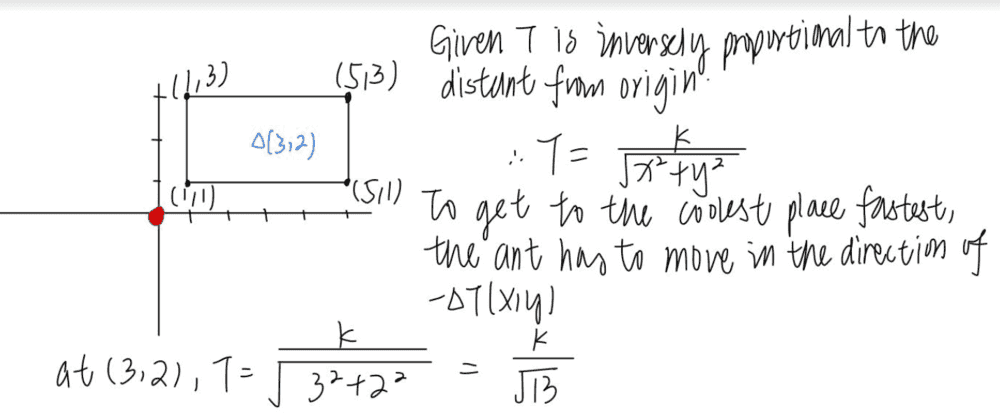
1593742216504.png
 
Physics news on Phys.org
daphnelee-mh said:
In which direction should the ant creep such that it gets to the cooler place fastest?

How can I find the value of 'k'
The question is ambiguous. Is the ant trying to maximise the rate at which the temperature starts to drop (which is what you seem to have assumed in your reference to derivatives) or to reach the coolest point on the plate in the least time (matching your use of "coolest" in your handwritten explanation)?
Either way, the value of k is irrelevant. You seem to be trying to find the temperature where the ant starts, which is also irrelevant.
 
It seems have to find out the direction to reach the point which is cooler. I am trying to get k to get the function T then take the derivative . Any other method to find out function ?
 
daphnelee-mh said:
It seems have to find out the direction to reach the point which is cooler. I am trying to get k to get the function T then take the derivative . Any other method to find out function ?
But ##\frac k{\sqrt{13}}## is not the function, it is only the value at one point.
And "the point which is cooler" doesn't define it. Lots of points are cooler.
Are you trying to find:
  1. The fastest route to the coolest point, or
  2. The direction in which it gets cooler fastest?
If (1), you first need to identify where the coolest point is.
If (2), taking the derivative (##\nabla##) of the function will tell you how fast it gets cooler in a given direction. You would then need to figure out the direction that maximises it. However, if you think a bit more you may realize the answer is obvious, no calculus needed.
 
if (2), but the function f is not defined, what can I do with the given vertices?
 
daphnelee-mh said:
if (2), but the function f is not defined, what can I do with the given vertices?
It is defined. As you wrote, it is ##\frac k{\sqrt{x^2+y^2}}##. Don't worry about what k is, just work with that and see what happens.
This is the sequence:
What is the gradient at (x,y)?
In which direction from (x,y) is the gradient steepest?
Which direction is that at the ant's starting point?
 
  • Like
Likes daphnelee-mh
haruspex said:
It is defined. As you wrote, it is ##\frac k{\sqrt{x^2+y^2}}##. Don't worry about what k is, just work with that and see what happens.
This is the sequence:
What is the gradient at (x,y)?
In which direction from (x,y) is the gradient steepest?
Which direction is that at the ant's starting point?
1593817194548.png

Is it correct? Thank you
 
daphnelee-mh said:
View attachment 265797
Is it correct? Thank you
Yes, but since it is only a direction you can just give (3,2) as the answer. Or normalise it to a unit vector if you prefer.
As I posted, calculus was not really needed. The ant just needs to move as fast as possible away from the origin, so that is obviously in the direction (3,2).
 
  • Like
Likes daphnelee-mh
haruspex said:
Yes, but since it is only a direction you can just give (3,2) as the answer. Or normalise it to a unit vector if you prefer.
As I posted, calculus was not really needed. The ant just needs to move as fast as possible away from the origin, so that is obviously in the direction (3,2).
Okay, Thank you very much
 

Similar threads

  • · Replies 8 ·
Replies
8
Views
2K
Replies
12
Views
9K
  • · Replies 4 ·
Replies
4
Views
3K
Replies
7
Views
2K
  • · Replies 2 ·
Replies
2
Views
2K
  • · Replies 9 ·
Replies
9
Views
2K
  • · Replies 8 ·
Replies
8
Views
5K
  • · Replies 16 ·
Replies
16
Views
3K
  • · Replies 13 ·
Replies
13
Views
4K
Replies
4
Views
2K