Using Chain Rule to Solve Questions - A Step-by-Step Guide

  • Context: MHB 
  • Thread starter Thread starter EconometricAli
  • Start date Start date
  • Tags Tags
    Chain Chain rule
Click For Summary

Discussion Overview

The discussion revolves around the application of the chain rule in multivariable calculus, specifically in solving problems involving partial derivatives. Participants are seeking assistance with specific problems and clarifying their understanding of the chain rule's application in various contexts.

Discussion Character

  • Homework-related
  • Mathematical reasoning
  • Technical explanation

Main Points Raised

  • One participant requests help with using the chain rule to solve specific problems, providing a function and its variable dependencies.
  • Another participant explains the chain rule and applies it to a given function, detailing the derivatives with respect to the variables involved.
  • There is a clarification on rewriting a logarithmic expression, with a participant expressing an alternative form of the function.
  • A participant expresses a desire to improve their mathematical skills, indicating a personal challenge with the material.
  • One participant expresses confusion regarding a specific part of a problem, asking for the final form of a derivative expression.
  • Another participant outlines the necessary derivatives and the application of the chain rule for a different function, prompting others to calculate specific partial derivatives.
  • A participant shares their experience of losing marks on their answers, indicating uncertainty about their understanding or application of the concepts discussed.

Areas of Agreement / Disagreement

The discussion contains multiple viewpoints and approaches to applying the chain rule. Participants express varying levels of understanding and confidence, with some seeking clarification while others provide explanations. No consensus is reached on the specific solutions to the problems presented.

Contextual Notes

Participants reference specific functions and their derivatives, but there are indications of missing steps or assumptions in their calculations. The discussion does not resolve the uncertainties expressed by participants regarding their understanding of the chain rule.

Who May Find This Useful

Students learning multivariable calculus, particularly those struggling with the chain rule and partial derivatives, may find this discussion beneficial.
EconometricAli
Messages
4
Reaction score
0
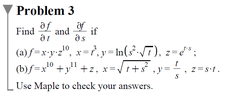
Hey everyone, could anyone help me figure out how to use chain rule to solve these questions in the attachments below?
 

Attachments

  • Differentiation.png
    Differentiation.png
    11.6 KB · Views: 141
  • Chainrules.png
    Chainrules.png
    12.5 KB · Views: 166
Physics news on Phys.org
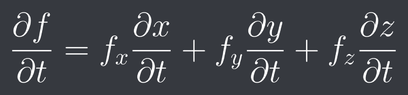
Okay your second picture gives the "chain rule":
If f is a function of x, y, and z and x, y, and z are functions of the variables, s and t, then f is a function of s and t and $\frac{\partial f}{\partial t}= f_x\frac{\partial x}{\partial t}+ f_y\frac{\partial y}{\partial t}+ f_z\frac{\partial z}{\partial t}$ and $\frac{\partial f}{\partial s}= f_x\frac{\partial x}{\partial s}+ f_y\frac{\partial y}{\partial s}+ f_z\frac{\partial z}{\partial s}$.
Great!

Now, in the first problem, $f(x, y, z)= xyz^{10}$, $x= t^3$, $y= ln(s^2\sqrt{t})$, and $z= e^{st}$.

The first thing I would do is write $y= 2(1/2)ln(st)= ln(st)$.

Now $f_x= yz^{10}$ and $\frac{\partial x}{\partial t}= 3t^2$ so $f_x\frac{\partial x}{\partial t}= 3t^2yz^{10}$. If you want to reduce that to s and t only, replace y with $ln(st)$ and z with $e^{st}$ to get $f_x\frac{\partial x}{\partial t}= 3t^3ln(sy)e^{10st}$.

$f_y= xz^{10}$ and $\frac{\partial y}{\partial t}= \frac{s}{t}$1 so $f_y\frac{\partial y}{\partial t}= xz^{10}\frac{s}{t}=\frac{st^3e^{10st}}{t}= st^2e^{10t}$.

$f_z= 10xyz^9$ and $\frac{\partial z}{\partial t}=se^{st}$ so $f_z\frac{\partial z}{\partial x}= 10xyz^9(se^{st})= 10(t^3)ln(st)e^{9st}(se^{st})= 90st^3ln(st)e^{10st}$.

$\frac{\partial f}{\partial t}$ is the sum of those.

$\frac{\partial f}{\partial s}$ is done the same way but with $\frac{\partial x}{\partial s}$, $\frac{\partial y}{\partial s}$, and $\frac{\partial z}{\partial s}$.
 
Country Boy said:
The first thing I would do is write $y=2(1/2)ln(st)=ln(st)$
$y = \ln(s^2 \cdot \sqrt{t}) = 2\ln(s) + \dfrac{1}{2}\ln(t)$
 
One of these days I really need to learn Math!
 
Thank you for the response but I'm lost in part b. The portion where fx (dx/dt) for x^10+y^11+z^10... what is its final form?
 
Okay, "part b" has $f= x^{10}+ y^{11}+ z$, $x= \sqrt{t+ s^2}$, $y=\frac{t}{s}$, $z= st$ and you want to find $\frac{\partial f}{\partial s}$ and $\frac{\partial f}{\partial t}$.

What are
$\frac{\partial f}{\partial x}$
$\frac{\partial f}{\partial y} $
$\frac{\partial f}{\partial z}$ ?

What are
$\frac{\partial x}{\partial s}$
$\frac{\partial x}{\partial t}$

$\frac{\partial y}{\partial s}$
$\frac{\partial y}{\partial t}$

$\frac{\partial z}{\partial s}$
$\frac{\partial z}{\partial t}$ ?

If you know basic Calculus you should be able to answer those.
If you can't do some of them, tell us which.

The "chain rule" says
$\frac{\partial f}{\partial s}= \frac{\partial f}{\partial x}\frac{\partial x}{\partial s}+ \frac{\partial f}{\partial y}\frac{\partial y}{\partial s}+ \frac{\partial f}{\partial z}\frac{\partial z}{\partial s}$
and
$\frac{\partial f}{\partial t}= \frac{\partial f}{\partial x}\frac{\partial x}{\partial t}+ \frac{\partial f}{\partial y}\frac{\partial y}{\partial t}+ \frac{\partial f}{\partial z}\frac{\partial z}{\partial t}$
 
I got my answers marked and lost a lot of marks actually. I'm not sure why.
 

Attachments

Similar threads

  • · Replies 5 ·
Replies
5
Views
2K
  • · Replies 3 ·
Replies
3
Views
3K
  • · Replies 1 ·
Replies
1
Views
2K
  • · Replies 1 ·
Replies
1
Views
2K
  • · Replies 7 ·
Replies
7
Views
4K
  • · Replies 4 ·
Replies
4
Views
2K
  • · Replies 10 ·
Replies
10
Views
2K
  • · Replies 4 ·
Replies
4
Views
1K
  • · Replies 1 ·
Replies
1
Views
2K
  • · Replies 20 ·
Replies
20
Views
4K