Using infinitesimals to find the volume of a sphere/surface

Click For Summary
SUMMARY

This discussion focuses on using infinitesimals to derive the volume and surface area of a sphere. The volume is calculated using the integral \(\displaystyle V = 2\pi \int_0^r x^2 dy\), which sums infinitesimal changes. However, confusion arises regarding the integration limits and the interpretation of surface area, where the integral \(\displaystyle A = \int_0^r 2\pi \sqrt{r^2-y^2} dy\) is incorrectly applied due to neglecting the orthogonality of the surface element. The correct approach involves using the infinitesimal \(ds\) and understanding the geometry of the shapes involved.

PREREQUISITES
  • Understanding of calculus, specifically integration techniques.
  • Familiarity with the concept of infinitesimals in mathematical analysis.
  • Knowledge of geometric properties of spheres and circles.
  • Ability to visualize and interpret geometric shapes in calculus.
NEXT STEPS
  • Study the application of Lagrange's mean value theorem in single variable calculus.
  • Learn about surface integrals using parametric equations, particularly for spheres.
  • Explore the derivation of the inertia of geometric shapes using calculus.
  • Investigate the use of cross products in vector calculus to find gradients and surface areas.
USEFUL FOR

Students and educators in mathematics, particularly those studying calculus and geometry, as well as professionals in fields requiring geometric modeling and analysis.

EddiePhys
Messages
144
Reaction score
6
I've always thought of dxat the end of an integral as a "full stop" or something to tell me what variable I'm integrating with respect to.
I looked up the derivation of the formula for volume of a sphere, and here, dx is taken as an infinitesimally small change which is multiplied by the area of a disc(pi r^2) giving \displaystyle V = 2\pi \int_0^r x^2 dy which is the sum of these infinitesimals.
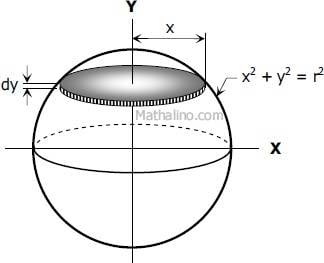
000-volume-of-sphere-integration.jpg


Now I'm really confused. Is it correct to think of it this way? Is there any other way to prove this result without using infinitesimals? Also, if I'm integrating from 0 to r, wouldn't this give me the area of only half the sphere?

Part two to my question:
Using this same logic of using infinitesimals, I tried to find the surface area of a sphere and looked at it as the sum of infinite rings.

\displaystyle A = \int_0^r 2\pi x dy
=> \displaystyle A = \int_0^r 2\pi \sqrt{r^2-y^2} dy
But this is wrong. Why?
 
Physics news on Phys.org
EddiePhys said:
But this is wrong. Why?
You are failing to account for the fact that the surface element is not orthogonal to the y-direction.
 
EddiePhys said:
Also, if I'm integrating from 0 to r, wouldn't this give me the area of only half the sphere?
Yes, but you have multiplied your integral by 2, so it's okay. Or you can omit the 2 and integrate from -r to +r. Same thing
 
Orodruin said:
You are failing to account for the fact that the surface element is not orthogonal to the y-direction.

I'm sorry, I don't understand. How is this any different from the volume case?
 
EddiePhys said:
I'm sorry, I don't understand. How is this any different from the volume case?
Draw a picture of your circle. At a given y, draw a section of the circle of width dy. That section is a straight rod (a supposed to the disk that you had in the case of the sphere). The analogue of the volume of the disk that you had for the case of the sphere (which was ##\pi dy x^2##) is now the area of the of the rod, which is width x length = dy times 2 x, where ## x = \sqrt{R^2-y^2} ##. Now integrate over y from 0 to R (and then multiply by 2 to get the total area of the circle).
 
Surface area when using single variable calculus without parametrization requires the use of Lagrange's mean value theorem. So, instead of using dy, there is a need to use the infinitesimal ds.
 
Try deriving the inertia of an inverted isosceles triangle using single variable calculus.
 
Last edited:
For your surface area equation, what you're doing is constructing cylinders, and the integral will add all of the surface areas of the cylinders to get the total surface area. The problem is that when you construct cylinders, like the one in the picture, the endpoints of the cylinder do not trace the surface of the circle, so your integral will not be accurate. Notice in the picture, the top-right of the cylinder touches the circle's surface, but the bottom-right of the cylinder is not actually touching the circle, it is off by a bit.
 
You should try finding the surface integral using two parameters theta and z. Try taking the cross product to find the vector that points in direction of gradient. It's that easy
 

Similar threads

  • · Replies 16 ·
Replies
16
Views
3K
  • · Replies 24 ·
Replies
24
Views
6K
  • · Replies 5 ·
Replies
5
Views
3K
  • · Replies 2 ·
Replies
2
Views
3K
  • · Replies 7 ·
Replies
7
Views
447
  • · Replies 2 ·
Replies
2
Views
3K
  • · Replies 4 ·
Replies
4
Views
4K
  • · Replies 3 ·
Replies
3
Views
3K
  • · Replies 3 ·
Replies
3
Views
3K
  • · Replies 2 ·
Replies
2
Views
1K