Using inverses to solve systems of equations

Click For Summary
SUMMARY

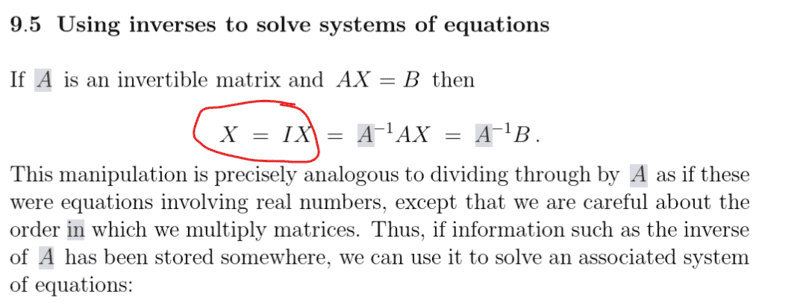
The discussion centers on the use of the identity matrix in solving systems of equations, specifically how the equation ##X = IX## is derived. Participants clarify that the identity matrix, denoted as ##I_n##, maintains the original vector ##X## when multiplied. The relationship ##A^{-1}A = I## is emphasized, demonstrating the properties of matrix multiplication and the associativity law in the context of linear algebra. This foundational understanding is crucial for manipulating equations involving matrices.

PREREQUISITES
  • Understanding of matrix multiplication
  • Familiarity with identity matrices, specifically ##I_n##
  • Knowledge of inverse matrices, denoted as ##A^{-1}##
  • Basic concepts of linear algebra and systems of equations
NEXT STEPS
  • Study the properties of identity matrices in linear algebra
  • Learn about matrix inverses and their applications in solving equations
  • Explore the concept of matrix associativity in depth
  • Practice solving systems of equations using matrix methods
USEFUL FOR

Students of linear algebra, educators teaching matrix theory, and anyone interested in solving systems of equations using matrix methods will benefit from this discussion.

member 731016
Homework Statement
Please see below
Relevant Equations
Please see below
For this,
1682305758972.png

Can someone please tell me where they got ##X = IX## from?

Many thanks!
 
Physics news on Phys.org
From the definition of ##I##. It is the one in matrix multiplication.
$$
\begin{pmatrix}x_{11}&\ldots &x_{1n}\\ \vdots&&\vdots \\x_{n1}&\ldots &x_{nn}\end{pmatrix} \cdot \underbrace{\begin{pmatrix}1&0&\ldots&0&0\\ 0&1&\ldots&0&0 \\ \vdots&\vdots&\ddots&\vdots&\vdots \\
0&0&\ldots&0&1 \end{pmatrix}}_{=I}=\begin{pmatrix}x_{11}&\ldots &x_{1n}\\ \vdots&&\vdots \\x_{n1}&\ldots &x_{nn}\end{pmatrix}
$$

Then they used ##A^{-1} A= I## and the associativity law: ##(I\cdot X)=((A^{-1}A)X)=(A^{-1}(AX))=A^{-1}B.##
 
  • Like
Likes   Reactions: Grelbr42, YouAreAwesome, MatinSAR and 1 other person
fresh_42 said:
From the definition of ##I##. It is the one in matrix multiplication.
$$
\begin{pmatrix}x_{11}&\ldots &x_{1n}\\ \vdots&&\vdots \\x_{n1}&\ldots &x_{nn}\end{pmatrix} \cdot \underbrace{\begin{pmatrix}1&0&\ldots&0&0\\ 0&1&\ldots&0&0 \\ \vdots&\vdots&\ddots&\vdots&\vdots \\
0&0&\ldots&0&1 \end{pmatrix}}_{=I}=\begin{pmatrix}x_{11}&\ldots &x_{1n}\\ \vdots&&\vdots \\x_{n1}&\ldots &x_{nn}\end{pmatrix}
$$

Then they used ##A^{-1} A= I## and the associativity law: ##(I\cdot X)=((A^{-1}A)X)=(A^{-1}(AX))=A^{-1}B.##
Thank you for your help @fresh_42! I see now.
 
  • Like
Likes   Reactions: YouAreAwesome
ChiralSuperfields said:
Can someone please tell me where they got ##X = IX## from?
This should be obvious. Based on the initial post, X is a column vector. If X consists of n elements, multiplication of X by an n x n identity matrix ##I_n## produces exactly the same vector X. This is analogous to writing ##b = 1 \cdot b## for ordinary numbers.
 
  • Like
Likes   Reactions: member 731016
ChiralSuperfields said:
Homework Statement: Please see below
Relevant Equations: Please see below

For this,
View attachment 325404
Can someone please tell me where they got ##X = IX## from?

Many thanks!
The ##I## should trigger the phrase "##I##dentity Matrix". It was the reason ##I## was chosen rather than some other letter in the first place.
 
  • Like
Likes   Reactions: fresh_42 and member 731016

Similar threads

  • · Replies 5 ·
Replies
5
Views
742
  • · Replies 5 ·
Replies
5
Views
2K
Replies
2
Views
2K
  • · Replies 19 ·
Replies
19
Views
2K
  • · Replies 9 ·
Replies
9
Views
3K
  • · Replies 7 ·
Replies
7
Views
3K
Replies
6
Views
2K
Replies
20
Views
4K
  • · Replies 13 ·
Replies
13
Views
9K
  • · Replies 4 ·
Replies
4
Views
3K