Using Kirchhoff's law, deduce the value and direction of the current

Click For Summary

Homework Help Overview

The discussion revolves around applying Kirchhoff's law to determine the value and direction of an unknown current, denoted as I, in a circuit. Participants are analyzing the implications of current values and directions based on the law that states the sum of currents entering a junction equals the sum of currents leaving it.

Discussion Character

  • Exploratory, Assumption checking, Conceptual clarification

Approaches and Questions Raised

  • Participants are questioning how a negative current value can be interpreted in terms of direction. There are discussions about the implications of designating current directions and how this affects the application of Kirchhoff's law. Some are exploring the arithmetic relationships between the currents at the junction.

Discussion Status

The discussion is active, with participants expressing confusion over the interpretation of negative current values and their implications for current direction. There is no explicit consensus, but various perspectives on the setup and assumptions are being explored, particularly regarding the designation of current directions and the application of Kirchhoff's law.

Contextual Notes

Participants are grappling with the definitions of current direction as indicated by arrows in the circuit diagram and the mathematical outcomes derived from Kirchhoff's law. There is an acknowledgment of the challenge posed by the negative current value in the context of the problem.

haha0p1
Messages
46
Reaction score
9
Homework Statement
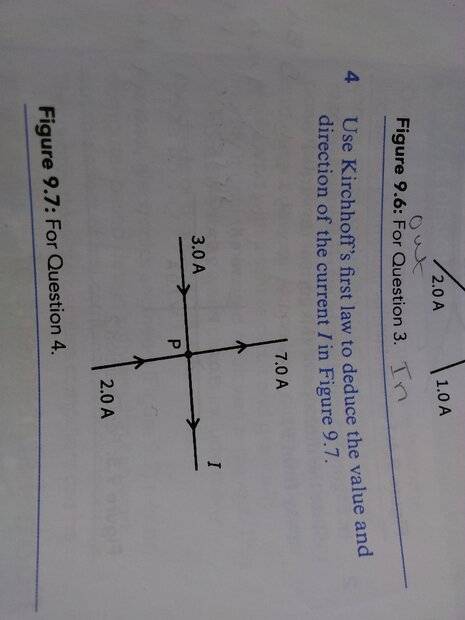
Use Kirchhoff's law to deduce the value and direction of the current I.
Relevant Equations
Current entering a point is equal to current exiting a point
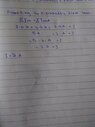
3 A+ 2 A = 7 A+ I
I = -2A
How the current can be in negative direction? If the sign if negative, doesn't it mean that the current will move towards the point P? Also If I am taking the 2A to be positive then Kirchhoff's law isn't satisfied as 5A≠7A
IMG_20230117_120617.jpg
 

Attachments

  • IMG_20230117_120454.jpg
    IMG_20230117_120454.jpg
    29.9 KB · Views: 135
Physics news on Phys.org
haha0p1 said:
Homework Statement:: Use Kirchhoff's law to deduce the value and direction of the current I.
Relevant Equations:: Current entering a point is equal to current exiting a point

3 A+ 2 A = 7 A+ I
I = -2A
How the current can be in negative direction? If the sign if negative, doesn't it mean that the current will move towards the point P?
The arrow on the diagram indicates the positive direction for current ##I##. It's doesn't imply the current itself is in the positive direction.
 
  • Like
  • Skeptical
Likes   Reactions: PhDeezNutz and haha0p1
PeroK said:
The arrow on the diagram indicates the positive direction for current ##I##. It's doesn't imply the current itself is in the positive direction
Even If I take the value of I to be 2 A, Still my current entering the wire and current exiting the wire is not the same as 3+5=7+2
And 5≠9
 
haha0p1 said:
Even If I take the value of I to be 2 A
Why would you do that?
 
PeroK said:
Why would you do that?
Because The question is asking to find value of I which is coming 2
 
haha0p1 said:
Because The question is asking to find value of I which is coming 2
##I \ne 2## as you yourself have already established. And, you seem to know that ##I = -2## but have decided that current must be positive. That puts you in an impossible position in this case.
 
  • Like
Likes   Reactions: SammyS
think of it this way:

If you designate a current leaving a node as positive and it mathematically turns out negative via KCL then that current is actually entering.

What’s really happening is that

3A is entering from the right
2A is entering from the bottom
2A is entering from the left

7A is leaving from the top
 
  • Like
Likes   Reactions: haha0p1 and PeroK

Similar threads

  • · Replies 18 ·
Replies
18
Views
3K
  • · Replies 12 ·
Replies
12
Views
3K
  • · Replies 8 ·
Replies
8
Views
2K
  • · Replies 9 ·
Replies
9
Views
2K
  • · Replies 28 ·
Replies
28
Views
2K
  • · Replies 2 ·
Replies
2
Views
2K
  • · Replies 2 ·
Replies
2
Views
2K
Replies
5
Views
5K
Replies
3
Views
1K
  • · Replies 1 ·
Replies
1
Views
2K