Using Linear Interpolation to Find Interest

Click For Summary

Homework Help Overview

The discussion revolves around the application of linear interpolation to find interest rates, particularly in the context of calculating net present worth (NPW). Participants are examining different methods of linear interpolation and their effectiveness in this financial context.

Discussion Character

  • Exploratory, Conceptual clarification, Mathematical reasoning

Approaches and Questions Raised

  • Participants discuss their understanding of NPW calculations and the specific linear interpolation method used. There are varying interpretations of how to apply the method, with some participants questioning the approach and others providing their own formulas and reasoning.

Discussion Status

The discussion is ongoing, with participants sharing their methods and clarifying their understanding of linear interpolation. Some have provided formulas they would use, while others are exploring the implications of interpolating different variables. There is no explicit consensus, but productive dialogue is occurring.

Contextual Notes

Participants note the difference between interpolating directly on the interest rate and on its reciprocal, which affects the present value calculations. There is also mention of the accuracy of different interpolation methods in relation to the exact solution.

ainster31
Messages
158
Reaction score
1

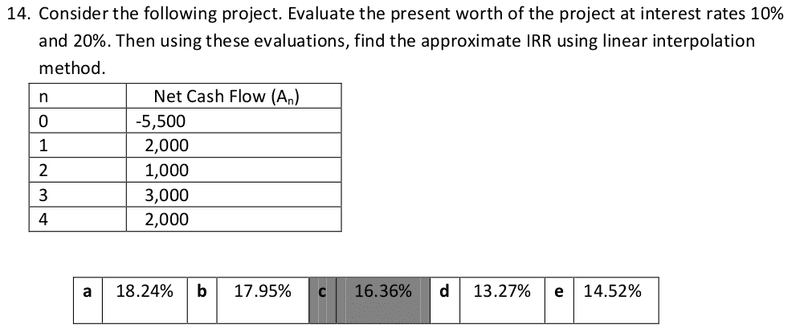
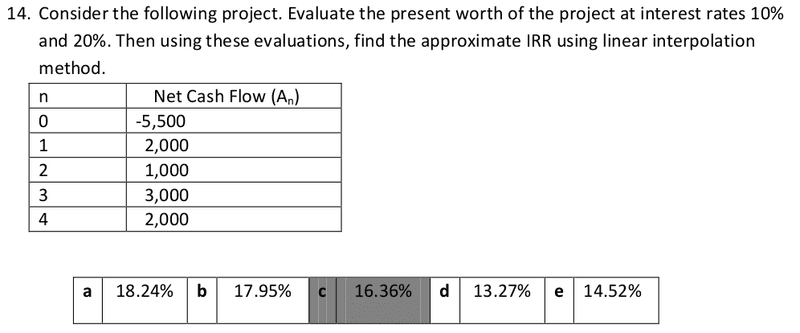
Homework Statement


F96Lk18.png


Homework Equations


The Attempt at a Solution



tpXoSpS.png


I understand how they calculated NPW but how did they use the linear interpolation method?
 
Physics news on Phys.org
ainster31 said:

Homework Statement


F96Lk18.png


Homework Equations


The Attempt at a Solution



tpXoSpS.png


I understand how they calculated NPW but how did they use the linear interpolation method?

I have never before seen their version of the linear interpolation method, but it does work. In linear interpolation we fit a linear function ##f = a + bx## through two points ##(x_1,f_1)## and ##(x_2,f_2)##:
[tex]f(x) = f_1 + \frac{f_2-f_1}{x_2-x_1} (x-x_1)[/tex]
This gives us the value of ##x_0##, the root of ##f(x) = 0,## as follows:
[tex]x_0 = \frac{f_2 x_1 - f_1 x_2}{f_2 - f_1}[/tex]
It follows (doing a lot of algebraic simplification) that
[tex]\frac{x_0 - x_1}{x_2-x_0} = -\frac{f_1}{f_2}[/tex]
In other words, we can find ##x_0## by solving the equation
[tex]\frac{x - x_1}{x_2-x} = -\frac{f_1}{f_2}[/tex]
The solution is ##x = x_0##. That is not how I would do it, but it is correct.
 
  • Like
Likes   Reactions: 1 person
Ray Vickson said:
That is not how I would do it, but it is correct.

How would you do it? Just set f(x)=0 and solve for x?
 
ainster31 said:
How would you do it? Just set f(x)=0 and solve for x?

I already gave you the formula I would use:
[tex]x_0 = \frac{f_2 x_1 - f_1 x_2}{f_2 - f_1}[/tex]
and I already explained how I got it.
 
Ray Vickson said:
I already gave you the formula I would use:
[tex]x_0 = \frac{f_2 x_1 - f_1 x_2}{f_2 - f_1}[/tex]
and I already explained how I got it.

You never explicitly said that you would use that formula so I didn't realize.

Thanks. I get it now.
 
I would use the following:

[tex]\frac{x-10}{20-10}=\frac{0-764}{-438-764}[/tex]

p.s. Check to see how closely 16.36% comes to making the Net present value zero.

Chet
 
ainster31 said:

Homework Statement


F96Lk18.png


Homework Equations


The Attempt at a Solution


tpXoSpS.png


I understand how they calculated NPW but how did they use the linear interpolation method?

Just so you know: there is a difference between using linear interpolation on ##r## directly, and using linear interpolation on ##x = 1/(1+r)##. The present value is a polynomial in ##x##, but not in ##r##. Linear interpolation on ##x## gives ##x_0 \approx .8609359558##, giving ##r_0 \approx .1615265843##, or about 16.15%. Which answer is closer? Well, the exact solution is ##r = .1594684085##, or about 15.95%. So, in this case at least, interpolation on ##x## produces slightly better results.
 

Similar threads

  • · Replies 4 ·
Replies
4
Views
1K
  • · Replies 3 ·
Replies
3
Views
3K
  • · Replies 4 ·
Replies
4
Views
3K
  • · Replies 5 ·
Replies
5
Views
2K
  • · Replies 4 ·
Replies
4
Views
3K
  • · Replies 2 ·
Replies
2
Views
1K
  • · Replies 19 ·
Replies
19
Views
1K
  • · Replies 6 ·
Replies
6
Views
2K
  • · Replies 4 ·
Replies
4
Views
3K
  • · Replies 1 ·
Replies
1
Views
1K