victorvmotti said:
Hello all,
In Carroll's there is a brief mention of how to get an idea about the curvature tensor using two infinitesimal vectors. Exercise 7 in Chapter 3 asks to compute the components of Riemann tensor by using the series expression for the parallel propagator. Can anyone please provide a sketch of the solution? When I use the parallel propagator on a vector to move from A to B and then from B to C the the vectors that make the infinitesimal loop do appear in the integrals but the indices of Christoffel symbol doesn't match with the equation 3.109. Is it correct to multiply four parallel propagators, each involving at least two terms in the series expression, to find the final vector components based on the initial components at A?
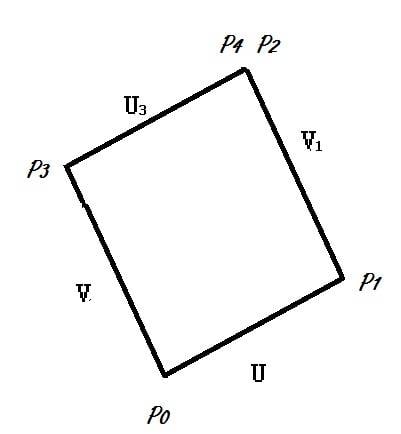
Imagine a parallelogram, with one side being the vector [itex]U[/itex], and the other side being the vector [itex]V[/itex]. Now, what we're going to do is to parallel-transport a third vector [itex]W[/itex] from one corner of the parallelogram to the opposite corner. There are two different paths to get to the opposite corner:
- Go around counter-clockwise:
- Start at point [itex]\mathcal{P}_0[/itex].
- Go along side [itex]U[/itex] to get to point [itex]\mathcal{P}_1[/itex].
- Then go along side [itex]V_1[/itex] to get to point [itex]\mathcal{P}_2[/itex]. Note, [itex]V_1[/itex] is not the same as vector [itex]V[/itex], but is instead the result of parallel-transport of [itex]V[/itex] along [itex]U[/itex].
- Go around clockwise:
- Start at point [itex]\mathcal{P}_0[/itex].
- Go along side [itex]V[/itex] to get to point [itex]\mathcal{P}_3[/itex].
- Then go along side [itex]U_3[/itex] to get to point [itex]\mathcal{P}_4[/itex]. Note, [itex]U_3[/itex] is not the same as vector [itex]U[/itex], but is instead the result of parallel-transport of [itex]U[/itex] along [itex]V[/itex].
Note: [itex]\mathcal{P}_4[/itex] and [itex]\mathcal{P}_2[/itex] are not precisely the same point, but they are close enough for the calculations that we're going to do.
If space if flat then the result of parallel-transporting [itex]W[/itex] will be the same, no matter which path you took. If space is curved, then the two paths will produce different results, and the difference will be proportional to the curvature tensor.
So how do we parallel-transport vector [itex]W[/itex]? Well, pick a coordinate system, and let [itex]W^\mu[/itex] be the components of [itex]W[/itex] in this coordinate system.
In terms of components, the result of transporting a vector [itex]A[/itex] along a vector [itex]B[/itex] produces a new vector [itex]A'[/itex] whose components are related to those of [itex]A[/itex] through:
[itex]A'^\mu = -\Gamma^\mu_{\nu \lambda} B^\nu A^\lambda[/itex]
where [itex]\Gamma[/itex] is the connection coefficients. Because it's such a pain to write all those superscripts and subscripts, I'm just going to write the symbols, and hope that I can later figure out what the superscripts and subscripts are supposed to be. So I'll write:
[itex]A' = -\Gamma B A[/itex]
So at point [itex]\mathcal{P}_0[/itex], we have vectors
[itex]U, V, W[/itex] and we have a connection coefficient [itex]\Gamma[/itex]
At point [itex]\mathcal{P}_1[/itex], we have vectors
[itex]U_1, V_1, W_1[/itex] and we have a connection coefficient [itex]\Gamma_1[/itex]
It's a different [itex]\Gamma[/itex], because the connection coefficients in general change from point to point. We compute these new values (approximately) by:
[itex]U_1 = U - \Gamma U U[/itex]
[itex]V_1 = V - \Gamma U V[/itex]
[itex]W_1 = W - \Gamma U W[/itex]
[itex]\Gamma_1 = \Gamma + (\partial \Gamma) U[/itex]
where in the last term, I'm again dropping superscripts and subscripts; it really should be [itex](\Gamma_1)^\mu_{\nu \tau}[/itex] [itex]= \Gamma^\mu_{\nu \tau} + (\partial_\lambda \Gamma^\mu_{\nu \tau}) U^\lambda[/itex]
At point [itex]\mathcal{P}_2[/itex], we have:
[itex]W_2 = W_1 - \Gamma_1 V_1 W_1 = W - \Gamma U W - \Gamma V W - (\partial \Gamma) U V W +\Gamma (\Gamma U V) W + \Gamma V (\Gamma U W) + \ldots[/itex]
(where [itex]\ldots[/itex] means higher-order terms involving three or more factors of [itex]U[/itex] or [itex]V[/itex])
Going around the other way (I'm going to skip to the answer), the result of parallel-transport of [itex]W[/itex] to [itex]\mathcal{P}_3[/itex] and then to [itex]\mathcal{P}_4[/itex] gives:
[itex]W_4 = W - \Gamma V W - \Gamma U W - (\partial \Gamma) V U W +\Gamma (\Gamma V U) W + \Gamma U (\Gamma V W) + \ldots[/itex]
So the difference between going counterclockwise and going clockwise is:
[itex]\delta W = W_2 - W_4 = - (\partial \Gamma) U V W +\Gamma (\Gamma U V) W + \Gamma V (\Gamma U W) + (\partial \Gamma) V U W - \Gamma (\Gamma V U) W - \Gamma U (\Gamma V W) + \ldots[/itex]
Since [itex]\Gamma V U = \Gamma U V[/itex], this simplifies a little to:
[itex]\delta W = - (\partial \Gamma) U V W + (\partial \Gamma) V U W<br />
+ \Gamma V (\Gamma U W) + - \Gamma U (\Gamma V W) + \ldots[/itex]
Now, the trick is to restore the stupid superscripts and subscripts. Then the Riemann tensor [itex]R[/itex] is defined via:
[itex]\delta W = R U V W + \ldots[/itex]
with the appropriately restored indices.