Using two electromagnets to study self-inductance

Click For Summary
SUMMARY

This discussion focuses on the use of two electromagnets to study self-inductance and mutual inductance. It is established that self-inductance is solely influenced by self-flux, while mutual inductance is affected by the orientation of the coils and their magnetic fields. The conversation highlights that the effective inductance of a system is a combination of self-inductance and mutual inductance, which can either add or subtract based on the winding directions. The role of the base material, potentially iron, is also noted to impact mutual inductance by reducing reluctance.

PREREQUISITES
  • Understanding of self-inductance and mutual inductance concepts
  • Familiarity with electromagnet configurations
  • Knowledge of magnetic flux and its effects
  • Basic principles of inductance in electrical circuits
NEXT STEPS
  • Research "series aiding" and "series opposing" inductance techniques
  • Explore the impact of core materials on inductance values
  • Study the geometry of inductive coils and their effects on mutual inductance
  • Investigate the design and construction of high-permeability cores for inductors
USEFUL FOR

Physics students, electrical engineers, and educators interested in the principles of inductance and electromagnetism.

Asmaa Mohammad
Messages
182
Reaction score
7
Hi,
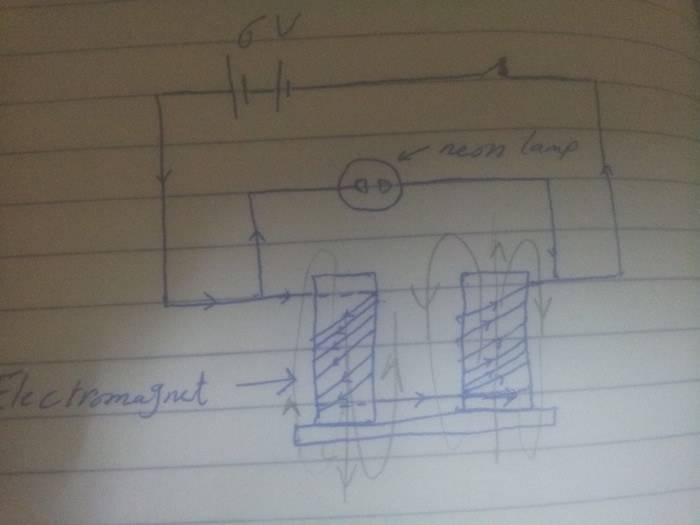
I study physics and I know what the concept self-inductance means, and in one of my study books, a figure like this was used to explain the self inductance in a coil
Ggh1F.jpg
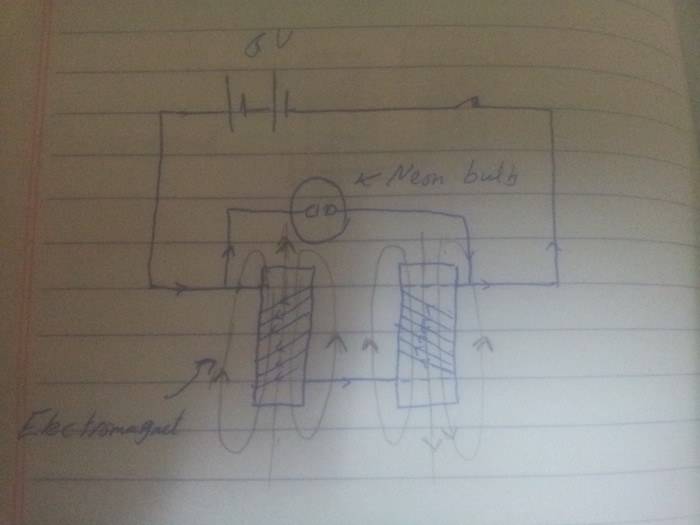
As shown in the figure, two electromagnets are connected together and the current is passing through them and would produce a magnetic field as shown, I drew it by myself, it wasn't drawn in the original figure. And at first, an induced emf and induced current will be produced, and the induced magnetic field will be in the opposite direction to the original magnetic field. What has attracted my attention is the way the electromagnets connected by, they are connected in a way so that the field between them can be in opposite directions, and I wonder whether it would be the same if we connected them like this:
KKDsc.jpg
will this connection affect self-inductance? Or will it make any difference in anything?
 
Last edited:
Physics news on Phys.org
Asmaa muhammad said:
will this connection affect self-inductance? Or will it make any difference in anything?
It will affect the mutual inductance between the two coils. Self inductance is affected by self-flux only.
 
  • Like
Likes   Reactions: davenn
Asmaa muhammad said:
a figure like this was used to explain the self inductance in a coil
Does the book's author indicate why he chose to use a pair of electromagnets instead of a single solenoid with a core, to illustrate self-inductance?

That horizontal base the magnets seem to be mounted on...are you told what it is made of?
 
Actually it didn't say why he used a pair of electromagnets, and the base, which I forgot to draw in the second figure, seems to be made of iron, but that is just my assumption, and I am not sure of it, and the author didn't say anything about it too.
 
Asmaa muhammad said:
Actually it didn't say why he used a pair of electromagnets, and the base, which I forgot to draw in the second figure, seems to be made of iron, but that is just my assumption, and I am not sure of it, and the author didn't say anything about it too.
Well, to explain self inductance, only one coil is sufficient.
Mutual inductance will depend on the directions of the coils. If the fluxes from the two coils tend cancel each other, mutual flux will be very small and hence, mutual inductance will be smaller than the MI when the fluxes add up.
 
  • Like
Likes   Reactions: Asmaa Mohammad
Asmaa muhammad said:
KKDsc.jpg
will this connection affect self-inductance? Or will it make any difference in anything?
I reply to my own post beacuase I can't edit it, and in this figure I forgot to draw the base of the two electromagnet existed in the other figure, and I think it has an importance somehow, but I don't know what is it, and the book's author didn't say any thing about it. So, do anyone know why it is here? and how could their connection affect both self and mutual inductance?
 
cnh1995 said:
Well, to explain self inductance, only one coil is sufficient.
Mutual inductance will depend on the directions of the coils. If the fluxes from the two coils tend cancel each other, mutual flux will be very small and hence, mutual inductance will be smaller than the MI when the fluxes add up.
Ok, but what about the self-inductance, would their connection by another way affect it?
 
Asmaa muhammad said:
Ok, but what about the self-inductance, would their connection by another way affect it?
No.
cnh1995 said:
It will affect the mutual inductance between the two coils. Self inductance is affected by self-flux only.
 
Asmaa muhammad said:
I reply to my own post beacuase I can't edit it, and in this figure I forgot to draw the base of the two electromagnet existed in the other figure, and I think it has an importance somehow, but I don't know what is it, and the book's author didn't say any thing about it. So, do anyone know why it is here? and how could their connection affect both self and mutual inductance?
If the base is made of a ferromagnetic material (like iron), it will reduce the reluctance of the path for the mutual flux. That will change the coupling co-efficient of the coils.
Self inductance will not be affected by the base plate.
 
  • #10
cnh1995 said:
No.
OK, but the two fluxes seem to cancel each others in the intermediate area, so the self-flux would be affected by this, wouldn't it?
 
  • #11
Asmaa muhammad said:
OK, but the two fluxes seem to cancel each others in the intermediate area, so the self-flux would be affected by this, wouldn't it?
cnh1995 said:
Well, to explain self inductance, only one coil is sufficient.
Mutual inductance **flux** will depend on the directions of the coils. If the fluxes from the two coils tend cancel each other, mutual flux will be very small and hence, mutual **effective** inductance will be smaller than the effective inductance when the fluxes add up.

I should have said "effective inductance" instead of mutual inductance.

Well, effective inductance of the system is a combination of self inductance and mutual inductance. Self inductance has a fixed value determined by its physical parameters and no of turns. Mutual inductance is also fixed, determined by the coupling co-efficient (and geometry). Winding directions decide whether self and mutual inductances add to each other or mutual inductance is subtracted from the self inductance.
Look up "series aiding" and "series opposing" inductance.
 
  • Like
Likes   Reactions: Asmaa Mohammad
  • #12
Asmaa muhammad said:
Actually it didn't say why he used a pair of electromagnets, and the base, which I forgot to draw in the second figure, seems to be made of iron, but that is just my assumption, and I am not sure of it, and the author didn't say anything about it too.
I was looking at this not as two coils having mutual inductance (though that is equally valid), but as a single coil wound onto a U-shape core. This shape allows the solenoid's field to pass through a high-permeability material for more of its path to give it a higher self-inductance than for the same number of turns wound on a similar cylindrical but straight core. This being a demonstration of self-inductance, consideration may be on efficiently obtaining a reasonable self-inductance. A donut-shape core would be even better, but it's not a shape that lends itself to DIY experimenters and it can be pain to wind with thousands of turns; further, without an air gap the magnetism can't be gauged with a scrap of steel like it can be for a horse-shoe shape.

(As with a horse-shoe magnet, this U-shape concentrates the field into a narrow air gap should we wish to use it as a strong magnet.)
 

Similar threads

  • · Replies 6 ·
Replies
6
Views
2K
  • · Replies 14 ·
Replies
14
Views
3K
  • · Replies 6 ·
Replies
6
Views
2K
  • · Replies 11 ·
Replies
11
Views
3K
  • · Replies 16 ·
Replies
16
Views
4K
  • · Replies 6 ·
Replies
6
Views
2K
  • · Replies 21 ·
Replies
21
Views
2K
  • · Replies 2 ·
Replies
2
Views
3K
  • · Replies 60 ·
3
Replies
60
Views
7K
  • · Replies 23 ·
Replies
23
Views
2K