Varnish or Potting, Which one is Better to Avoid Humming Noise from Inductor

  • Thread starter Thread starter victorb
  • Start date Start date
  • Tags Tags
    Inductor Noise
Click For Summary

Discussion Overview

The discussion revolves around the effectiveness of varnishing versus potting inductors to reduce humming noise. Participants explore the processes, materials, and potential outcomes associated with each method, focusing on their applications in electrical engineering and power supply contexts.

Discussion Character

  • Debate/contested
  • Technical explanation
  • Exploratory

Main Points Raised

  • Some participants suggest that varnishing an inductor can effectively reduce audible humming noise by securing the magnet wire and preventing vibrations, while others argue that potting may provide better results.
  • One participant describes the traditional varnishing process as economical and effective for small coils, while encapsulation involves using a mold to apply a potting compound, often epoxy.
  • Another viewpoint posits that neither varnishing nor potting will reduce humming from a resonant circuit, attributing the noise to frequency mismatches requiring additional damping resistors.
  • Participants discuss causes of humming in inductors, including loose windings, magnetostriction, and mechanical resonances, with some emphasizing the importance of securing coils properly.
  • There is mention of using thin laminations in transformers to minimize eddy current losses, with varnish serving as a temporary adhesive to prevent rattling, while potting is noted as a more permanent solution that complicates repairs.
  • One participant shares an experience with wet winding, where epoxy is applied during the winding process to enhance stability.
  • Concerns are raised about heat dissipation in potted inductors, with a note that potting may lead to higher operating temperatures due to reduced thermal management.

Areas of Agreement / Disagreement

Participants express differing opinions on the effectiveness of varnishing versus potting, with no consensus reached on which method is superior for reducing humming noise. Multiple competing views remain regarding the processes and their implications.

Contextual Notes

Some participants highlight limitations in the discussion, such as the lack of information on the operating profile of the coils and the specific conditions under which each method is applied. There are also unresolved questions about the definitions of potting and encapsulation as they relate to the discussed processes.

victorb
Messages
12
Reaction score
0
Someone just tell me that, "varnishing an inductor can reduce humming noise much better than encupsulating it", and this is what his friend told him where his friend worked in power supply field for over 10years.
(But I don't know did his "encupsulating" means potting)
Or did he mean varnish the winded core first, then pot it?

I agree with varnishing an inductor can reduce audible humming noise, as varnishing the winding can hold the magnet wire at its position and prevent it from vibration.
But I would rather think that potting the inductor should works even better.
Please correct me if I'm wrong :)

May I know more information on it?

Potting inductor:(pot the inductor by applying glue between the winded core and ferrite shielding)
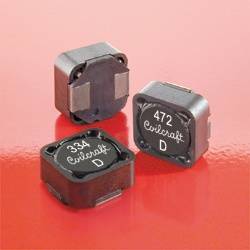
mss1260.jpg

Varnsihing inductor: (dip varnish the winding, maybe after or before assembly the winded core on the header)
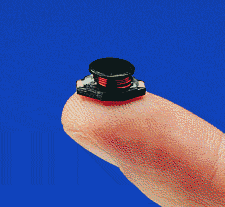
do3316.gif

(Please only refer to the inductor's sharp, but not size...)
 
Engineering news on Phys.org
It is a little better to talk about processes rather than results.

The traditional process is varnish dip and bake. That is very economical and fast. It works pretty well for most small coils which can stand having some areas free to vibrate.

Encapsulation usually refers to a process whereby you put the coil in a mold and pour/inject/suck the potting compound in. The potting compound is often an epoxy but may be a softer material in some instances.

If your application warrants it, the best way is to use an epoxy, applied either by vacuum/pressure or vacuum only. This gets the epoxy into almost all the tiny spaces. This is expensive and somewhat slow. However, there are many shops who do custom work in this area; you may generally find them by looking for "VPI coils" or something similar.

The ultimate goal is to have a rigid material holding every bit of winding in place, but you always end up making tradeoffs.

QUIZ: "Why do coils hum?" ANSWER: "'Cause they don't know the words.":biggrin:
 
I do not think that either will reduce humming from a resonant circuit with inductor and capacator. Humming is caused by a frequency mis-match and a resistor has to be added to dampen the oscillations. The varnish is only meant to insulate the inductor, be it a 700HP motor or a three micro-henry inductor.
 
Capacitors generally do not hum. Inductors do hum, for either
a) loose windings in coils, or coils that are not firmly secured in place, or
b) magnetostriction in magnetic material, or loose laminations in iron, or not fully compressed gap in pot cores. These can be exascerbated by mechanical resonances near the operating frequency.
 
Better quality transformers use a lot of very thin laminations.
These are thin sheets of soft iron intended to stop eddy current losses.

Being so thin, they tend to bend easily and, unless they are packed very tightly, they rattle or bang against each other due to magnetic forces caused by the currents in the transformer windings.

Varnish has been used as a removable glue to avoid this. It grips the outer edges of the iron strips and fills any gaps between them,
Because it is varnish it will come apart with a little force and this would allow the transformer to be rewound.

Potting is a much more permanent process. It involved dipping the whole transformer in a two part epoxy mix. This is normally thicker than the varnish and grips better, so it would probably do a better job. However, rewinding or repair of the transformer is not possible after potting.

Either type of coating is quite capable of producing a quiet transformer, though.
 
Thanks all your replys, it's informative for me and let me learned something more.

I think I got my answer.
The potting inductor that I posted is not really potted as I think (at least for the 1 that I disassembled), I disassembled 1 and found that's only EPOXY at the top gap of the inductor, and those EPOXY doesn't goes down to other internal part (winding, base...). And that's only 2 turns of tape (or 1 turn on somekind of unknown soft plastic tube) to serect the winding. I think that should called encapsulated, but not potted.
 
Oh, the other process that might help (and I forgot to say) is wet winding. I've used this with superconductor coils (where any movement can be a disaster). You simply apply epoxy to the wire as you wind it, perhaps a cm or so before it reaches the bobbin. It gets messy, but there's epoxy everywhere.
 
Aside: the operating profile of the coil is not mentioned, but keep in mind the potting process is will reduce the heat dissipation of the magnetics a bit, so for a given ambient it will run a bit hotter.
 
mheslep said:
Aside: the operating profile of the coil is not mentioned, but keep in mind the potting process is will reduce the heat dissipation of the magnetics a bit, so for a given ambient it will run a bit hotter.

Good point. You can mitigate that a little bit by using a high thermal conductance epoxy such as Stycast 2850, but that's still only maybe 2% that of steel, so...
 

Similar threads

  • · Replies 7 ·
Replies
7
Views
18K
  • · Replies 8 ·
Replies
8
Views
7K
  • · Replies 59 ·
2
Replies
59
Views
12K
  • · Replies 5 ·
Replies
5
Views
5K
  • · Replies 5 ·
Replies
5
Views
3K