##\vec v## and ##\vec a## expressions - motion on an off center circle

Click For Summary
SUMMARY

The discussion focuses on the decomposition of velocity into radial and angular components for motion on an off-center circle. The user encounters difficulties with the angular coordinate due to varying velocity directions along the trajectory. Specifically, the challenge lies in determining the appropriate trigonometric relationships for accurate decomposition. The term ## q(t) = 0.8t ## remains ambiguous, complicating the user's understanding of the problem.

PREREQUISITES
  • Understanding of radial and angular motion in physics
  • Familiarity with trigonometric functions and relationships
  • Knowledge of kinematic equations
  • Basic concepts of circular motion
NEXT STEPS
  • Study the principles of circular motion and angular velocity
  • Learn about trigonometric decomposition in physics
  • Explore kinematic equations for non-linear trajectories
  • Investigate the implications of parametric equations in motion analysis
USEFUL FOR

Physics students, educators, and anyone involved in analyzing motion dynamics, particularly in circular trajectories.

Like Tony Stark
Messages
182
Reaction score
6
Homework Statement
A particle moves along a circular trajectory, and its angular coordinate depends on ##q(t)=0,8t##. Considering ##Q## as the origin, find the expressions for velocity and acceleration in function of time, and also their radial and angular components.
Relevant Equations
##\dot{r} = \dot{r} e_r + r \dot{\theta} e_\theta ##
##\ddot{x} = (\ddot{r}-r \dot{\theta}^2) e_r + (r \ddot{\theta}+2 \dot{r} \dot{\theta}) e_\theta##
Well, I tried decomposing velocity into its components on the radial and angular axis. But I have problems with the angles because in some parts of the trajectory the velocity is on the angular coordinate, but in other parts it isn't. I mean, I can't say ##V=V e_\theta## because it's not always like that. So I'm having problems finding out which trigonometric relationship should I use to be able to decompose it.
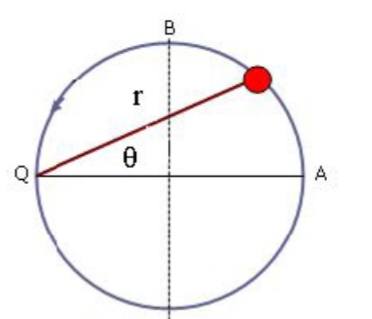
20190831_142328.jpg
 
Physics news on Phys.org
It's unclear how you worded the problem in the OP what ## q(t) ## is. The problem probably is somewhat routine, but I can't follow what ## q(t)=0,8t ## means.
 

Similar threads

Replies
67
Views
4K
  • · Replies 9 ·
Replies
9
Views
2K
  • · Replies 31 ·
2
Replies
31
Views
2K
  • · Replies 21 ·
Replies
21
Views
1K
  • · Replies 17 ·
Replies
17
Views
2K
Replies
1
Views
1K
Replies
16
Views
2K
Replies
2
Views
799
  • · Replies 14 ·
Replies
14
Views
4K
  • · Replies 6 ·
Replies
6
Views
2K