Vector Derivatives Explained: Definition and Examples

  • Context: Graduate 
  • Thread starter Thread starter Jhenrique
  • Start date Start date
  • Tags Tags
    Derivatives Vectors
Click For Summary

Discussion Overview

The discussion revolves around the concept of vector derivatives, specifically focusing on the directional derivative and its mathematical representation. Participants explore definitions, equations, and the implications of various matrix operations related to vector calculus.

Discussion Character

  • Technical explanation
  • Debate/contested
  • Mathematical reasoning

Main Points Raised

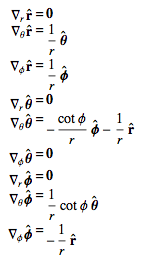
  • One participant questions the meaning of the expression ##\vec{\nabla}_{\hat{\phi}} \hat{r}## and provides a matrix representation, seeking clarification on its interpretation.
  • Another participant identifies the expression as a directional derivative and shares links for further reading, but does not address the original question directly.
  • A subsequent reply critiques the clarity of the initial question and points out a potential issue with the matrix multiplication presented, suggesting it may not be defined correctly.
  • One participant corrects the matrix representation, arguing that the correct form should involve a different arrangement of the matrices to ensure proper multiplication.
  • Another participant expresses confusion over how the directional derivative is computed using the vectors and gradient, seeking further clarification on the operations involved.
  • Several participants provide links to external resources that may help clarify the concept of directional derivatives and related mathematical operations.
  • One participant attempts to relate the directional derivative to the gradient of vector-valued functions, presenting an equation that connects these concepts.

Areas of Agreement / Disagreement

Participants demonstrate a lack of consensus on the correct interpretation of the expressions and the validity of the mathematical operations involved. Multiple competing views and interpretations are present throughout the discussion.

Contextual Notes

There are unresolved issues regarding the definitions and assumptions underlying the matrix operations and the expressions used. Participants express uncertainty about the validity of certain mathematical steps and the clarity of the original question.

Jhenrique
Messages
676
Reaction score
4
What means:

imagem.png


?

This guy, ##\vec{\nabla}_{\hat{\phi}} \hat{r}##, for example, means:

\\ \hat{\phi}\cdot\vec{\nabla}\hat{r} = \begin{bmatrix}<br /> \phi _1 \\ <br /> \phi _2 \\<br /> \end{bmatrix}<br /> \begin{bmatrix}<br /> \frac{\partial r_1}{\partial x} &amp; \frac{\partial r_1}{\partial y} \\ <br /> \frac{\partial r_2}{\partial x} &amp; \frac{\partial r_2}{\partial y} \\<br /> \end{bmatrix}
?
 
Physics news on Phys.org
Your question was not clear. Were you asking what each of the equations in the first image means? Or were you asking what the following means?
$$\\ \hat{\phi}\cdot\vec{\nabla}\hat{r} = \begin{bmatrix}
\phi _1 \\
\phi _2 \\
\end{bmatrix}
\begin{bmatrix}
\frac{\partial r_1}{\partial x} & \frac{\partial r_1}{\partial y} \\
\frac{\partial r_2}{\partial x} & \frac{\partial r_2}{\partial y} \\
\end{bmatrix}$$
BTW, that matrix product looks flaky to me. On the left side of your equation you have a dot product, which should result in a scalar, but on the right side, you have a 2X1 matrix multiplying a 2 X 2 matrix. That multiplication is not defined.

If you want a clear, concise answer, limit your questions to one per post.
 
Wrong my, the correct would be \begin{bmatrix} \phi _1 &amp; \phi _2 \\ \end{bmatrix} \begin{bmatrix} \frac{\partial r_1}{\partial x} &amp; \frac{\partial r_1}{\partial y} \\ \frac{\partial r_2}{\partial x} &amp; \frac{\partial r_2}{\partial y} \\ \end{bmatrix}
Anyway, this multiplication is just a tentative of answer my own ask (my unique ask), that is: what means ##\vec{\nabla}_\hat{u} \vec{v}## ?
 
Jhenrique said:
Wrong my, the correct would be \begin{bmatrix} \phi _1 &amp; \phi _2 \\ \end{bmatrix} \begin{bmatrix} \frac{\partial r_1}{\partial x} &amp; \frac{\partial r_1}{\partial y} \\ \frac{\partial r_2}{\partial x} &amp; \frac{\partial r_2}{\partial y} \\ \end{bmatrix}
Well, at least the matrix product is now defined. But another problem is that I don't see how this can be equal to the dot product you showed in the OP; namely,
$$\hat{\phi}\cdot\vec{\nabla}\hat{r} $$
Jhenrique said:
Anyway, this multiplication is just a tentative of answer my own ask (my unique ask), that is: what means ##\vec{\nabla}_\hat{u} \vec{v}## ?
 
Mark44 said:
Well, at least the matrix product is now defined. But another problem is that I don't see how this can be equal to the dot product you showed in the OP; namely,
$$\hat{\phi}\cdot\vec{\nabla}\hat{r} $$

You already understood that I'm lost and that all my equations no pass of speculation. I will not argue anymore about it.

The question is clear:
what means ##\vec{\nabla}_\hat{u} \vec{v}## ?
 
Its a directional derivative of the v vector function in the u direction
 
jedishrfu said:
Its a directional derivative of the v vector function in the u direction

ok, given, u = (u1, u2) , v = (v1, v2) and = (∂x, ∂y), how you'll operate u, v and for get the "directional derivative of the v vector function in the u direction" ?
 
  • #12
Mark44 said:
This might be what you're looking for - http://en.wikipedia.org/wiki/Normal_derivative#Normal_derivative

Scroll down to this section - Derivatives of vector valued functions of vectors.

In other words, ##\frac{\partial \vec{f}}{\partial \vec{v}} \cdot \vec{u}## is the same thing that $$\\ \ \vec{\nabla}\vec{f}\cdot \vec{u} =
\begin{bmatrix}
\frac{\partial f_1}{\partial v_1} & \frac{\partial f_1}{\partial v_2} \\
\frac{\partial f_2}{\partial v_1} & \frac{\partial f_2}{\partial v_2} \\
\end{bmatrix}
\begin{bmatrix}
u_1 \\
u_2 \\
\end{bmatrix} = \vec{\nabla}_{\vec{u}}\vec{f}
$$

(assuming that v = (v1, v2) = r = (x, y))

Like I say in the principle... correct?
 
Last edited:

Similar threads

  • · Replies 12 ·
Replies
12
Views
5K
Replies
3
Views
3K
  • · Replies 9 ·
Replies
9
Views
3K
  • · Replies 3 ·
Replies
3
Views
2K
  • · Replies 36 ·
2
Replies
36
Views
6K
  • · Replies 9 ·
Replies
9
Views
2K
  • · Replies 21 ·
Replies
21
Views
4K
Replies
2
Views
1K
  • · Replies 4 ·
Replies
4
Views
1K
  • · Replies 1 ·
Replies
1
Views
3K