Velocity Addition Example: Morin's Confusing Use of Equation

Click For Summary

Discussion Overview

The discussion revolves around the application and interpretation of the velocity addition formula as presented in Morin's book. Participants explore the nuances of using this formula in different reference frames, particularly in the context of relativistic speeds, and express confusion regarding the sign conventions used in the calculations.

Discussion Character

  • Exploratory
  • Technical explanation
  • Debate/contested
  • Mathematical reasoning

Main Points Raised

  • One participant questions Morin's use of the velocity addition equation, specifically why the velocity of B in B's frame is treated as non-zero.
  • Another participant clarifies that ##v_1## and ##v_2## represent the velocities of the trains in the ground frame, while ##u## is the velocity in the frame where the train moving at ##v_1## is at rest.
  • Some participants propose that the confusion arises from the opposite sign conventions used in Morin's equation compared to their understanding.
  • A participant suggests that the negative sign in the velocity addition formula can be understood through non-relativistic limits and vector addition principles.
  • Discussion includes the idea that different sign conventions can lead to the same mathematical results, but may cause confusion in interpretation.
  • Participants express a preference for a consistent sign convention to simplify calculations and understanding.
  • Some participants acknowledge the importance of becoming comfortable with the relativistic formulae rather than relying solely on Newtonian approximations.

Areas of Agreement / Disagreement

Participants do not reach a consensus on the best approach to the sign conventions in the velocity addition formula. There are multiple competing views regarding the interpretation of Morin's use of the equation and the implications of different sign conventions.

Contextual Notes

Participants note that the discussion is limited by the assumptions made about reference frames and the definitions of velocities involved. The resolution of the sign convention issue remains unresolved.

Oz123
Messages
29
Reaction score
0
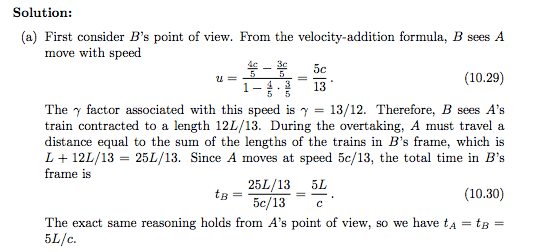
Ok, so here's another example Morin did in his book:

image.png

2_1.png

2_2.png

Ok, so the thing that confuses me is when he used the velocity addition equation:
image.png

Note:4c/5 and 3c/5 are their speeds relative to the ground.
Where v2 is the velocity of the S' frame, and v1 is the velocity of the object moving in the S' frame.
For the B's point of view, he used v1 as the velocity of A, and v2 as the velocity of B...Now, the thing that confuses me is that the velocity of B in B's frame should be zero, so why did he used v2 as non zero in B's frame? He seemed to just plug in numbers and don't explain why he used those numbers, can anyone explain to me why he used those numbers in? I would understand a bit if it's in the ground frame, v2 wouldn't be zero, but then v1 should be the velocity of A with respect to B not with respect to the ground.
 
Physics news on Phys.org
##v_1## and ##v_2## are the velocities of the trains in the ground frame. ##u## is the velocity measured in the frame where the train moving at ##v_1## is at rest.

One way to see what's going on is to take the non-relativistic limit, ##v_1,v_2 <<c##. Then the denominator is very close to one and can be disregarded. Then ##u=v_1-v_2##. So if you're a pedestrian and you see two cars doing 60mph in opposite directions in your frame, you know that one is stationary (##u=60-60##) while the other is doing 120mph (##u=60-(-60)##) seen from a frame doing 60mph.

The only change for the relativistic case is that velocities add in a slightly more complicated way (please do work out my car example using the full relativistic formula - I think the difference is on the 14th significant figure).

Note that Morin's 10.29 and your version of the velocity addition formula appear to be using opposite sign conventions for ##v_2##. Not sure if this is simply a mistake, or indicative of some deeper misunderstanding.
 
Last edited:
Thanks a lot!
Ya, I don't know why he used opposite signs, both the trains are going in the same direction, but the velocity addition formula right there is the one derived by Morin.

Ibix said:
u is the velocity measured in the frame where the train moving at v1 is at rest.
But v1, which is the train A is not at rest on any of the frame besides the train A itself, in the first calculation, he used B's frame as the rest frame, so I guess u is the velocity measured in the frame where the train moving at v2 (train B) is at rest?
From what I understand, suppose we use this instead:
## u = \frac {u' + v} {{1 + \frac {v u'} {c^2}}} ##
(Morin's notation is quite confusing), but here I define u' as the velocity of thing A in the moving frame B (so v of A with respect to B), v is the velocity of the moving frame with respect to some other frame C (So v of B with respect to C). So u is the velocity of A with respect to C.
So what he used as u' is the velocity of the train A with respect to C (ground), and he used v as the velocity of the train B with respect to C. So from this, u must be the velocity of A with respect to B, so it makes sense, but why the negative sign? u and v are with respect to C, and in C's frame, they are both going in the same direction.
 
Last edited:
Oh, I think I understand now why there is a negative sign, in non relativistic velocity, Vac=Vbc+Vba...So Vab=Vac-Vbc where Vab is velocity of a with respect to b etc. So in things like this, we need to look at the non relativistic limit if the vector addition makes sense, right? So if that happens, we also flip the signs in the denominator?
 
Last edited:
Think about every day speeds. If you see a train, A, doing 60mph and another train, B, doing 70mph then you know that someone looking out of train A's window will see the window frame having velocity 0, train B passing at 10mph, and the landscape going by at -60mph. You are using ##u=v_1-v_2##, where ##v_2## is the velocity (in the ground frame) of the person whose perspective you want, ##v_1## is the velocity (in the ground frame) that you wish to transform, and ##u## is the transformed velocity.

The only difference with what Morin is doing is that he's using a more precise calculation of the transformed speeds because ##u=v_1-v_2## is not a valid approximation. So he works out how fast a train going at 0.8c will be travelling, viewed from a train traveling at 0.6c. Then he figures out how long the overtake requires viewed from this frame.
 
  • Like
Likes   Reactions: Oz123
Ya I think I get now, thanks a lot!
 
Oh, also if we can think of the rest frame as B, so C is the moving frame with respect to B which is moving the other way, that's where the negative sign goes. Thanks for explaining :)
 
Oz123 said:
Oh, I think I understand now why there is a negative sign, in non relativistic velocity, Vac=Vbc+Vba...So Vab=Vac-Vbc where Vab is velocity of a with respect to b etc.
All that's happening here is a choice of sign convention. The smart thing to do is to declare that all velocities are positive moving to the right (for example). Then $$u=\frac {v_1-v_2}{1-v_1v_2/c^2}$$But some people like to think of it as a velocity addition formula and consider speeds in opposite directions to be both positive, and speeds in the same direction to be one negative one positive. In that case $$u=\frac {v_1+V_2}{1+v_1V_2/c^2}$$ I think that's just confusing, but ultimately the formulae are the same. Everyone agrees that ##v_1=-V_1##, they just argue about whether it's easier to think about ##v_1## or ##V_1##. I like the first convention because then everything is measured in the same sense and the maths keeps track of which way everything is pointing.
Oz123 said:
So in things like this, we need to look at the non relativistic limit if the vector addition makes sense, right? So if that happens, we also flip the signs in the denominator?
Relativity is a better model of reality than Newtonian physics, so I would be uncomfortable agreeing with this. That said, you can check your working by thinking: if these were highway speeds and I could use thr Newtonian approximation, would the signs come out the way I expect? Better to aim to become comfortable with the relativistic formulae, however.
 
  • Like
Likes   Reactions: Oz123
Yup, thank you! Noted everything :)
 

Similar threads

  • · Replies 18 ·
Replies
18
Views
2K
  • · Replies 3 ·
Replies
3
Views
2K
  • · Replies 4 ·
Replies
4
Views
1K
  • · Replies 47 ·
2
Replies
47
Views
5K
  • · Replies 20 ·
Replies
20
Views
3K
  • · Replies 5 ·
Replies
5
Views
2K
Replies
14
Views
2K
  • · Replies 14 ·
Replies
14
Views
2K
  • · Replies 21 ·
Replies
21
Views
2K
  • · Replies 4 ·
Replies
4
Views
2K