Velocity Addition: Unraveling the Mystery

Click For Summary

Discussion Overview

The discussion revolves around the complexities of velocity addition in special relativity, particularly in scenarios involving multiple objects moving at relativistic speeds. Participants explore different cases, including ships moving in opposite and orthogonal directions relative to Earth, and the mathematical formulations required to accurately describe their relative velocities.

Discussion Character

  • Exploratory
  • Technical explanation
  • Debate/contested
  • Mathematical reasoning

Main Points Raised

  • One participant describes two ships receding from Earth at .9c in opposite directions, questioning the application of velocity addition due to the cancellation of velocities.
  • Another participant suggests that velocity is a vector and emphasizes the need to consider vector components in 2D motion.
  • A different viewpoint argues that from the perspective of one ship, both Earth and the other ship are moving in the same direction, negating the need for relativistic addition.
  • One participant proposes a formula for calculating the relative speed between two ships moving orthogonally, incorporating time dilation effects.
  • Another participant identifies common sources of confusion regarding velocity addition, including the distinction between vector components and magnitudes.
  • Several participants share links to external resources and formulas for velocity addition in three-dimensional contexts.
  • There are corrections and refinements to proposed formulas, with participants pointing out errors in mathematical expressions and suggesting proper formulations.

Areas of Agreement / Disagreement

Participants express differing views on the application of velocity addition, with no consensus reached on the correct approach or formula. Some participants agree on the need for careful consideration of vector components, while others challenge the interpretations and calculations presented.

Contextual Notes

Limitations include potential misunderstandings of vector addition, the need for clarity in distinguishing between different reference frames, and unresolved mathematical steps in the proposed formulas.

Who May Find This Useful

This discussion may be of interest to those studying special relativity, particularly in understanding the nuances of velocity addition in different scenarios and the mathematical frameworks involved.

DaveC426913
Gold Member
2025 Award
Messages
24,304
Reaction score
8,460
TL;DR
How to apply rel. vel. addition in various geometrical scenarios
I keep getting into these discussions and finding out they are not as simple as I thought. Or at least, my math is rusty.

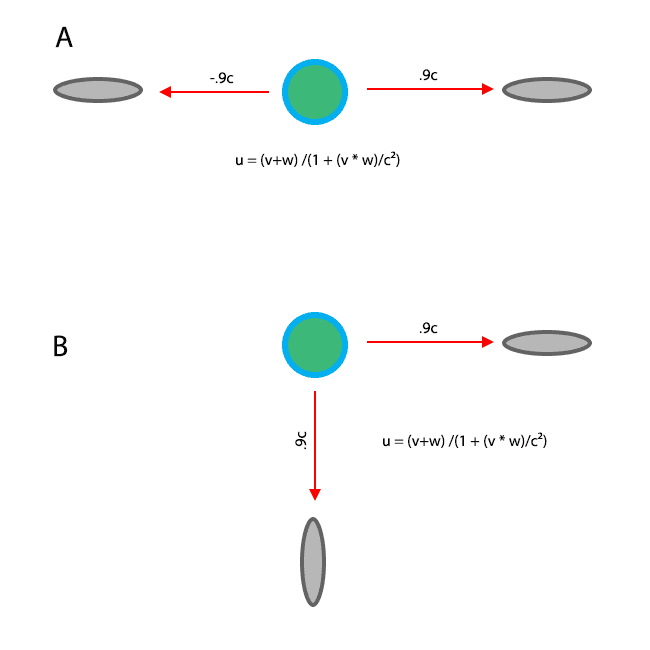
Scenario A:

Two ships are each receding from Earth at .9c in opposite directions. Since these are velocities, they should have opposite signs.

That can't be right, since they immediately cancel out in (v+w) to get zero.

Scenario B:

The two ships are receding orthagonally from Earth.
I thought this would be a simple case of finding the hypotenuse, but that leaves me with one number: 1.27 I need two numbers to apply the formula.

Where am I going wrong?
velocity addition.png
 
Physics news on Phys.org
First, if you set ##v, w \ll c##, you must get Galilean velocity addition, which is ##u = v - w##.

Second, velocity is a vector, so in the case of 2D motion you have formulas for each component of the velocity.

PS A better notation is: objects A, B are moving at 1D velocities ##v, u## in some reference frame. The veloctity of ##B## relative to ##A## is given by:
$$u' = u - v$$
And, of course, the velocity of ##A##, relative to ##B## is given by:
$$v'' = v - u$$
Where I've made ##A##'s frame the primed frame and ##B##'s frame the double-prime frame.
 
In the first case (scenario A), from left ship point of view, Earth is going to the right, and right ship is going "even more" to the right. So there's no need to use one +ve and one -ve.

i.e. from the perspective of one ship, Earth and the other ship are going in the same direction.

From Earth point of view, where one ship is going left and one is going right, no relativistic addition is needed.
 
In the first example, call the two ships L for left and R for right.

L’s speed relative to R is the earth’s speed relative to R plus L’s speed relative to earth. That’s a plus sign for the same reason that you’d add the speeds using Galilean relativity.

The second example is trickier because you can’t just naively divide the velocity of the downwards-moving object into x and y components using the frame in which the left-mover is at rest and then transform the x-component. You’ll find the right formulas in the Wikipedia article in the “Standard configuration” section: https://en.wikipedia.org/wiki/Velocity-addition_formula#Standard_configuration. As with the previous example, you get the signs right by asking yourself “should increasing this speed increase or decrease the final result?”
 
DaveC426913 said:
Summary:: How to apply rel. vel. addition in various geometrical scenarios

I keep getting into these discussions and finding out they are not as simple as I thought. Or at least, my math is rusty.

Scenario A:

Two ships are each receding from Earth at .9c in opposite directions. Since these are velocities, they should have opposite signs.

That can't be right, since they immediately cancel out in (v+w) to get zero.

Scenario B:

The two ships are receding orthagonally from Earth.
I thought this would be a simple case of finding the hypotenuse, but that leaves me with one number: 1.27 I need two numbers to apply the formula.

Where am I going wrong?

View attachment 258890
In this simple case, You can treat the Earth and downward moving ship as a system moving to the left at 0.9c relative to the ship shown moving to the right from the Earth frame.
This whole system is subject to time dilation. So, According to our "right moving" ship, the vertical component of the other ship is ~ 0.436 x 0.9c = 0.3924c Then the Pythagorean theorem can be used to get the resultant velocity according to our ship of choice.

Thus if v is the horizontal ship's velocity with respect to the Earth and w the vertical ship's velocity with respect to the Earth, then the relative speed between the two ships as measured from the horizontal ship is:

## u = \sqrt{ v^2 + \left( \sqrt{1- \frac{v^2}{c^2}}w \right)^2 }##
Which reduces to
## u = \sqrt{ v^2 + w^2 - \frac{vw}{c^2}} ##
 
Common sources of confusion with "velocity addition"—a misleading term, IMO—seem to be: A) not carefully distinguishing among vectors, vector components, and vector magnitudes; B) confusing the boost parameter with the quantity you're trying to transform; and C) not knowing when to use the inverse Lorentz transformation.

I recommend focusing on vector components.

Start with the Lorentz transformation and its "inverse" in standard configuration, and derive from them the corresponding transformation rules for velocity-components.

Understand that the boost parameter is the relative speed between the frames (a positive number less than ##c## that's the same for both the primed and unprimed observers), whereas the quantities you're transforming are the appropriately signed velocity-components of some third party whose motion the observers are tracking.

When applying the velocity-component-transformation rules to a given scenario, first determine whether you need to use the "inverse" formulas.
 
DaveC426913 said:
Where am I going wrong?
Looks like you didn't look up the actual formula, just guessed it by its misleading name.
 
  • #10
Janus said:
In this simple case, You can treat the Earth and downward moving ship as a system moving to the left at 0.9c relative to the ship shown moving to the right from the Earth frame.
This whole system is subject to time dilation. So, According to our "right moving" ship, the vertical component of the other ship is ~ 0.436 x 0.9c = 0.3924c Then the Pythagorean theorem can be used to get the resultant velocity according to our ship of choice.

Thus if v is the horizontal ship's velocity with respect to the Earth and w the vertical ship's velocity with respect to the Earth, then the relative speed between the two ships as measured from the horizontal ship is:

## u = \sqrt{ v^2 + \left( \sqrt{1- \frac{v^2}{c^2}}w \right)^2 }##
Which reduces to
## u = \sqrt{ v^2 + w^2 - \frac{vw}{c^2}} ##
It appears your next to last formula is correct, but you made a mistake in your last formula.
 
  • #11
PAllen said:
It appears your next to last formula is correct, but you made a mistake in your last formula.
Oops, you're right, I forgot to square That last term under the radical. :sorry:

It should be
## u = \sqrt {v^2 + w^2 - \left ( \frac{vw}{c^2} \right )^2}##
 
  • #12
Janus said:
Oops, you're right, I forgot to square That last term under the radical. :sorry:

It should be
## u = \sqrt {v^2 + w^2 - \left ( \frac{vw}{c^2} \right )^2}##
Hate to say it, but still not quite right. The third term under the radical should be v2w2/c2. You can see this either by units consistency or by correct algebra from the prior equation.
 
  • #13
  • #14
I'm here.
 
  • Like
Likes   Reactions: PeroK
  • #15
Guess I don't have to feel too bad about not quite getting it right... :smile:
 
  • Like
Likes   Reactions: Klystron

Similar threads

  • · Replies 16 ·
Replies
16
Views
4K
  • · Replies 18 ·
Replies
18
Views
2K
  • · Replies 3 ·
Replies
3
Views
2K
  • · Replies 25 ·
Replies
25
Views
2K
  • · Replies 5 ·
Replies
5
Views
2K
  • · Replies 18 ·
Replies
18
Views
1K
  • · Replies 4 ·
Replies
4
Views
2K
  • · Replies 6 ·
Replies
6
Views
5K
  • · Replies 19 ·
Replies
19
Views
2K
  • · Replies 73 ·
3
Replies
73
Views
5K