Velocity Calculation: Boat Crossing a River at 1.50 m/s - Problem Solved

  • Thread starter Thread starter Cowtipper
  • Start date Start date
  • Tags Tags
    Homework Thanks
Click For Summary

Homework Help Overview

The problem involves a boat crossing a river with a current. The river flows east at 1.50 m/s while the boat moves north at 10.0 m/s relative to the water. Participants are tasked with finding the boat's velocity relative to the shore and determining how far downstream it moves while crossing a 300 m wide river.

Discussion Character

  • Exploratory, Assumption checking, Mathematical reasoning

Approaches and Questions Raised

  • Participants discuss vector components of the boat's motion, considering the effects of the river's current. Some suggest using a force triangle to visualize the problem, while others question the method of using Pythagorean theorem for calculating the resultant velocity.

Discussion Status

Several participants have offered guidance on how to approach the problem, including breaking down the motion into components and considering the time taken to cross the river. There is ongoing exploration of the calculations involved, and some participants express uncertainty about their methods and results.

Contextual Notes

Participants are navigating the complexities of relative motion and are encouraged to clarify their understanding of the problem setup and assumptions regarding the velocities involved.

Cowtipper
Messages
36
Reaction score
0
I am having a very tough time trying to figure this one out. Any help would be appreciated.

A river flows due east at 1.50 m/s. A boat crosses the river from the south shore to the north shore by maintaining a consistent velocity of 10.0 m/s due north relative to the water.

A) What is the velocity of the boat relative to the shore?

B) If the river is 300 m wide, how far downstream has the boat moved by the time it reaches the north shore?

Here is a picture I made that I hope illustrates what the problem is talking about. I hope it helps you.
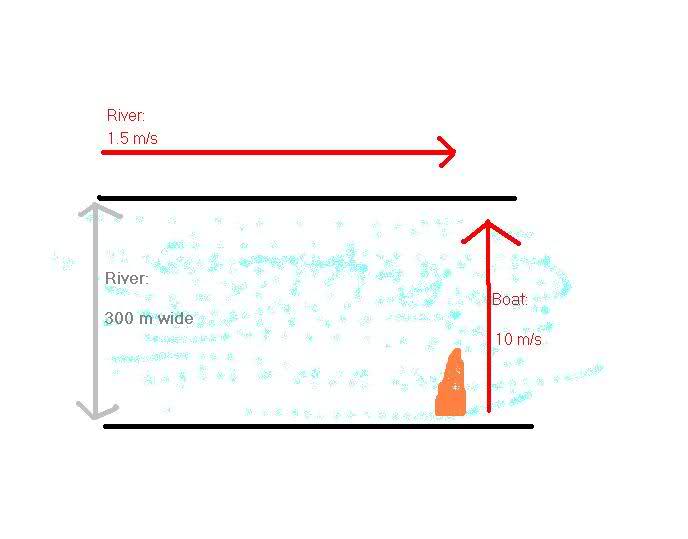
2qav2q1.jpg


One of these days I am going to have an "aha!" moment and all these problems will make sense. But that "aha!" moment is not here yet, apparently. Thanks for your help.
 
Physics news on Phys.org
You have almost drawn the answer.
At the end of the 10m/s line draw a 1.5m/s line downstream (to scale)
Now draw a line from the start position to the end of the downstrem arrow.
This diagonal line is the path the boat will take - it's called a force triangle.
Then it's just a matter of simple trig.
 
Cowtipper said:
I am having a very tough time trying to figure this one out. Any help would be appreciated.

A river flows due east at 1.50 m/s. A boat crosses the river from the south shore to the north shore by maintaining a consistent velocity of 10.0 m/s due north relative to the water.

A) What is the velocity of the boat relative to the shore?

Look at what the current does to the boat. The boat is pointed straight north (top of page) and moves forward by 10 meters each second on the water. But the water is moving eastward (to the right) by 1.5 meters each second, carrying everything on its surface along with it. To someone watching this from the shore (or, say, hovering overhead), they see the boat traveling 10 meters to the north and 1.5 meters to the east each second. So, relative to the shore, that describes the velocity of the boat in terms of eastward (positive-x, say) and northward (positive-y) components.

In terms of vectors for relative motion, you can express it in words this way:

velocity of boat relative to shore =

velocity of boat relative to water + velocity of water relative to shore .

(In a sense, the parts involving water "cancel".)

B) If the river is 300 m wide, how far downstream has the boat moved by the time it reaches the north shore?

So now you want to ask, in the time it takes for the boat to cross the 300 meters width of the river (going north), how far will the water current have carried the boat along to the west?
 
mgb_phys said:
You have almost drawn the answer.
At the end of the 10m/s line draw a 1.5m/s line downstream (to scale)
Now draw a line from the start position to the end of the downstrem arrow.
This diagonal line is the path the boat will take - it's called a force triangle.
Then it's just a matter of simple trig.

Using Pythagorean's Theorem is what you are suggesting? If that's the case, then the square root of 10^2 + 1.5^2 = 10.11.

Is this the correct method?

It might seem like common sense, but I don't want to make a silly mistake that will haunt me in the future.
 
dynamicsolo said:
So now you want to ask, in the time it takes for the boat to cross the 300 meters width of the river (going north), how far will the water current have carried the boat along to the west?

This still confuses me some. Would you kindly explain what I must do? I don't want to mooch, but I'm not too certain.

Now, if this is a simple T = D/V problem and I'm just overcomplicating the subject, then boy, do I feel stupid...
 
In each second you go 10m across the river and you are pushed 1.5m downstream.
How long does it take you to go across 300m at 10m/s? In that time how far will a 1.5m/s current have pushed you downstream?
 
The answer wouldn't happen to be 45, would it?
 
Cowtipper said:
The answer wouldn't happen to be 45, would it?

Show how you got it and we'll let you know... BTW, you should give answers with units if they have them.
 
Yes, my mistake. Sorry about not including meters.

This is what I did:

Using the hint mgb_phys provided, I divided 300 meters by 10 meters/second. Then I multiplied the answer (30) by 1.5 meters per second, to get me my answer of 45 meters. I checked with another person who was working on the problem, and they said they got that answer too. I just want to make sure we're both not wrong, and if we are I would like to know why so I don't make the mistake again in the future.
 
  • #10
Cowtipper said:
Yes, my mistake. Sorry about not including meters.

This is what I did:

Using the hint mgb_phys provided, I divided 300 meters by 10 meters/second. Then I multiplied the answer (30) by 1.5 meters per second, to get me my answer of 45 meters.

That's pretty much all there is to that. The downstream component of the velocity and the cross-stream (transverse) component can be dealt with separately. The hypotenuse which you found using

10^2 + 1.5^2 = (10.11)^2 [corrected]

gives the speed of the boat relative to the shore as 10.11 m/sec. The direction will be given from the trigonometric relation

[tex]tan \theta = 1.5 / 10 = 0.15[/tex],

giving a direction of about 8.5º east of due north. It wasn't clear from your original statement how they wanted the velocity relative to the shore presented. You could give it in terms of the speed and direction found here or the components I described a few posts back.
 

Similar threads

  • · Replies 5 ·
Replies
5
Views
3K
  • · Replies 2 ·
Replies
2
Views
2K
  • · Replies 16 ·
Replies
16
Views
4K
  • · Replies 11 ·
Replies
11
Views
3K
  • · Replies 4 ·
Replies
4
Views
3K
  • · Replies 29 ·
Replies
29
Views
4K
  • · Replies 1 ·
Replies
1
Views
3K
Replies
2
Views
2K
  • · Replies 10 ·
Replies
10
Views
5K
Replies
1
Views
2K