Math Amateur
Gold Member
MHB
- 3,920
- 48
I am reading Theodore W. Gamelin's book: "Complex Analysis" ...
I am focused on Chapter 1: The Complex Plane and Elementary Functions ...
I am currently reading Chapter 1, Section 4: The Square and Square Root Functions ... and need some help in verifying a remark by Gamelin ... ...
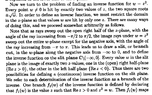
The relevant section from Gamelin is as follows:View attachment 9288
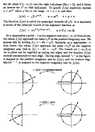
View attachment 9289In the above text by Gamelin we read the following ... ...
" ... ... Every value $$w$$ in the slit plane is the image of exactly two $$z$$ values. one in the (open) right half-plane [Re $$z \gt 0$$], the other in the left half-plane [Re $$z \lt 0$$]. ... ... "Now, I wanted to demonstrate via an example that a value of $$w$$ was given by two values of $$z$$ ... so I let $$w = 1 + i$$ ... and proceeded as follows ...
$$w = 1 + i$$
so that
$$w = 2^{ \frac{1}{2} } e^{ i \frac{ \pi }{ 4} }$$So then we have ... ...
$$z_1 = f_1(w) = w^{ \frac{1}{2} } = 2^{ \frac{1}{4} } e^{ i \frac{ \pi }{8} }$$
... and ...
$$ z_2 = f_2(w) = - f_1(w) = -w^{ \frac{1}{2} } = 2^{ \frac{1}{4} } e^{ - i \frac{ \pi }{8} } $$(Note that Gamelin uses $$f_2(w)$$ for the second branch of $$w^{ \frac{1}{2} }$$ ... and, further, notes that $$f_2(w) = - f_1(w)$$ ... ... ... ... )My problem is that I do not believe my value or $$z_2$$ is correct ... but I cannot see where my process for calculating $$z_2$$ is wrong ...
Can someone please explain my mistake and show and explain the correct process for calculating $$z_2$$ ... ...
Help will be appreciated ...
Peter
I am focused on Chapter 1: The Complex Plane and Elementary Functions ...
I am currently reading Chapter 1, Section 4: The Square and Square Root Functions ... and need some help in verifying a remark by Gamelin ... ...
The relevant section from Gamelin is as follows:View attachment 9288
View attachment 9289In the above text by Gamelin we read the following ... ...
" ... ... Every value $$w$$ in the slit plane is the image of exactly two $$z$$ values. one in the (open) right half-plane [Re $$z \gt 0$$], the other in the left half-plane [Re $$z \lt 0$$]. ... ... "Now, I wanted to demonstrate via an example that a value of $$w$$ was given by two values of $$z$$ ... so I let $$w = 1 + i$$ ... and proceeded as follows ...
$$w = 1 + i$$
so that
$$w = 2^{ \frac{1}{2} } e^{ i \frac{ \pi }{ 4} }$$So then we have ... ...
$$z_1 = f_1(w) = w^{ \frac{1}{2} } = 2^{ \frac{1}{4} } e^{ i \frac{ \pi }{8} }$$
... and ...
$$ z_2 = f_2(w) = - f_1(w) = -w^{ \frac{1}{2} } = 2^{ \frac{1}{4} } e^{ - i \frac{ \pi }{8} } $$(Note that Gamelin uses $$f_2(w)$$ for the second branch of $$w^{ \frac{1}{2} }$$ ... and, further, notes that $$f_2(w) = - f_1(w)$$ ... ... ... ... )My problem is that I do not believe my value or $$z_2$$ is correct ... but I cannot see where my process for calculating $$z_2$$ is wrong ...
Can someone please explain my mistake and show and explain the correct process for calculating $$z_2$$ ... ...
Help will be appreciated ...
Peter
Attachments
Last edited: