Visualising atomic orbitals in a unit cell (software for making figures?)

Click For Summary
SUMMARY

The discussion centers on the challenges of visualizing atomic orbitals within a unit cell, specifically using VESTA version updates. Users express difficulty in reproducing clover-leaf d or p orbitals similar to those in a referenced paper on tetragonal VO2. Alternatives like AVOGADRO are deemed insufficient for creating desired visualizations. The conversation also touches on the need for accessible .pdb or .cif files for atomic structures.

PREREQUISITES
  • Familiarity with VESTA software for crystallographic visualization.
  • Understanding of atomic orbitals and their representations in 3D space.
  • Knowledge of file formats such as .pdb and .cif for molecular structures.
  • Basic skills in 2D and 3D modeling software for scientific visualization.
NEXT STEPS
  • Explore advanced features of VESTA for visualizing electron density and atomic orbitals.
  • Research alternative software like Gaussian or Quantum ESPRESSO for orbital visualization.
  • Learn techniques for morphing 2D shapes into 3D representations in visualization software.
  • Find repositories or databases for downloading .pdb and .cif files relevant to atomic structures.
USEFUL FOR

Researchers, chemists, and materials scientists involved in computational chemistry and crystallography who need to visualize atomic orbitals and molecular structures effectively.

ApeXaviour
Messages
34
Reaction score
0
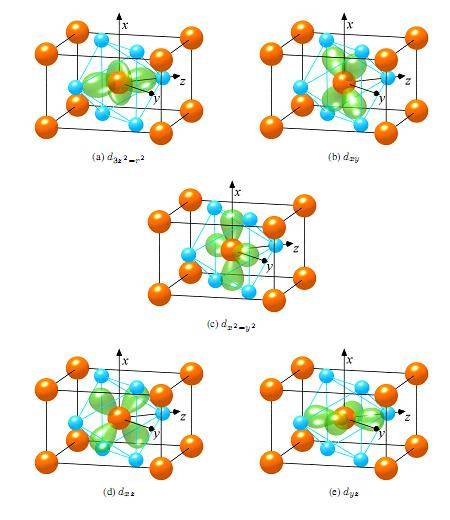
So I usually use VESTA to make my figures, and though the new version is able to do many mad things with calculated electron density isostructures and whatnot, I can't seem to just be able to throw in some clover-leaf d or p orbitals like what was done in the image below (from this paper on tetragonal VO2). Does anyone know what software he uses? I really just want to be able to reproduce something very similar.

Failing that, even if I could just produce some nice pictures of the orbital lobes on an xyz axis, I don't even need to be able to have the crystal structure around it. I can't find anything that seems to cater for this... even AVOGADRO doesn't look like it could do it easily.
dMxUv.jpg

Larger image

Any ideas :/ trawling through google has been thusfar fruitless
 
Physics news on Phys.org
Interesting, don't know how it was done. I would guess rather then 3d software being used, perhaps a good 2d software is used and an ellipse is "morphed/turned/stretched" into some type of shape, then layered to look 3d. Do you know any good place to get .pdb or .cif type files of the coordinates for these type of structures?
 
Thread 'Unexpected irregular reflection signal from a high-finesse cavity'
I am observing an irregular, aperiodic noise pattern in the reflection signal of a high-finesse optical cavity (finesse ≈ 20,000). The cavity is normally operated using a standard Pound–Drever–Hall (PDH) locking configuration, where an EOM provides phase modulation. The signals shown in the attached figures were recorded with the modulation turned off. Under these conditions, when scanning the laser frequency across a cavity resonance, I expected to observe a simple reflection dip. Instead...