Why is the Voltage Drop Across a Resistor -Ve to +Ve?

Click For Summary
The discussion centers on the polarity of voltage across resistors in relation to conventional current flow, which is defined as moving from negative to positive. It clarifies that resistors do not have innate polarity; instead, the voltage drop is determined by the direction of current flow, where current moves from higher to lower voltage. The conversation also touches on the concept that while resistors and inductors lack inherent polarity, capacitors do have specific polarity requirements, especially in practical applications like electrolytic capacitors. Furthermore, the historical context of electrical conventions is mentioned, highlighting the confusion between conventional current flow and electron flow. Understanding these principles is essential for correctly applying Kirchhoff's Law in circuit analysis.
PhysicsTest
Messages
256
Reaction score
27
TL;DR
Require clarity on the voltage drop on resistor
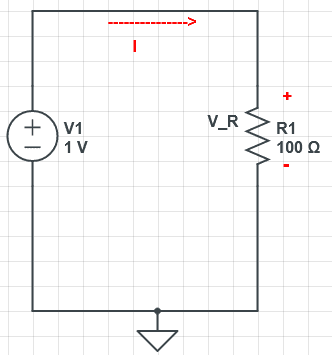
Really very elementary one, if i refer the circuit below
1602938660181.png

For the source in the direction of current the polarity is -Ve to +Ve that is understood which is conventional current, but in the case of resistance in the direction of current the voltage V_R polarity is -Ve to +Ve. Why for resistance the polarity is defined like that?
 
Last edited by a moderator:
Engineering news on Phys.org
PhysicsTest said:
Summary:: Require clarity on the voltage drop on resistor

Really very elementary one, if i refer the circuit below
View attachment 271054
For the source in the direction of current the polarity is -Ve to +Ve that is understood which is conventional current, but in the case of resistance in the direction of current the voltage V_R polarity is -Ve to +Ve. Why for resistance the polarity is defined like that?
(1) resistors do not HAVE any innate polarity, they just show a higher voltage where the current flows into them than where it flows out.
(2) current flows from higher voltage to lower voltage, so in this case the current flows as shown ("I").
 
  • Like
Likes etotheipi and PhysicsTest
Thank you for the reply, it was clear. Similarly capacitor and inductor does not have innate polarity and i need to assign based on current direction? Can you please clarify this.
 
PhysicsTest said:
Thank you for the reply, it was clear. Similarly capacitor and inductor does not have innate polarity and i need to assign based on current direction? Can you please clarify this.
Well, it's true that neither has an innate polarity in the ideal case but I seem to recall that caps in particular, in the real world. are sometimes meant to be used only with the higher voltage on a particular side in DC (or rectified AC) circuits due to construction techniques. I haven't worked much with inductors but I don't think that's the case with them.
 
Electrolytic caps have polarity, but why are we going down this path on a circuit without any caps at all?
 
Vanadium 50 said:
Electrolytic caps have polarity, but why are we going down this path on a circuit without any caps at all?
Can you please explain, so i cannot assign polarity to capacitors based on direction of current what i do for resistors?
 
I don't know what you are asking. There are no capacitors in that circuit.
 
  • Like
Likes etotheipi
The direction of the voltage drop should be pretty clear from context, but there does exist quite a straightforward sign convention to stop you from mucking up. With any circuit element on the schematic, you have a reference direction for current and a reference direction for voltage.

If the reference directions for the current and voltage are in opposite directions, then the defining equations for passive circuit elements don't have negative signs, i.e. ##v=iR##, ##i =C\frac{dV}{dt}##, ##V = L\frac{di}{dt}##. That's called the passive convention.

And if the reference directions for current and voltage are in the same direction, then the defining equations for passive circuit elements do have negative signs, i.e. ##v=-ir##, ##i=-C\frac{dV}{dt}##, ##V=-L\frac{di}{dt}##. That's called the active convention.

[N.B. that with the passive convention, passive elements have positive power whilst active elements (like batteries) have negative power. And vice versa for the active convention.]
 
  • Like
Likes tech99 and DaveE
PhysicsTest said:
Can you please explain, so i cannot assign polarity to capacitors based on direction of current what i do for resistors?
You can assign a polarity for the VOLTAGE on a cap, but not the cap by itself.
 
  • #10
PhysicsTest said:
Thank you for the reply, it was clear. Similarly capacitor and inductor does not have innate polarity and i need to assign based on current direction? Can you please clarify this.
The polarity requirements of an electrolytic capacitor have nothing to do with circuit design other than "do not use them if the voltage is bipolar". They are just capacitors that get angry when back biased. They are used because they provide large capacity in a small and inexpensive package. The polarity mark on a capacitor is a warning.
 
  • Like
Likes phinds and anorlunda
  • #11
PhysicsTest said:
Summary:: Require clarity on the voltage drop on resistor

1602938660181-png.png

For the source in the direction of current the polarity is -Ve to +Ve that is understood which is conventional current

That is one of the more troublesome conventions in electronics.

Back when electricity was first being understood, there was no concept of Electrons. It was understood however that there was a "Polarity." To keep track of polarity, a "+" and a "-" were arbitrarily assigned, and it was arbitrarily assumed that current flowed from "+" to "-". Quite logical, and that is now called Conventional Current Flow, "+" to "-".

Eventually Electrons started being understood. They are the charge carriers that actually move, or flow; and that is what is measured when we measure Current.

There is no end of confusion because of these two conflicting definitions.

For instance car mechanics consider current to flow from "+" to"-", out the plus battery terminal, thru the load, then back to the minus battery terminal. This convention is common and frequently used even in electronics, but only when passive devices are being considered. (passive = resistor, capacitor, inductor, battery)

When considering Active electronic components (diode, transistor, vacuum tube, atom smasher, etc) the Electron Flow usually comes into play... because it matches the physics of what actually happens and makes it easier to understand.

For a little bit of historical background see:
https://en.wikipedia.org/wiki/Luigi_Galvani
https://en.wikipedia.org/wiki/Alessandro_Volta

Hopes this helps!

Cheers,
Tom
 
  • #12
Tom.G said:
You won't find it there under Galvani or Volta. See
https://en.wikipedia.org/wiki/Electric_charge#History

Up until about 1745, the main explanation for electrical attraction and repulsion was the idea that electrified bodies gave off an effluvium.[34] Benjamin Franklin started electrical experiments in late 1746,[35] and by 1750 had developed a one-fluid theory of electricity, based on an experiment that showed that a rubbed glass received the same, but opposite, charge strength as the cloth used to rub the glass.[35][36] Franklin imagined electricity as being a type of invisible fluid present in all matter; for example, he believed that it was the glass in a Leyden jar that held the accumulated charge. He posited that rubbing insulating surfaces together caused this fluid to change location, and that a flow of this fluid constitutes an electric current. He also posited that when matter contained too little of the fluid it was negatively charged, and when it had an excess it was positively charged. He identified the term positive with vitreous electricity and negative with resinous electricity after performing an experiment with a glass tube he had received from his overseas colleague Peter Collinson. The experiment had participant A charge the glass tube and participant B receive a shock to the knuckle from the charged tube. Franklin identified participant B to be positively charged after having been shocked by the tube.[37]
 
  • #13
PhysicsTest said:
Summary:: Require clarity on the voltage drop on resistor

Really very elementary one, if i refer the circuit below
View attachment 271054
For the source in the direction of current the polarity is -Ve to +Ve that is understood which is conventional current, but in the case of resistance in the direction of current the voltage V_R polarity is -Ve to +Ve. Why for resistance the polarity is defined like that?
The voltages around the loop have to add up to zero (Kirchoff's Law).
 

Similar threads

Replies
10
Views
2K
Replies
68
Views
7K
  • · Replies 5 ·
Replies
5
Views
4K
  • · Replies 35 ·
2
Replies
35
Views
5K
Replies
93
Views
8K
  • · Replies 5 ·
Replies
5
Views
3K
Replies
3
Views
3K
Replies
11
Views
4K
  • · Replies 42 ·
2
Replies
42
Views
5K
  • · Replies 7 ·
Replies
7
Views
24K