Wave equation, D'Alembert's Solution

Click For Summary
SUMMARY

The discussion focuses on the wave equation and D'Alembert's solution, highlighting the distinction between general and specific solutions. D'Alembert's solution is recognized as a general solution to the wave equation, represented as a function g(x-ct) rather than in terms of sines and cosines. This approach allows for the representation of non-periodic waveforms, such as a distorted rope, which can be modeled by arbitrary functions. The conversation emphasizes the nature of wave propagation and the role of initial conditions in shaping the solution.

PREREQUISITES
  • Understanding of partial differential equations (PDEs)
  • Familiarity with wave equations and their properties
  • Knowledge of D'Alembert's solution and its formulation
  • Concept of initial conditions in wave motion
NEXT STEPS
  • Study the derivation of D'Alembert's solution for the wave equation
  • Explore the implications of initial conditions on wave propagation
  • Investigate the characteristics of non-periodic waveforms in physics
  • Learn about the role of Fourier series in solving wave equations
USEFUL FOR

Students and professionals in mathematics and physics, particularly those studying wave phenomena, partial differential equations, and the applications of D'Alembert's solution in various contexts.

Tuneman
Messages
41
Reaction score
0
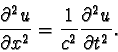
I am having trouble understanding the solution to the wave equation:

735128d3de55366340a2e5fb647c470e.png


this is thought of as the final solution to the PDE:
img250.gif


but I see that:
img246.gif


is a solution to the function. But what I don't get is why D'Alembert's Solution isn't in terms of sines and cosines like that solution right above.

Is it because D'Albemerts is a gereneral solution, and the other is a specific solution? If so, still how come the general solution to the problem isn't expressed as a wave, and instead of some arbitrary function g(x-ct)?
 
Physics news on Phys.org
The general solution is a wave. But a wave is not necessarily periodic like sine or cosine. Imagine a taut rope that is distorted initially in a shape that consists of a bulge, say a triangle between x= -1 and x= 1, given by y= x+1 for x<0, y= 1-x for x>=0 and then released from rest at t=0. "g" splits into two parts which move right and left: that's what (1/2)g(x-ct) and (1/2)g(x+ct) are. The h integral allows non-zero speed at t= 0 also.
 

Similar threads

Replies
4
Views
4K
Replies
1
Views
3K
  • · Replies 10 ·
Replies
10
Views
5K
  • · Replies 11 ·
Replies
11
Views
3K
  • · Replies 4 ·
Replies
4
Views
1K
Replies
27
Views
2K
Replies
2
Views
1K
  • · Replies 3 ·
Replies
3
Views
2K
Replies
7
Views
2K
  • · Replies 34 ·
2
Replies
34
Views
3K
