Master1022
- 590
- 116
- Homework Statement
- At [itex] t = 0 [/itex] the string is released. Let [itex] y(t,x) = f(x - ct) + g(x - ct) [/itex]. Obtain [itex] f(u) [/itex] and [itex] g(v) [/itex] for u > 0 and v > 0 using the initial condition.
- Relevant Equations
- d'Alembert solution to the wave equation
Hi,
I was trying to get some practice with the wave equation and am struggling to solve the problem below. I am unsure of how to proceed in this situation.
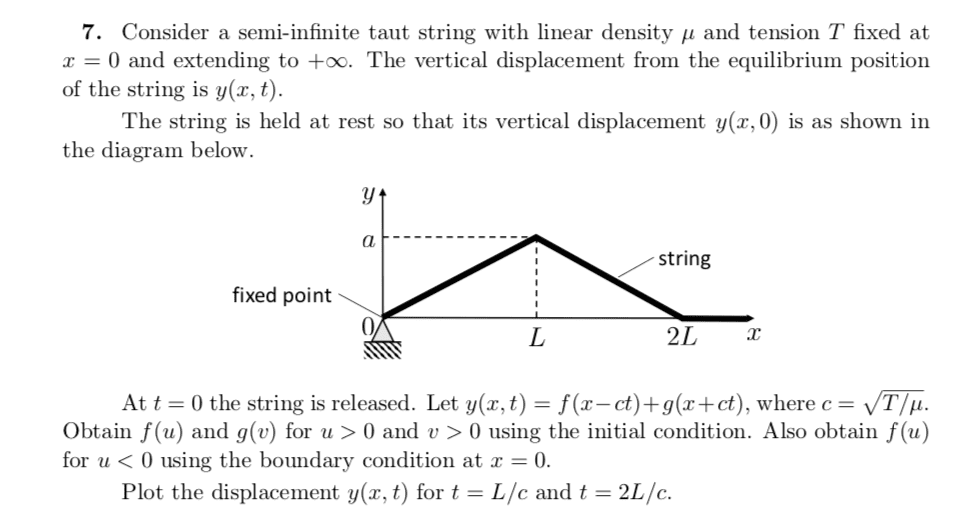
My attempt:
So we are told that the string is held at rest, so we only need to think about the displacement conditions for the wave equation solution. If we are using the given expression, then f will be the 'forward' (+ ve [itex]x[/itex]) traveling wave and g will be the 'backward' (-ve [itex]x[/itex]) traveling wave.
I would turn the given function [tex]H(x) =<br /> \begin{cases}<br /> -h(-x), & -2L \leq x \lt 0 \\<br /> h(x), & 0 \leq x \lt 2L \\<br /> (periodic), & otherwise<br /> \end{cases}[/tex]
(where [itex]h(x)[/itex] is the triangular function shown - I could have explicitly written out the exact function, but just after the method for the moment)
(EDIT: was I correct to make it periodic?)
Then, we can use the solution to write: [itex]y(t,x) = \frac{1}{2} \left( H(x + ct) + H(x - ct) \right)[/itex] (replacing f and g with our defined function). Is that correct up to that point?
Some specific questions I have are:
- how do we deal with the fixed boundary condition? - I have just tried to create the odd periodic extension of the initial condition so that the zero displacement is satisfied at [itex]x = 0[/itex]
- in general, do I start the two oppositely traveling waves from the same place on the string
- Perhaps related for the boundary condition, but how do I include the reflection that will take place? - I presume that we just allow our two waves to pass over one another so that the -ve part of the forward wave superposes with the +ve part of the backwards wave. After that, our backwards wave solution will be 'beyond the boundary' so we won't need to consider it any more?
Thanks in advance.
I was trying to get some practice with the wave equation and am struggling to solve the problem below. I am unsure of how to proceed in this situation.
My attempt:
So we are told that the string is held at rest, so we only need to think about the displacement conditions for the wave equation solution. If we are using the given expression, then f will be the 'forward' (+ ve [itex]x[/itex]) traveling wave and g will be the 'backward' (-ve [itex]x[/itex]) traveling wave.
I would turn the given function [tex]H(x) =<br /> \begin{cases}<br /> -h(-x), & -2L \leq x \lt 0 \\<br /> h(x), & 0 \leq x \lt 2L \\<br /> (periodic), & otherwise<br /> \end{cases}[/tex]
(where [itex]h(x)[/itex] is the triangular function shown - I could have explicitly written out the exact function, but just after the method for the moment)
(EDIT: was I correct to make it periodic?)
Then, we can use the solution to write: [itex]y(t,x) = \frac{1}{2} \left( H(x + ct) + H(x - ct) \right)[/itex] (replacing f and g with our defined function). Is that correct up to that point?
Some specific questions I have are:
- how do we deal with the fixed boundary condition? - I have just tried to create the odd periodic extension of the initial condition so that the zero displacement is satisfied at [itex]x = 0[/itex]
- in general, do I start the two oppositely traveling waves from the same place on the string
- Perhaps related for the boundary condition, but how do I include the reflection that will take place? - I presume that we just allow our two waves to pass over one another so that the -ve part of the forward wave superposes with the +ve part of the backwards wave. After that, our backwards wave solution will be 'beyond the boundary' so we won't need to consider it any more?
Thanks in advance.