Wave-function solution under Galilean transformations

3 replies · 3K views · last reply
Happiness
Messages
686
Reaction score
30
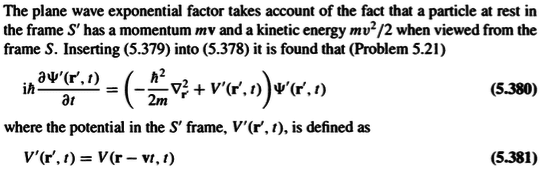
How do we get (5.381)?

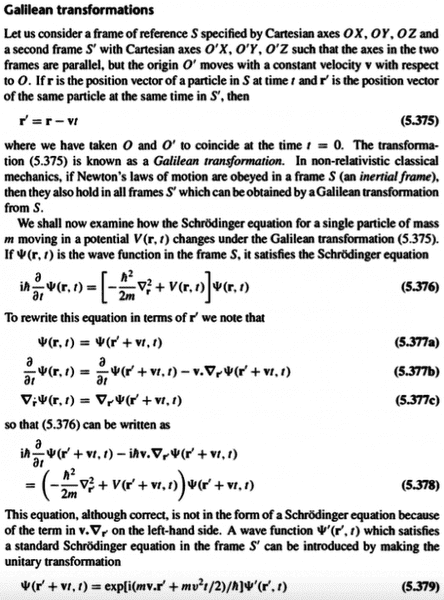
The term involving ##V## in (5.378) is ##V(r' + vt, t)\ \Psi(r' + vt, t)##. After dividing on both sides of (5.378) by the exponential term ##e^{[i(mv.r' + mv^2t/2)/\hbar]}## [which appears in (5.379)], the term becomes ##V(r' + vt, t)\ \Psi(r', t)##. But the term as given in (5.380) is ##V'(r', t)\ \Psi(r', t)##. This means that we must have ##V'(r', t) = V(r' + vt, t) = V(r, t)##, which contradicts (5.381).

I've worked out the other terms and they are correct.
Textbook page titled Galilean transformations with numbered equations 5.375 to 5.379, covering the Galilean transformation of coordinates and the Schrödinger equation under that transformation.

Printed text from a textbook page: the plane wave exponential factor accounts for a particle at rest in frame S' having momentum mv, with equations 5.379, 5.380 and 5.381 defining the transformed potential V'(r', t) = V(r - vt, t).
 
I think you are right. Under Galileian transformations one should have
$$V'(\vec{r}',t')=V(\vec{r},t)=V(\vec{r}'+\vec{v} t',t'),$$
because
$$\vec{r}=\vec{r}'+\vec{v} t', \quad \vec{p}=\vec{p}'+m \vec{v}, \quad t=t'.$$
 
  • Like
Likes   Reactions: bhobba and Happiness
vanhees71 said:
I think you are right. Under Galileian transformations one should have
$$V'(\vec{r}',t')=V(\vec{r},t)=V(\vec{r}'+\vec{v} t',t'),$$
because
$$\vec{r}=\vec{r}'+\vec{v} t', \quad \vec{p}=\vec{p}'+m \vec{v}, \quad t=t'.$$

Is there an explanation (intuitive or otherwise) how $$\vec{r}=\vec{r}'+\vec{v} t', \quad \vec{p}=\vec{p}'+m \vec{v}, \quad t=t'$$ implies or is consistent with $$V'(\vec{r}',t')=V(\vec{r},t)$$? I mean apart from doing the calculations after substituting (5.379) into (5.378).
 
Happiness said:
Is there an explanation (intuitive or otherwise) how $$\vec{r}=\vec{r}'+\vec{v} t', \quad \vec{p}=\vec{p}'+m \vec{v}, \quad t=t'$$ implies or is consistent with $$V'(\vec{r}',t')=V(\vec{r},t)$$? I mean apart from doing the calculations after substituting (5.379) into (5.378).
Because the potential is a scalar function of the coordinates and time, i.e., its value stay the same if you transform it. Suppose you have the following non-singular transformations
[tex]\bar{x} = f(x), \ \ \ \bar{t} = g(t) .[/tex]
Since the transformations are non-singular, you can solve for [itex]x[/itex] and [itex]t[/itex]:
[tex]x = f^{-1}(\bar{x}) , \ \ \ t = g^{-1}(\bar{t}) .[/tex]
Now, substitute the solutions in the original potential function
[tex]V(x,t) = V(f^{-1}(\bar{x}) , g^{-1}(\bar{t}) ) ,[/tex]
and call the new function on the right-hand-side [itex]\bar{V}(\bar{x},\bar{t})[/itex].
 
  • Like
Likes   Reactions: vanhees71, Happiness and bhobba