Taylor_1989
- 400
- 14
1. The problem statement, all variables and given/known date
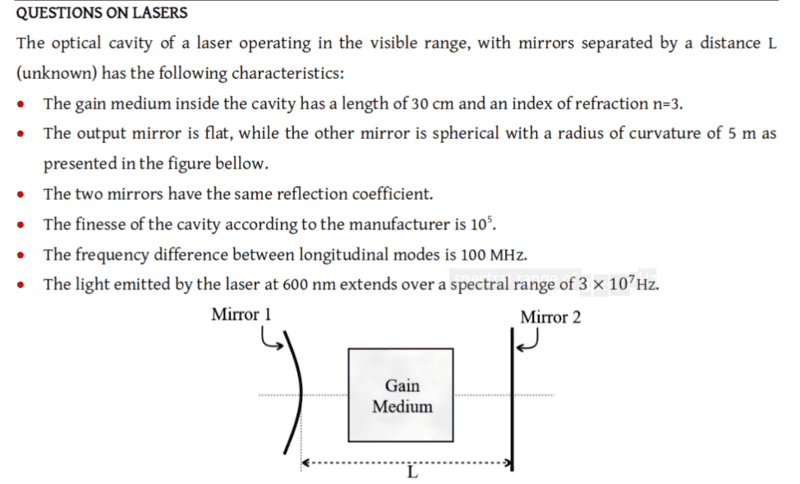
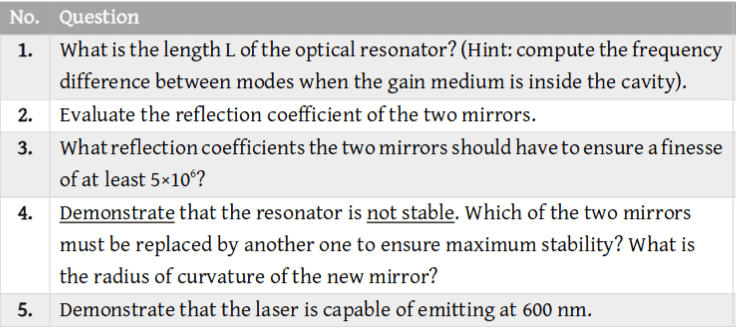
$$\delta v=\frac{c}{2nL} \:[1]$$
$$N=\frac{\Delta v}{\delta v}=\frac{2nL\Delta v}{c} \:[2]$$
I am having trouble with question 5, but have come to realize I think my cavity length is wrong but I can't see how.
Here my working for question 1
Assuming that the medium is in the middle at equal distance from each mirror, then I could assume that ##L=L_{m}+2x## so subsituiting this into equation 1.
$$\delta v=\frac{c}{2nL}=\frac{c}{2n(L_{m}+2x)}$$
by rearranging the equation for x
$$x=\left(\frac{c}{\delta \:v}\cdot \:\frac{1}{2n}-Lm\right)\cdot \frac{1}{2}$$
so subbing ##x=0.1## I make the cavity length ##L=L_{m}+2(0.1)=0.5m##.
Which seem to reasonable to me. But if I plug this length of the cavity into [2] and using the spectral range of ##3\times 10^{7}## I make the number of modes 0.3 which can't be correct.
So the reason I want to workout the number of modes is so I can verify the ##600nm## via the equation ##\lambda=2\times L_{c}/N##, which dose not give the 600nm so either my cavity is length is wrong or my understanding is wrong.
Any advice would be much appreciated.
Homework Equations
$$\delta v=\frac{c}{2nL} \:[1]$$
$$N=\frac{\Delta v}{\delta v}=\frac{2nL\Delta v}{c} \:[2]$$
The Attempt at a Solution
I am having trouble with question 5, but have come to realize I think my cavity length is wrong but I can't see how.
Here my working for question 1
Assuming that the medium is in the middle at equal distance from each mirror, then I could assume that ##L=L_{m}+2x## so subsituiting this into equation 1.
$$\delta v=\frac{c}{2nL}=\frac{c}{2n(L_{m}+2x)}$$
by rearranging the equation for x
$$x=\left(\frac{c}{\delta \:v}\cdot \:\frac{1}{2n}-Lm\right)\cdot \frac{1}{2}$$
so subbing ##x=0.1## I make the cavity length ##L=L_{m}+2(0.1)=0.5m##.
Which seem to reasonable to me. But if I plug this length of the cavity into [2] and using the spectral range of ##3\times 10^{7}## I make the number of modes 0.3 which can't be correct.
So the reason I want to workout the number of modes is so I can verify the ##600nm## via the equation ##\lambda=2\times L_{c}/N##, which dose not give the 600nm so either my cavity is length is wrong or my understanding is wrong.
Any advice would be much appreciated.

