Weather - not climate - extremes

  • Thread starter Thread starter Andre
  • Start date Start date
  • Tags Tags
    Climate Weather
Click For Summary
SUMMARY

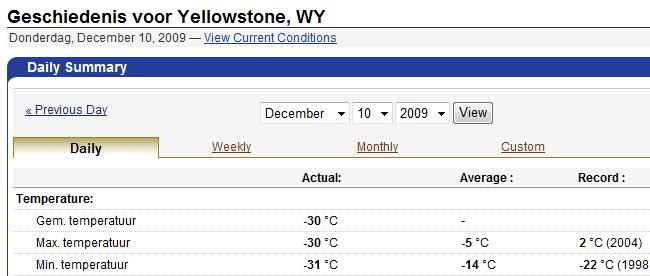
The forum discussion centers on the record low temperature of -31°C recorded in Yellowstone, WY on December 10, surpassing the previous record of -22°C set in 1998. Participants highlight the relationship between extreme weather events and climate change, emphasizing that while local weather extremes may exhibit natural variability, the overarching trend is one of global warming. The discussion also references the significant impact of El Niño on weather patterns, particularly in North America, and underscores the importance of analyzing long-term climate trends rather than isolated weather events.

PREREQUISITES
  • Understanding of climate change concepts and terminology
  • Familiarity with El Niño and its effects on weather patterns
  • Knowledge of temperature variance and its calculation
  • Awareness of global temperature datasets, such as UAH
NEXT STEPS
  • Research the impact of El Niño on North American winter weather patterns
  • Explore the methodologies for calculating temperature variance from weather station data
  • Investigate the role of natural variability in climate change trends
  • Study the historical context of extreme weather events and their implications for climate science
USEFUL FOR

Climate scientists, meteorologists, environmental researchers, and anyone interested in understanding the dynamics of extreme weather events in the context of climate change.
Andre
Messages
4,294
Reaction score
73
It looks like Yellowstone WY beat the all time low record of 1998 for 10 December (-22 C) with a remarkable big margin: -31C. The page updates all the time so I include a screenshot.

x3ha9y.jpg


But of course, when it's hot then it's global warming and when it's cold then it's natural variability
 
Earth sciences news on Phys.org
Actually, it might be from global warming (climate change).

Extreme weather is one of the hallmarks of global warming which is why it's often referred to as cliamte change; storms are getting bigger and that includes winter storms.

There was an exceptionally large storm storm over North America during this time that was pulling a lot of cold air down from the Arctic.
 
Andre said:
It looks like Yellowstone WY beat the all time low record of 1998 for 10 December (-22 C) with a remarkable big margin: -31C. The page updates all the time so I include a screenshot.
But of course, when it's hot then it's global warming and when it's cold then it's natural variability

Also interesting... the previously record low was in 1998 which was one of the hottest years ever on record. (1998, 2003 and 2005 are all exceptionally close to each other, and may rank differently with different global anomaly estimates.)

Just to underline the obvious; ALL records whether high OR low are cases where you have natural variability giving a boost to the numbers. Global trends, such as the strong global warming that has been measured over recent decades, are not identified by looking at extremes, but at the trend over all values -- high, low, and in between. The trend means you will keep getting new record highs regularly, but every new record is still a case where natural variability lifts temperatures above the main trend.

By the way; it seems that the natural variations (globally) are on the way up again, and so given the strong warming trend, we can expect a new record hottest year pretty soon. 2010 is a distinct possibility; anyone of the next three years being a new all time record for the global anomaly is a good bet. And of course, there will still be local regional cold extremes, somewhere around the planet.

Cheers -- sylas
 
Last edited:
Andre said:
But of course, when it's hot then it's global warming and when it's cold then it's natural variability

Do you think that there'd be any error in your estimate of the mean global surface temperature with a non-random sample of one point?

Because November was the hottest November yet on the UAH dataset.
 
Is there also an increasing trend in short term temperature fluctuations averaged over the whole Earth, like there is for the average temperature?
 
Count Iblis said:
Is there also an increasing trend in short term temperature fluctuations averaged over the whole Earth, like there is for the average temperature?

I'm not quite sure what you are asking here. I believe that in most areas winter temperatures are increasing a bit more than summer temperatures.

Cheers -- sylas
 
sylas said:
I'm not quite sure what you are asking here. I believe that in most areas winter temperatures are increasing a bit more than summer temperatures.

Cheers -- sylas

Suppose you take the data from all the weather stations and for each station compute the fluctuation <T^2>- <T>^2 over, say, one month and then average this over all the stations of the World. Then this is a measure of the amplitude of short term local fluctuations, but it is averaged over the World. So, you would expect that this quantity, while it gives some information about local weather, is still determined by the climate. A good enough climate model should be able to allow one to extract this quantity.
 
Count Iblis said:
Suppose you take the data from all the weather stations and for each station compute the fluctuation <T^2>- <T>^2 over, say, one month and then average this over all the stations of the World. Then this is a measure of the amplitude of short term local fluctuations, but it is averaged over the World. So, you would expect that this quantity, while it gives some information about local weather, is still determined by the climate. A good enough climate model should be able to allow one to extract this quantity.

I'm feeling short here.

What does the notation <> mean?
 
Bored Wombat said:
What does the notation <> mean?

<X> is a notation for a mean. <X^2> - <X>^2 is variance; the mean of the square minus the square of the mean.

I believe there is some research looking at trends in temperature variance, both for models and for historical records, but it's not something I've looked at myself much. It would be easy enough to try something like this yourself, using readily available daily data from weather stations around the world.

Cheers -- sylas
 
  • #10
sylas said:
Also interesting... the previously record low was in 1998 which was one of the hottest years ever on record. (1998, 2003 and 2005 are all exceptionally close to each other, and may rank differently with different global anomaly estimates.)

1998 was also an El Nino year. What I have noticed is that during El Nino events, North America gets more extreme weather, especially during the winter as the jet stream tends to dip further south bringing Arctic air down over North American continent.
 
  • #11
Here are a few more weather data (not climate) about the year 2009

http://www.canadaeast.com/front/article/529471
http://www.telegraph.co.uk/news/uknews/4108744/Coldest-start-to-the-New-Year-for-seven-years.html
http://www.telegraph.co.uk/news/worldnews/antarctica/4126690/London-colder-than-Antarctica.html
http://in.reuters.com/article/topNews/idINIndia-37291320090105
http://www.dailymail.co.uk/news/wor...ffer-record-cold-temperatures-plunge-40C.html
http://www.mauinews.com/page/content.detail/id/513864.html
http://www.washingtontimes.com/news/2009/jan/30/world-is-getting-colder/
http://www2.newsadvance.com/lna/news/local/article/lynchburg_breaks_84-year_cold_record/14003/
http://www.omaha.com/section/news01
http://www.noaanews.noaa.gov/stories2009/20090508_aprilstats.html
http://www.startribune.com/local/45305862.html?elr=KArksLckD8EQDUoaEyqyP4O:DW3ckUiD3aPc:_Yyc:aUUl
http://network.nationalpost.com/np/blogs/posted/archive/2009/06/07/let-the-global-warming-jokes-begin-Alberta-saskatchewan-get-snow-in-june.aspx
http://www.todaystmj4.com/news/local/49608727.html
http://archives.chicagotribune.com/2009/jul/09/news/chi-wx-weathersummary0709jul09
http://en.mercopress.com/2009/08/01/falkland-islands-antarctic-air-flow-brings-record-snow-fall
http://www.ifallsdailyjournal.com/news/weather/record-setting-cold-weekend-109
http://www.noaanews.noaa.gov/stories2009/20090910_summerstats.html
http://www.deseretnews.com/article/705333724/Storm-brought-record-cold-in-six-areas.html
http://in.reuters.com/article/entertainmentNews/idINIndia-43114820091013
http://uk.reuters.com/article/idUKTRE59D4V020091014
http://china.globaltimes.cn/society/2009-11/484504.html
http://www.azstarnet.com/allheadlines/317522
http://www.examiner.com/x-11224-Bal...ns--Next-up-Baltimores-date-with-snow-destiny
http://www.santacruzsentinel.com/ci_13957540
http://earthobservatory.nasa.gov/IOTD/view.php?id=42067

But as noted already, El nino was there too/, also: this

How many heat wave events were there last year?
 
Last edited by a moderator:
  • #12
Andre said:
How many heat wave events were there last year?

http://www.lincolnweather.org/January22-2009.html
http://climate.umn.edu/doc/journal/heat090519.htm
http://bravenewclimate.com/2009/11/14/three-record-heatwaves-seaust/
http://capitalclimate.blogspot.com/2009/06/texas-toast-record-heat-continues.html
http://www.cnn.com/2009/US/weather/06/25/heat.wave/index.html

I could do more... but I fail to see the point.

From your editorial comments, you seem to be suggesting that record warm and record cold are interpreted differently somehow. I have seen no evidence of scientists dismissing localized cooling as cyclical and localized warming as part of a greater trend. In fact to a climate scientist, local weather is nothing more than one of ten's of thousands of data points.

If you are suggesting otherwise, please provide some real evidence of such a bias in the scientific community. If you are suggesting that it is the media that is misrepresenting these data points, then please ask to have the thread moved to P&WA
 
  • #13
Count Iblis said:
Suppose you take the data from all the weather stations and for each station compute the fluctuation <T^2>- <T>^2 over, say, one month and then average this over all the stations of the World. Then this is a measure of the amplitude of short term local fluctuations, but it is averaged over the World. So, you would expect that this quantity, while it gives some information about local weather, is still determined by the climate. A good enough climate model should be able to allow one to extract this quantity.

I would be interested in seeing any results on this. It seems like a good way to quantify the claim on increased variability.
 
  • #14
sylas said:
Just to underline the obvious; ALL records whether high OR low are cases where you have natural variability giving a boost to the numbers. Global trends, such as the strong global warming that has been measured over recent decades, are not identified by looking at extremes,

And that point has probably been made here [in this forum] hundreds of times. Apparently one can take on the mainstream of science while not being capable of understanding that simple point. I'm sure this is taught in the first year of college, if not in high school.
 
  • #15
Why all the strawmen? This is not a climate thread, look at the title. It's about weather extremes. Like these of today:

http://www.straitstimes.com/BreakingNews/Asia/Story/STIStory_473736.html
http://english.sina.com/china/p/2010/0104/297405.html

The underlying objective is maybe to discuss the possible causes of there extremities. Late Marcel Leroux did extensive research into the phenomonon Mobile Polar Highs especially in relation to paleo climate. See for instance

Leroux, M. (1993). The Mobile Polar High: a new concept explaining present mechanisms of meridional air-mass and energy exchanges and global propagation of paleoclimatic changes. Global and Planetary Change 7, 69–93.

See also:

http://www.pages.unibe.ch/products/specialissues/QSR2000/markgraf.pdf

recent research about the phenomenon in the southern hemisphere: http://english.sina.com/china/p/2010/0104/297405.html
 
Last edited by a moderator:

Similar threads

  • · Replies 3 ·
Replies
3
Views
574
  • · Replies 7 ·
Replies
7
Views
3K
Replies
8
Views
4K
  • · Replies 4 ·
Replies
4
Views
3K
  • · Replies 13 ·
Replies
13
Views
4K
  • · Replies 11 ·
Replies
11
Views
8K
  • · Replies 180 ·
7
Replies
180
Views
55K
  • · Replies 1 ·
Replies
1
Views
3K
  • · Replies 2 ·
Replies
2
Views
4K
Replies
7
Views
11K