What Are the Normal and Shear Stresses on the Inclined Butt Weld?

  • Thread starter Thread starter Zouatine
  • Start date Start date
  • Tags Tags
    Normal Shear
Click For Summary
SUMMARY

The discussion focuses on calculating normal and shear stresses on an inclined butt weld subjected to tensile stresses of σ(x) = 54 N/mm² and σ(y) = 38 N/mm². The transformation matrices are utilized to analyze the stress tensor, which is defined as σ = σ_x i_x i_x + σ_y i_y i_y. The maximum normal stress direction is determined by the equations for the traction vector and the normal component, leading to the conclusion that the shear stress τ is derived from the difference in tensile stresses and the sine and cosine of the angle β.

PREREQUISITES
  • Understanding of stress transformation in mechanics
  • Familiarity with the concepts of normal and shear stresses
  • Knowledge of trigonometric functions in engineering applications
  • Experience with stress tensors and traction vectors
NEXT STEPS
  • Study the derivation of stress transformation equations in mechanics
  • Learn about the Mohr's Circle method for stress analysis
  • Explore the effects of applied torque on shear stress in welded joints
  • Investigate the design considerations for inclined butt welds in structural engineering
USEFUL FOR

Mechanical engineers, structural engineers, and students studying materials science or mechanical design who are involved in stress analysis and welding applications.

Zouatine
Messages
19
Reaction score
0
Homework Statement
Calcul of stresses
Relevant Equations
1- σ'x=σx*cos(β)^2+σy*sin(β)^2+2*τxy*cos(β)*sin(β)

2- σ'y=σx*sin(β)^2+σy*cos(β)^2-2*τxy*cos(β)*sin(β)

3- τxy'=-σx*sin(β)*cos(β)+σy*sin(β)*cos(β)+τxy*(cos(β)^2-sin(β)^2)
Hi! i have this exercise and solution :

Exercise:
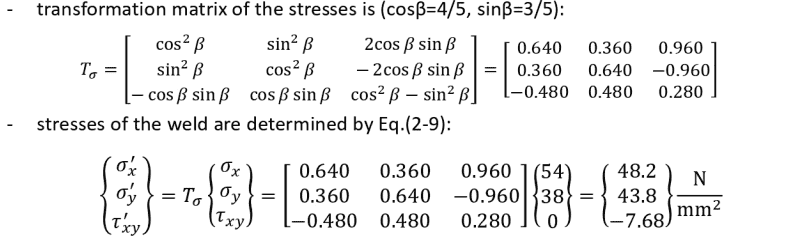
steel plate given in figure (a) is joined by an inclined butt weld ,the plate is subjected to tensile stresses in both x and y directions, σ(x)=54 N/mm^2 and σ(y)=38 N/mm^2 ,
1) Determine the normal and shear stresses of the butt weld.
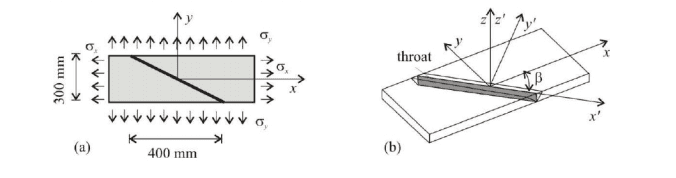
1.PNG


this is transformation matrices :
2.PNG


2)second question :
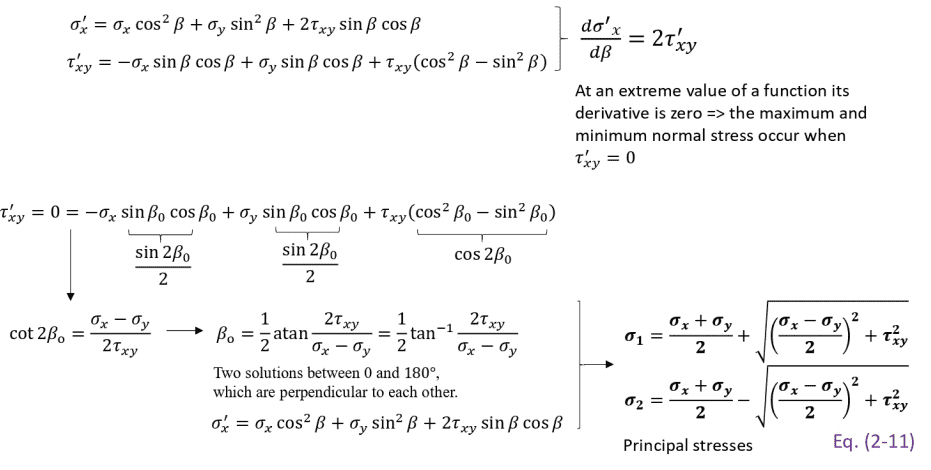
in which direction the stress normal will be maximum ?
3.PNG


My problem: is τxy ( why in first we made it 0 in transformation matrice (and why it's 0) and in second question it's calculed .
 
Physics news on Phys.org
As far as I can make out, the first part is a calculation for a special case where there is no applied torque, whereas the second finds the weld direction that maximises stress in the more general case.
 
In this system, the stress tensor is given by$$\boldsymbol{\sigma}=\sigma_x\mathbf{i_x}\mathbf{i_x}+\sigma_y\mathbf{i_y}\mathbf{i_y}$$and the unit normal to the weld is given by: $$\mathbf{n}=\sin{\beta}\mathbf{i_x}+\cos{\beta}\mathbf{i_x}$$So the traction vector on the weld is given by: $$\boldsymbol{T}=\boldsymbol{\sigma}\centerdot \mathbf{n}=\sigma_x \sin{\beta}\mathbf{i_x}+\sigma_y \cos{\beta}\mathbf{i_y}$$The normal component of the traction vector on the weld is equal to the traction vector dotted with the unit normal: $$\sigma_n=\boldsymbol{T}\centerdot \mathbf{n}=\sigma_x \sin^2{\beta}+\sigma_y\cos^2{\beta}=\frac{(\sigma_x+\sigma_y)}{2}-\frac{(\sigma_x-\sigma_y)}{2}\cos{2\beta}$$The unit tangent vector to the weld is given by $$\mathbf{t}=\cos{\beta}\mathbf{i_x}-\sin{\beta}\mathbf{i_y}$$The shear component of the traction is obtained by dotting the traction vector with the unit tangent:$$\tau=(\sigma_x-\sigma_y)\sin{\beta}\cos{\beta}=\frac{(\sigma_x-\sigma_y)}{2}\sin{2\beta}$$
 
Last edited:

Similar threads

  • · Replies 2 ·
Replies
2
Views
2K
Replies
2
Views
2K
  • · Replies 1 ·
Replies
1
Views
2K
  • · Replies 3 ·
Replies
3
Views
14K
  • · Replies 16 ·
Replies
16
Views
3K
  • · Replies 2 ·
Replies
2
Views
2K
  • · Replies 7 ·
Replies
7
Views
2K
  • · Replies 2 ·
Replies
2
Views
4K
  • · Replies 6 ·
Replies
6
Views
3K
  • · Replies 11 ·
Replies
11
Views
3K