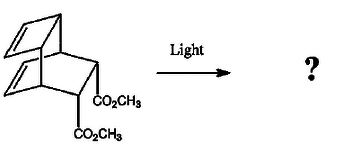
What are these pericyclic reactions?

  • Thread starter Thread starter CrimpJiggler
  • Start date Start date
  • Tags Tags
    Reactions
Click For Summary
SUMMARY

This discussion focuses on the mechanisms of pericyclic reactions, specifically intramolecular [2+2] photocycloaddition and intramolecular Alder-ene reactions involving cyclopropyl rings. Participants highlight the instability of cyclopropyl rings and their tendency to open during electrocyclizations, which plays a crucial role in the reaction pathways. The stabilization of positive charges by adjacent groups, such as carbonyl oxygens and methyl groups, is also emphasized as a significant factor in these reactions.

PREREQUISITES
  • Understanding of pericyclic reactions
  • Familiarity with intramolecular [2+2] photocycloaddition
  • Knowledge of Alder-ene reactions
  • Basic concepts of cyclopropyl ring stability
NEXT STEPS
  • Study the mechanisms of pericyclic reactions in detail
  • Learn about the role of cyclopropyl rings in organic chemistry
  • Investigate the effects of electron-donating groups in reaction stabilization
  • Explore the principles of electrocyclization and its applications
USEFUL FOR

Chemistry students, organic chemists, and researchers interested in reaction mechanisms and the behavior of cyclic compounds in pericyclic reactions.

CrimpJiggler
Messages
141
Reaction score
1
First one:
feea75c6577d97b85310a41fb53f06bb.png

is this an intramolecular [2+2] photocycloaddition?

And this one:
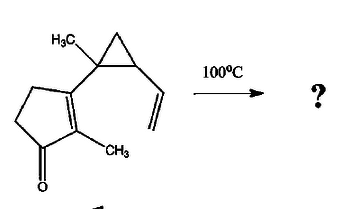
aa86e2304119606f2535da3b00648cdc.png

I'm fairly confused about this one. Could it be an intramolecular Alder-ene reaction? Whats confusing me most is that cyclopropyl ring up there. I know they're pretty unstable and I read that they open during electrocyclisations and stuff like that so I'm wondering if it plays a role in this reaction.
 
Chemistry news on Phys.org
It's been a while since I studied chemistry, but since no one answered, I'll throw my 2 cents.

For #2:

It's a fairly safe bet that the cyclopropane ring will open, leaving a temporary + on the quaternary carbon. There are two things that make this easier: the carbonyl oxygen can donate electrons through the conjugated double bonds, and the + is stabilized by the methyl group.

Then, I think, the 6-membered ring will close with rearrangement of protons.
 

Similar threads

  • · Replies 8 ·
Replies
8
Views
4K
  • · Replies 8 ·
Replies
8
Views
4K
  • · Replies 1 ·
Replies
1
Views
1K
  • · Replies 7 ·
Replies
7
Views
2K
  • · Replies 6 ·
Replies
6
Views
3K
Replies
7
Views
3K
  • · Replies 10 ·
Replies
10
Views
3K
Replies
1
Views
2K
  • · Replies 17 ·
Replies
17
Views
3K
  • · Replies 5 ·
Replies
5
Views
4K