What Calculus Book Can Help Understand Goldstein's Classical Mechanics?

  • Context: Classical 
  • Thread starter Thread starter Shakir
  • Start date Start date
  • Tags Tags
    Book Calculus
Click For Summary
SUMMARY

The discussion focuses on the challenges faced by learners of Goldstein's Classical Mechanics, particularly in understanding the calculus concepts presented in the text. Key issues include confusion over summation and integration notations, as well as the use of dot notation for derivatives. Recommended resources for mastering these concepts include Feynman's Lectures on Physics, specifically Chapters 9 and 10, and the book "Calculus of Variations" available on Amazon. The discussion emphasizes the importance of familiarizing oneself with the specific notations used in physics compared to standard calculus courses.

PREREQUISITES
  • Understanding of multivariable calculus concepts
  • Familiarity with calculus notations and operations
  • Basic knowledge of classical mechanics principles
  • Experience with summation and integration techniques
NEXT STEPS
  • Study Feynman's Lectures on Physics, particularly Chapters 9 and 10
  • Read "Calculus of Variations" by Gelfand and Fomin
  • Explore online resources for advanced calculus techniques
  • Practice problems involving dot notation in physics contexts
USEFUL FOR

Students and educators in physics, particularly those studying classical mechanics, as well as anyone seeking to bridge the gap between standard calculus and its application in physics.

Shakir
Messages
8
Reaction score
4
Hello PF

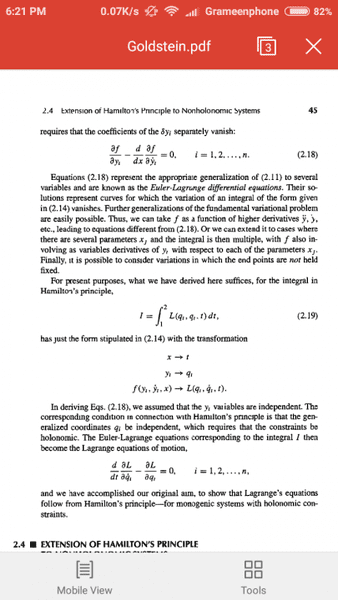
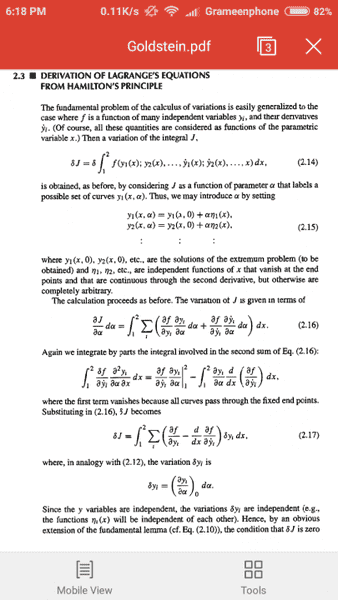
I have attached two screenshots from Goldstein's Classical Mechanics. Although I have done a course on multivariable calculus, I don't understand what is going on in this math part.

Could you please provide some online resources or suggest a book so I can understand this sort of calculus? I am really stuck here.
Screenshot_2017-02-01-18-18-59-245_cn.wps.moffice_eng.png
Screenshot_2017-02-01-18-21-15-694_cn.wps.moffice_eng.png
 
Physics news on Phys.org
Could you point out what part(s) of those two pages you have an issue with? at a glance, I don't see anything that wasn't covered in my Calculus II and III courses back in the 90s.

I learned calculus with Larson & Hostetler and Varburg & Purcell, by the way. I know there are better texts out there, though.
 
Last edited:
Hello
My problem is with the summation and integration part. I do not know how to use this method. Besides I learned multivariable calculus from a MATH teacher. The notations used in physics are a bit different e.g representation of x dot x, double dot to express velocity, acceleration etc. It often becomes very confusing. Maybe I missed some concepts or did not learn properly.
 
Problem starts at 2.16 to the rest.
 
The only two pieces of notation I see that are not in a standard Calculus sequence are summing over I and the use of a dot instead of a prime for time derivative.

The sum over I just means to sum over all values of the index i. It's written that way so that the same equation can be used for systems with any number of degrees of freedom.

One thing that takes a bit of getting used to in mechanics is that you can take a derivative with respect to y-dot in an expression as though it is a totally separate variable to y. It feels odd, but it works that way and it's just one of those things that must be gotten used to.

Other than those two points, you might find the chapter on calculus of variations in Feynman's lectures helpful. It's available free here:

http://www.feynmanlectures.caltech.edu/II_19.html
 
  • Like
Likes   Reactions: Shakir

Similar threads

  • · Replies 17 ·
Replies
17
Views
3K
Replies
9
Views
4K
  • · Replies 6 ·
Replies
6
Views
3K
  • · Replies 20 ·
Replies
20
Views
5K
  • · Replies 17 ·
Replies
17
Views
3K
  • · Replies 5 ·
Replies
5
Views
3K
  • · Replies 26 ·
Replies
26
Views
6K
  • · Replies 17 ·
Replies
17
Views
10K
  • · Replies 12 ·
Replies
12
Views
3K
  • · Replies 11 ·
Replies
11
Views
5K