Discussion Overview
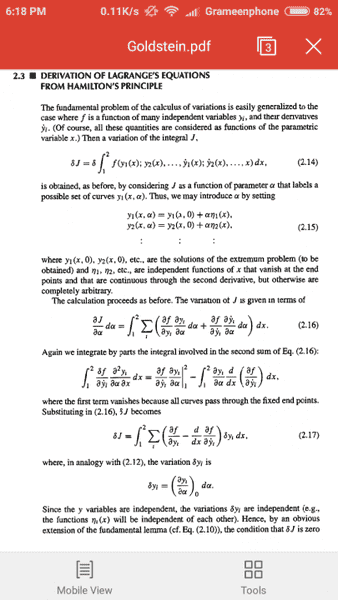
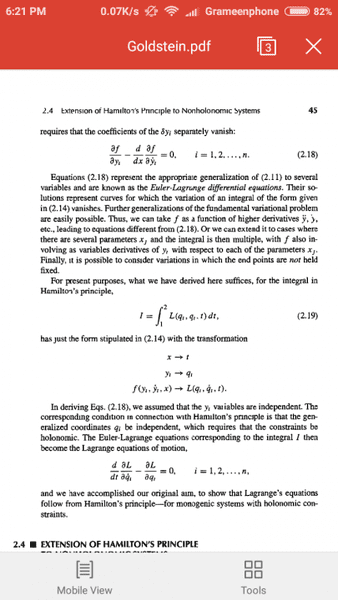
The discussion revolves around the challenges faced by a participant in understanding the calculus concepts presented in Goldstein's Classical Mechanics. The focus is on identifying suitable resources or books that could aid in grasping the mathematical methods used in the text, particularly in relation to summation and integration techniques.
Discussion Character
- Homework-related
- Technical explanation
- Conceptual clarification
Main Points Raised
- One participant expresses difficulty with the mathematical notation and concepts in Goldstein's text, particularly regarding summation and integration methods.
- Another participant suggests that the issues may stem from differences in notation between mathematics and physics, noting that the representation of derivatives can be confusing.
- A later reply identifies specific notations that may not be standard in typical calculus courses, such as summing over an index and using dots for time derivatives.
- Resources are proposed, including Feynman's lectures on calculus of variations and a specific book that may help clarify the concepts.
Areas of Agreement / Disagreement
Participants generally agree that the notation and methods in physics can differ from standard calculus teachings, leading to confusion. However, there is no consensus on the best resources, as different participants suggest various texts and materials.
Contextual Notes
Participants note that the understanding of certain notations and concepts may depend on prior exposure to specific calculus courses and the differences in notation between disciplines. There is also mention of potential gaps in foundational knowledge that could affect comprehension.
Who May Find This Useful
This discussion may be useful for students of physics or mathematics who are encountering difficulties with advanced calculus concepts in classical mechanics, particularly those transitioning from pure mathematics to applied physics contexts.