What Causes Temperature Gradient at y=0 in Convective Heat Transfer?

  • Context: Graduate 
  • Thread starter Thread starter tonyjk
  • Start date Start date
  • Tags Tags
    Heat Heat transfer
Click For Summary
SUMMARY

The discussion centers on the temperature gradient at y=0 in convective heat transfer, specifically addressing the balance of heat transfer processes. At y=0, heat is transferred by conduction due to the no-slip condition of the fluid, which has a temperature equal to the surface temperature (Ts). Above this layer, the competing processes of heat removal by the flowing fluid and heat delivery from the wall create a steady state where the temperature remains constant over time. This steady state requires fluid movement, as a static fluid would result in an unbounded conductive front.

PREREQUISITES
  • Understanding of convective heat transfer principles
  • Knowledge of conduction and no-slip boundary conditions
  • Familiarity with steady state heat transfer concepts
  • Basic thermodynamics, including heat flux calculations
NEXT STEPS
  • Study the principles of convective heat transfer in detail
  • Learn about the no-slip condition and its implications in fluid dynamics
  • Explore steady state heat transfer and its mathematical modeling
  • Investigate heat flux calculations and their applications in thermal systems
USEFUL FOR

Engineers, thermal analysts, and students studying heat transfer, particularly those focusing on convective processes and steady state conditions in fluid dynamics.

tonyjk
Messages
227
Reaction score
3
Hello,
Consider this exemple:
Convective_heat_transfer.png


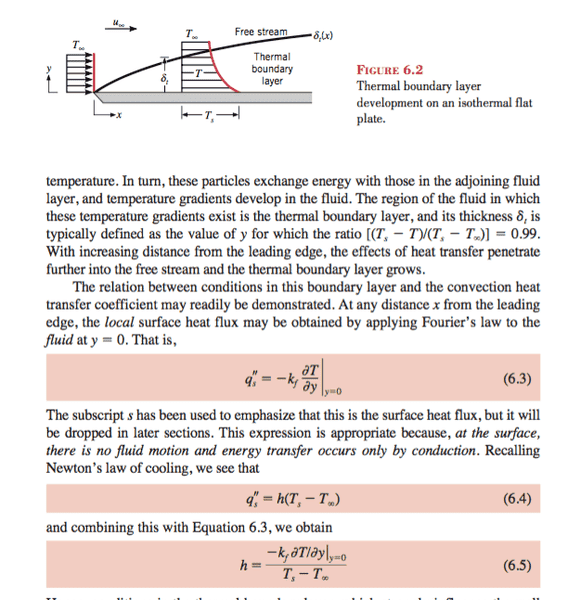
At y = 0 It is said that the heat is transferred by conduction because the fluid has a velocity equal to 0 (no-slip conditions). But the temperature of the fluid for y=0 is equal to Ts(temperature of the surface) so how come there's a gradient in the temperature? Do they mean there's gradient at y=0 just above the layer of the fluid having a temperature equal to Ts? Another question, the conduction heat transfer at y = 0 is happening for 1s (J/S = W) but during this second the fluid is passing and it is not static like in a wall that issue is confusing me. Even the exchange of energy between the fluid that is not on the surface, this fluid is flowing and heat is transferred each second by qs = h(Ts-Tinf) and on each position x we have a gradient of temperature that is independent of the time. I am very confused about the steady state heat transfer by convection.

Hope someone can clarify it

Thank you
 
Science news on Phys.org
Yes, the thermal gradient they are referring to is for ## y \geq 0 ##. Think of the fluid as an infinite heat sink of temperature ## T_\infty ## and the wall as an infinite heat reservoir of temperature ## T_s ##. Heat will flow from the reservoir to the sink. Right at the wall, heat is delivered purely conductively. Just above ## y = 0 ##, however, there are two competing processes: flowing fluid is removing heat, while fluid just below is delivering heat from the wall. At steady state, these two processes just balance one another, so that the temperature at any given point stays constant in time.

Note that steady state does not imply that the fluid is static. In fact, for there to be a steady state in this situation, the fluid must be moving. Otherwise, there would just be a hot conductive front penetrating further and further into the fluid as time progresses.
 
Great. but for exemple, heat flux is joule per second, but during this second the fluid will flow but how the temperature will remain constant for a position x
 
Over a given time interval, fluid flowing from the left toward the right will replace warmed up fluid with fluid that would be cooler. I say "would be", because the heat delivered from the wall during the same time interval will warm up the incoming fluid just enough to keep the temperature at that position constant. These are the competing effects I was trying to describe above.
 
  • Like
Likes   Reactions: tonyjk

Similar threads

  • · Replies 5 ·
Replies
5
Views
2K
  • · Replies 2 ·
Replies
2
Views
3K
  • · Replies 14 ·
Replies
14
Views
3K
Replies
7
Views
2K
  • · Replies 5 ·
Replies
5
Views
2K
  • · Replies 22 ·
Replies
22
Views
3K
  • · Replies 2 ·
Replies
2
Views
2K
  • · Replies 3 ·
Replies
3
Views
2K
  • · Replies 20 ·
Replies
20
Views
2K
  • · Replies 9 ·
Replies
9
Views
5K