What Causes the Optical Illusion in the Pale Blue Dot Photo?

  • Context: Undergrad 
  • Thread starter Thread starter Avathacis
  • Start date Start date
  • Tags Tags
    Dot
Click For Summary
SUMMARY

The Pale Blue Dot photo, captured by Voyager 1 from a distance of 6.1 billion kilometers, exhibits an optical illusion due to sunlight reflection off the spacecraft. Carl Sagan noted that the Earth appears illuminated in a beam of light, which is a result of geometric and optical accidents rather than any intrinsic significance. This phenomenon occurs when bright light sources, not in the field of view, cause glare from internal reflections within the camera system. Understanding these principles is essential for interpreting similar optical effects in photography.

PREREQUISITES
  • Understanding of basic optics principles
  • Familiarity with geometric optics
  • Knowledge of light reflection and refraction
  • Experience with photography techniques and camera systems
NEXT STEPS
  • Research the principles of geometric optics
  • Learn about internal reflections in camera systems
  • Explore the effects of glare in photography
  • Study the history and significance of the Voyager missions
USEFUL FOR

Photographers, physics enthusiasts, and anyone interested in the intersection of optics and astronomy will benefit from this discussion.

Avathacis
Messages
43
Reaction score
0
So as you might or might not know the Pale Blue Dot is a picture taken from the spacecraft Voyager 1 when it was 6.1 billion kilometers away from Earth.
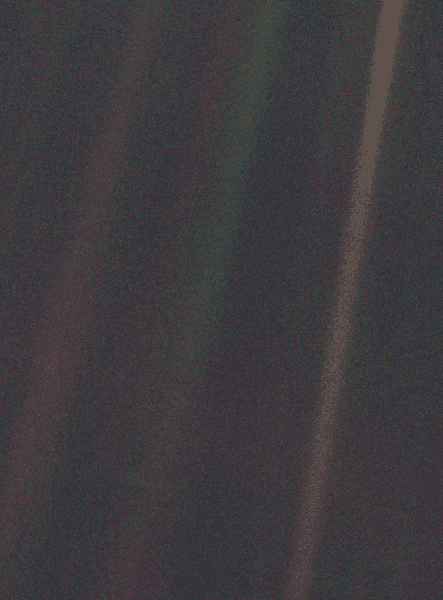
Pale_Blue_Dot.png


To quote Carl Sagan: (of course there is a lot more quotable and more important material, but it serves for the question)

"Because of the reflection of sunlight off the spacecraft , the Earth seems to be sitting in a beam of light, as if there were some special significance to this small world; but it's just an accident of geometry and optics."

Can anybody explain (in detail) the "accident of geometry and optics"?

P.S. I'm not sure if this belongs in general physics (because i would guess that most of the explanation would take place on the grounds of optics and geometry) or if it belongs in astrophysics/astronomy.
 
Science news on Phys.org
Ant time you have a nearby bright source of light that isn't in the field of view you can still get a glare from internal reflections. It happens with eartbound pictures when the sun is nearby too.

[edit] Here's an example of the same phenomena screwing up a picture I took last week. Obviously, if the background of the pic is black, the flare looks even worse.
 

Attachments

  • P1020077.jpg
    P1020077.jpg
    71.4 KB · Views: 559
Last edited:

Similar threads

  • · Replies 1 ·
Replies
1
Views
2K
  • · Replies 5 ·
Replies
5
Views
5K
  • · Replies 3 ·
Replies
3
Views
3K
  • · Replies 17 ·
Replies
17
Views
9K
  • · Replies 1 ·
Replies
1
Views
4K
  • · Replies 1 ·
Replies
1
Views
4K