eoghan
- 201
- 7
Hi there!
I wonder where the resolution limit for a microscope comes out. I know that the lens can act as a circular aperture of diameter D and so a point source is diffracted in a disk of angular aperture 1.22\lambda/D
Two sources are resolved if their distance is greater than (without Abbe correction) 1.22\lambda/NA
How can I obtain this result?
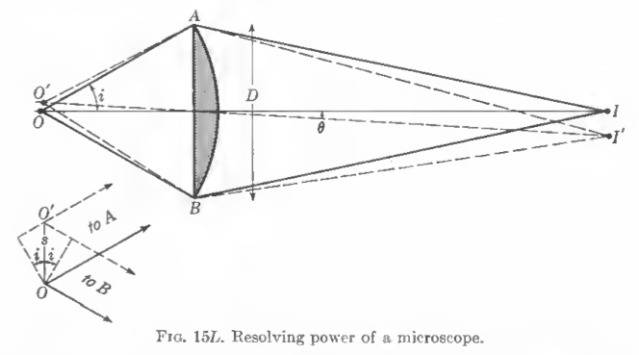
I'm reading Jenkins and White and they start supposing two point sources, O on the axis of the lens and O' slightly above which form images I and I'. Each image consists of a disk and the angular separation of the disks when they are on the limit of resolution is 1.22\lambda/D
When this condition holds, the wave from O' diffracted to I has zero intensity and the extreme rays O'BI and O'AI differ in path by 1.22lambda. (B is the top point of the lens, and A is the lower point; I is the position of the image of O and lies on the lens axis) Why do they differ in path by 1.22lambda?
I also attach the image, taken from the book, of the geometry
I wonder where the resolution limit for a microscope comes out. I know that the lens can act as a circular aperture of diameter D and so a point source is diffracted in a disk of angular aperture 1.22\lambda/D
Two sources are resolved if their distance is greater than (without Abbe correction) 1.22\lambda/NA
How can I obtain this result?
I'm reading Jenkins and White and they start supposing two point sources, O on the axis of the lens and O' slightly above which form images I and I'. Each image consists of a disk and the angular separation of the disks when they are on the limit of resolution is 1.22\lambda/D
When this condition holds, the wave from O' diffracted to I has zero intensity and the extreme rays O'BI and O'AI differ in path by 1.22lambda. (B is the top point of the lens, and A is the lower point; I is the position of the image of O and lies on the lens axis) Why do they differ in path by 1.22lambda?
I also attach the image, taken from the book, of the geometry
Last edited: