What do the color maps in spherical harmonics represent?

Click For Summary

Discussion Overview

The discussion revolves around the interpretation of color maps in spherical harmonics, particularly in relation to their representation of quantum numbers and oscillatory modes on a sphere. Participants explore the meaning of these visualizations in the context of mathematical and physical applications.

Discussion Character

  • Exploratory
  • Technical explanation
  • Conceptual clarification
  • Debate/contested

Main Points Raised

  • One participant questions the meaning of the color maps in spherical harmonics, seeking clarification on their significance.
  • Another participant suggests a connection to quantum numbers for bound electrons, indicating a potential application in quantum mechanics.
  • A participant explains that spherical harmonics serve as eigenfunctions of the Laplacian on a sphere, with color representing the complex phase and brightness indicating the modulus of the function value.
  • One participant describes possible oscillation modes of a sphere, linking specific (l,m) values to different motion patterns, such as radial surface motions and latitudinal bands.
  • Another participant notes that the images display phase information without amplitudes, while a subsequent reply corrects this by stating that brightness does represent amplitude.
  • There is a clarification regarding the representation of amplitudes in the color maps, with some participants initially misunderstanding this aspect.

Areas of Agreement / Disagreement

Participants express differing views on the interpretation of the color maps, particularly regarding the representation of amplitude and phase. There is no consensus on a singular interpretation, as multiple perspectives and clarifications are presented throughout the discussion.

Contextual Notes

Some participants' claims depend on specific interpretations of the spherical harmonics and their applications, which may not be universally agreed upon. The discussion includes nuances regarding the representation of complex values and the implications of the (l,m) indices.

gfd43tg
Gold Member
Messages
949
Reaction score
48
Hello,

I am watching a video about spherical harmonics, and I am at the point where the color map is being shown for various values of ##l## and ##m##

upload_2015-3-27_2-26-56.png


My question is, what am I supposed to make of these plots? Pretty colors yes, but what do these things mean?
 
Physics news on Phys.org
http://dwb4.unl.edu/Chem/CHEM869Z/CHEM869ZLinks/www.rwc.uc.edu/koehler/biophys/6b.html

It looks like quantum numbers for bound electrons.
 
Last edited by a moderator:
Spherical harmonics are the equivalent to the Fourier basis on S^2, as both are the eigenfunctions of the natural Laplacian. The Fourier basis is usually labeled with a set of integer wave numbers, k_n, n=1..N where N is the dimension of the coordinate vector space. Spherical harmonics are labeled with two similar integer wave numbers, usually named l and m. The graphs you posted show the function value of the (l,m)th spherical harmonic basis function with brightness as modulus and hue for the complex phase. That should allow you to understand what the complex basis function looks like.
 
Not sure what the application is for your example, but the surface of a sphere may have modes of oscillation (radial surface motions).
Simplest way is for the entire surface to move in and out (the whole sphere gets smaller and bigger) - looks like l=0 m=0
Another way is for one half to move in as the other half moves out and vice versa - looks like l=1 m=0
Those are the only ones that look clear in the picture, to me; but the l and m numbers are continuing to identify the modes.
From there the sphere may be sectioned into four longitudinal quadrants where the opposing pairs make opposing motions.
Same for eight sections, four in one half and four in the other, etc...
And others where the moving parts are like the latitudinal bands around the Earth - looks like l=2 m=0

The sections and bands get complicated because they interact to form whole number counts, some required to be even numbers to support a repeating series of opposite polarities of motion (the longitudinal "slices"), and others not held to that constraint (the bands) because they don't repeat, they occupy the poles... the use of the m and l numbers are used to describe all combination possibilities completely.

Typically, colors may be used to distinguish which parts are moving in a direction at a moment to mark the polarities of the regions, and boundaries (node lines of no movement) between them.

These harmonic "motions" may in your example be analogous to some other oscillatory property that may not be a strict motion but rather a change in some other attributes like field strength, density, polarity, probability, etc...
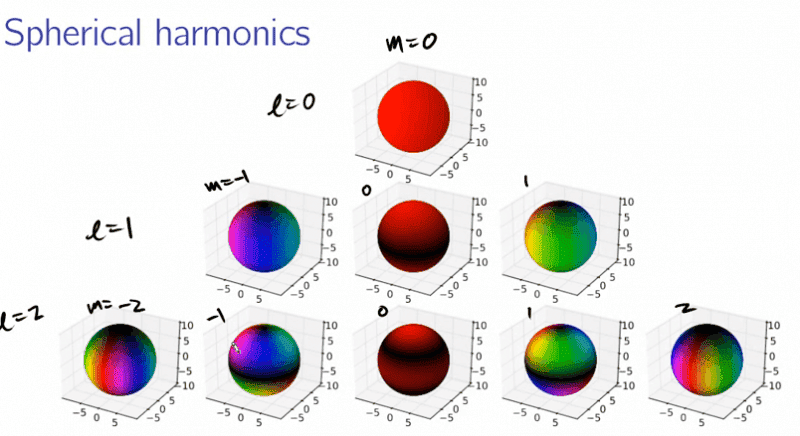
 
Each (l,m) has the function of two variables (angles) with complex value. We can rewrite any complex number in form 'x+iy' to r*Exp(i∆) The colors is due to phase of this complex values (∆) which obtain for any solid angle. This pictures only show phase without amplitudes.
 
abbas_majidi said:
This pictures only show phase without amplitudes.

The images actually do show the magnitude, mapped to the brightness of the color.
 
Forgive me. In above picture amplitudes are shown but by the brightness of each color. In first time i don't see it. Therefore this form is appreciate to show spherical functions with complex values.
 
Jazzdude said:
The images actually do show the magnitude, mapped to the brightness of the color.
Thanks.
 

Similar threads

  • · Replies 3 ·
Replies
3
Views
3K
  • · Replies 8 ·
Replies
8
Views
2K
  • · Replies 3 ·
Replies
3
Views
2K
  • · Replies 2 ·
Replies
2
Views
2K
  • · Replies 13 ·
Replies
13
Views
2K
  • · Replies 1 ·
Replies
1
Views
4K
  • · Replies 3 ·
Replies
3
Views
2K
  • · Replies 6 ·
Replies
6
Views
3K
  • · Replies 1 ·
Replies
1
Views
1K
  • · Replies 7 ·
Replies
7
Views
3K