SUMMARY
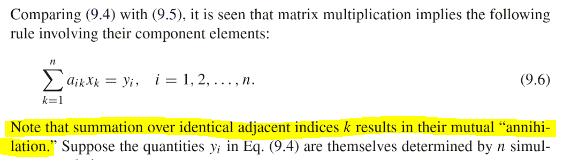
The term "adjacent indices" in the context of matrix multiplication refers to the summation indices that are eliminated in the resulting expression. In the discussion, it is clarified that the term is unnecessary, as the elimination of the summation index is a general property of summation, not exclusive to matrices. The example provided, $$\sum_{k=0}^nx^k=\frac{1-x^{n+1}}{1-x}$$, illustrates that the index \( k \) does not appear in the result. The mention of "adjacent" may relate to the summation convention but does not add value to the explanation.
PREREQUISITES
- Understanding of matrix multiplication concepts
- Familiarity with summation notation and conventions
- Basic knowledge of mathematical indices
- Experience with mathematical proofs and derivations
NEXT STEPS
- Study the properties of summation indices in mathematical expressions
- Explore the implications of summation conventions in linear algebra
- Review S.M. Blinder's "Guide to Essential Math" for further insights on matrix operations
- Practice deriving results from summations in various mathematical contexts
USEFUL FOR
Mathematicians, students of linear algebra, educators teaching matrix operations, and anyone interested in the nuances of mathematical notation and summation conventions.