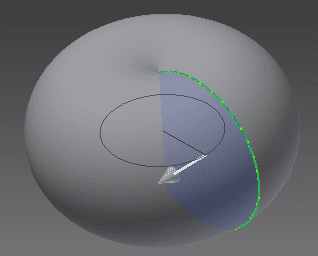
What Does Rotating a Circular Arc Create?

Click For Summary
SUMMARY

Rotating a circular arc creates distinct 3D shapes based on the angle of rotation. A 180-degree arc generates a sphere, while a 90-degree arc forms a spindle torus, not an ellipsoid, due to the presence of cusps. The discussion highlights the need for equations to describe these surfaces, particularly the inner surface of the spindle torus. Additional resources, including links to the lemon and apple shapes, were shared for further exploration of these geometries.

PREREQUISITES
  • Understanding of basic geometric shapes and their properties
  • Familiarity with 3D modeling concepts
  • Knowledge of mathematical equations related to surface geometry
  • Basic comprehension of toroidal shapes and their characteristics
NEXT STEPS
  • Research the mathematical properties of spindle tori
  • Explore equations for the inner surface of a spindle torus
  • Investigate the intersection of lemon and apple shapes in 3D geometry
  • Learn about the implications of cusps in geometric surfaces
USEFUL FOR

Mathematicians, 3D modelers, geometry enthusiasts, and anyone interested in advanced geometric shapes and their mathematical descriptions.

murrdpirate0
Messages
29
Reaction score
0
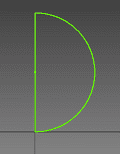
A 180 degree circular arc (i.e. a half sphere) is obvious:
Upx2A.png


When you rotate this about its two end points, you get a sphere.

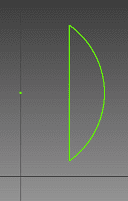
What about for something less than 180 degrees (e.g. 90)?:
8up3r.png
iWLlN.png


I believe this forms an ellipsoid, with coefficients a and b being equal, with respect to wikipedia's entry on ellipsoid: http://en.wikipedia.org/wiki/Ellipsoid. Can anyone confirm that is correct?

I have no idea what it would be for something greater than 180 degrees:

VUJC1.png
kYgBs.png


Its cross section would look like a butterfly. I have no idea what the 3D shape would be called. Anyone have any idea? I'm especially interested in obtaining an equation that would describe its surface.
 
Last edited:
Physics news on Phys.org


murrdpirate0 said:
A 180 degree circular arc (i.e. a half sphere) is obvious:

Upx2A.png


When you rotate this about its two end points, you get a sphere.

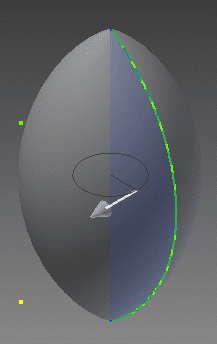
What about for something less than 180 degrees (e.g. 90)?:
8up3r.png
iWLlN.png


I believe this forms an ellipsoid, with coefficients a and b being equal, with respect to wikipedia's entry on ellipsoid: http://en.wikipedia.org/wiki/Ellipsoid. Can anyone confirm that is correct?

It cannot be an ellipsoid. The reason is that an ellipsoid is smooth everywhere, while your surface has "cusps" on the bottom and on the top.

I have no idea what it would be for something greater than 180 degrees:
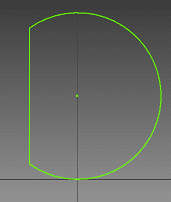
VUJC1.png
kYgBs.png


Its cross section would look like a butterfly. I have no idea what the 3D shape would be called. Anyone have any idea? I'm especially interested in obtaining an equation that would describe its surface.

It looks like a spindle torus: http://en.wikipedia.org/wiki/Spindle_torus
 
I was just looking at the spindle torus and I agree, that appears right. It would be preferable if I could have the math only describe the outer shell, but maybe that's not practical.

Good point about the other shape not being an ellipsoid. I don't think I would have noticed that. I guess it's actually the inner surface of the spindle torus. Being able to make an equation for that might solve both problems...

Thanks for the help. Any other ideas are warmly welcomed :)

Edit: Just found this http://mathworld.wolfram.com/Lemon.html and this http://mathworld.wolfram.com/Apple.html I need to find the intersection of these two shapes. Looks pretty promising.
 
Last edited:

Similar threads

  • · Replies 8 ·
Replies
8
Views
2K
  • · Replies 10 ·
Replies
10
Views
4K
  • · Replies 3 ·
Replies
3
Views
3K
  • · Replies 1 ·
Replies
1
Views
2K
  • · Replies 40 ·
2
Replies
40
Views
9K
  • · Replies 3 ·
Replies
3
Views
3K
  • · Replies 20 ·
Replies
20
Views
4K
  • · Replies 2 ·
Replies
2
Views
2K
  • · Replies 5 ·
Replies
5
Views
3K
  • · Replies 16 ·
Replies
16
Views
3K