Leo Liu
- 353
- 156
- Homework Statement
- .
- Relevant Equations
- .
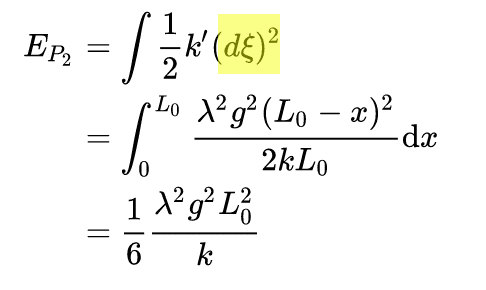
When I was following the calculations of finding the potential energy of a spring standing on a table under gravity, I encountered the integral shown below, where ##d\xi## is the compression of a tiny segment of the spring and ##k'## is the effective spring constant of that segment. The integral sums up the elastic potential energy of each segment along the spring. However, it is not a run of the mill integral in that its differential term is squared. From my experience, the square of a differential is 0, but in this case it obviously possesses some unique properties. Could someone explain why this makes sense? And how do you compute this integral?
Origin: https://www.zhihu.com/question/324405110/answer/1860254582
In case you need it: https://www.deepl.com/translator
Origin: https://www.zhihu.com/question/324405110/answer/1860254582
In case you need it: https://www.deepl.com/translator