What Happens to Volume Change Ratio in Caesium When Pressure Exceeds 1.6 GPa?

Click For Summary
SUMMARY

The discussion centers on the behavior of Caesium under pressure, specifically its Bulk Modulus of 1.6 GPa. When pressure exceeds this value, the volume change ratio cannot exceed 1, as the Bulk Modulus is defined in terms of the rate of fractional change in volume with pressure. The correct formula for volume under pressure is given by V=V0*exp(-P/K), which indicates that volume approaches zero asymptotically but never actually reaches it. This clarifies the misconception regarding the potential for a volume change ratio greater than one.

PREREQUISITES
  • Understanding of Bulk Modulus and its significance in material science.
  • Familiarity with the concept of volume strain and its mathematical representation.
  • Knowledge of the exponential function and its application in physical equations.
  • Basic principles of gas laws and their differences from solid and liquid behavior.
NEXT STEPS
  • Study the differential form of Bulk Modulus equations in material science.
  • Explore the implications of the exponential decay function in physical systems.
  • Research the properties of Caesium and its applications in high-pressure environments.
  • Learn about the limitations of Bulk Modulus in predicting material behavior under extreme conditions.
USEFUL FOR

Material scientists, physicists, and engineers interested in the mechanical properties of materials under pressure, particularly those studying the behavior of solids and liquids like Caesium.

Fitz Watson
Messages
7
Reaction score
0
Today, while studying about bulk Modulus, I encountered a doubt. Please consider this thought experiment.

I'm considering Caesium as an example as it seems to have a quite low Bulk Modulus (comparatively) of 1.6 GPa.
Let's say I apply a pressure of X GPa.
Volume change ratio can be given by X/1.6

What happens if I increase X to more than 1.6 GPa? Practically speaking, its impossible to have Volume change ratio of > 1. So, where am I going wrong?
 
Physics news on Phys.org
Fitz Watson said:
What happens if I increase X to more than 1.6 GPa?
Of course you can't expect to squeeze the sample down to nothing. :wink:
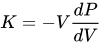
The expression for Bulk Modulus K is not what you are implying though. Bulk modulus is useful for describing the behaviour of solids and liquids.
e782c2d3008ff51d03795ad928b9c6b1b1f99515

Is the way it's defined - in terms of the rate of fractional change in volume with pressure and not the change of volume with pressure. Does that help with your confusion?
Gases follow the 'Gas Laws' because there is a lot of space between the molecules so Boyle's Law PV=Constant can be used over a huge range of pressures and volumes.
 
sophiecentaur said:
Of course you can't expect to squeeze the sample down to nothing. :wink:
The expression for Bulk Modulus K is not what you are implying though. Bulk modulus is useful for describing the behaviour of solids and liquids.
e782c2d3008ff51d03795ad928b9c6b1b1f99515

Is the way it's defined - in terms of the rate of fractional change in volume with pressure and not the change of volume with pressure. Does that help with your confusion?
Gases follow the 'Gas Laws' because there is a lot of space between the molecules so Boyle's Law PV=Constant can be used over a huge range of pressures and volumes.

Is this formula wrong?
Bulk Modulus = Pressure/Volume Strain?
I haven't gone into the differential form of it yet, so that's why I'm using this one
 
If you apply the nominal 1.6 GPa pressure, you'll compress the substance by a factor of e. To make a long story short, that's because ##\lim_{n \to \infty}(1-\frac{1}{n})^n## = 1/e.
 
Last edited:
  • Like
Likes   Reactions: sophiecentaur
Fitz Watson said:
Is this formula wrong?
I don't recognise it. You yourself have pointed out a problem with it as it suggests that you could crush a sample out of existence. As @jbriggs444 points out, the proper formula is consistent with experience - always a good thing. :wink:
 
If one assumes that the bulk compressibility is approximately constant, then the solution to the (correct) differential equation posted by @sophiecentaur in post #4 is not $$V=V_0\left[1-\frac{P}{K}\right]$$The correct solution to this equation is $$V=V_0\exp{\left(-\frac{P}{K}\right)}$$So, no matter how high P gets, V never goes to zero.
 
  • Like
Likes   Reactions: sophiecentaur and jbriggs444

Similar threads

Replies
2
Views
3K
  • · Replies 1 ·
Replies
1
Views
3K
  • · Replies 3 ·
Replies
3
Views
2K
Replies
14
Views
3K
Replies
2
Views
30K
Replies
13
Views
4K
  • · Replies 3 ·
Replies
3
Views
2K
  • · Replies 2 ·
Replies
2
Views
11K
  • · Replies 4 ·
Replies
4
Views
4K
Replies
6
Views
5K