entropy15
- 38
- 0
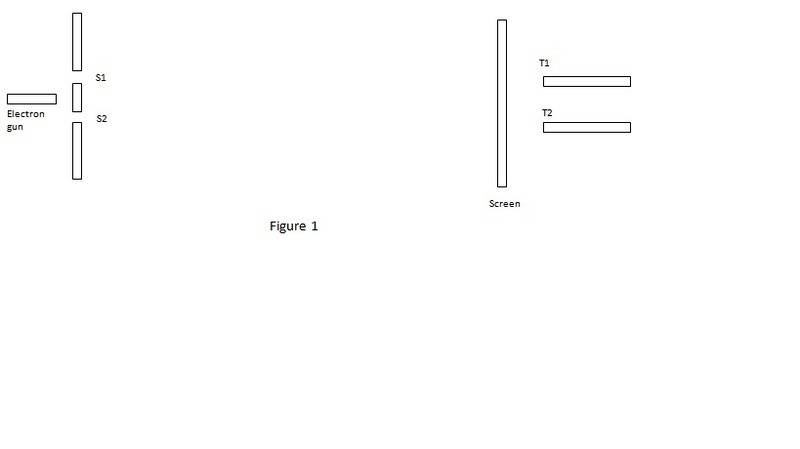
Consider the below (figure 1), an electron gun is made to emit electrons one by one through two slits S1 and S2.
There is a screen at the other side and a pair of telescopes (with electron detectors inside them) T1 and T2 trained on the slits S1 and S2 respectively.
We can choose to bring down the screen even after the electron has crossed the slits.
If we choose to keep the screen up, we get an interference pattern as more and more electrons move through the slits.
But if we choose to remove the screen the electron is always detected either at T1 or T2 with a 50:50 chance.
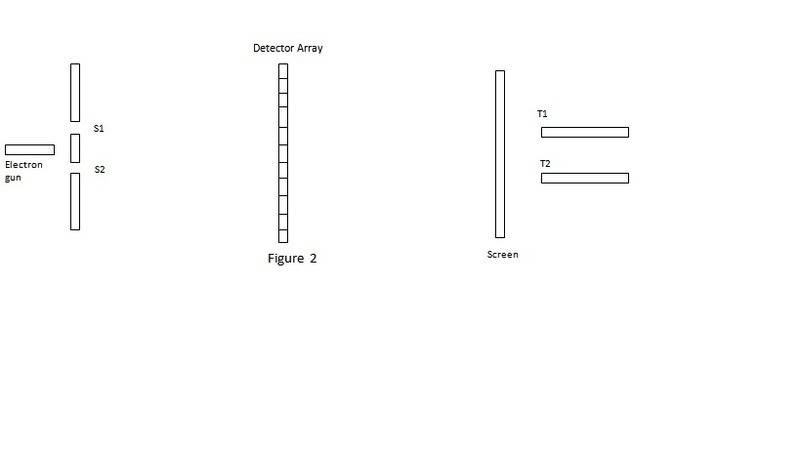
Now if we choose to insert an array of detectors in between the slits and the screen/telescopes (figure 2), the electron will be detected in only one of the detectors in the array as it moves from the slits to the screen.
How does the detector affect the entire set up?
Consider that we have the screen up. Since we have the detectors the interference pattern should disappear.
If we have the screen down, then the electron shows up only at either of the telescopes.
So wouldn't the electron be detected at the detectors which are in line with the telescopes T1 and T2.
The question is whether there would be any difference in the detection pattern (at the detector array) depending on whether the screen is up or down?
There is a screen at the other side and a pair of telescopes (with electron detectors inside them) T1 and T2 trained on the slits S1 and S2 respectively.
We can choose to bring down the screen even after the electron has crossed the slits.
If we choose to keep the screen up, we get an interference pattern as more and more electrons move through the slits.
But if we choose to remove the screen the electron is always detected either at T1 or T2 with a 50:50 chance.
Now if we choose to insert an array of detectors in between the slits and the screen/telescopes (figure 2), the electron will be detected in only one of the detectors in the array as it moves from the slits to the screen.
How does the detector affect the entire set up?
Consider that we have the screen up. Since we have the detectors the interference pattern should disappear.
If we have the screen down, then the electron shows up only at either of the telescopes.
So wouldn't the electron be detected at the detectors which are in line with the telescopes T1 and T2.
The question is whether there would be any difference in the detection pattern (at the detector array) depending on whether the screen is up or down?
Attachments

