What happens when you connect a charged capacitor to 2 uncharged capacitors?

Click For Summary
SUMMARY

This discussion focuses on the behavior of capacitors when a charged capacitor is connected to two uncharged capacitors. A 1μF capacitor charged to 1000V is connected to two additional capacitors of 2μF and 8μF. The final voltage across the 1μF capacitor is determined using conservation of charge and Kirchhoff's Voltage Law (KVL). The energy variation is calculated using the energy formula for capacitors, revealing that energy is not conserved during the process due to energy loss in the system.

PREREQUISITES
  • Understanding of capacitor charging and discharging principles
  • Familiarity with Kirchhoff's Voltage Law (KVL)
  • Knowledge of conservation of charge in electrical circuits
  • Ability to calculate energy stored in capacitors using the formula E = 1/2 CV²
NEXT STEPS
  • Learn how to calculate equivalent capacitance for capacitors in series and parallel
  • Study the implications of energy loss in capacitor circuits
  • Explore advanced topics in circuit analysis, including impedance and inductance effects
  • Investigate real-world applications of capacitors in electronic circuits
USEFUL FOR

Electronics students, electrical engineers, and hobbyists interested in understanding capacitor behavior in circuits and energy conservation principles.

liam1992
Messages
19
Reaction score
0
For my electronics work I have a question to answer:

"A 1000V source is used to fully charge a 1μF capacitor. The capacitor is then disconnected from the source and connected to two additional capacitors (2μF and 8μF) as shown in the circuit schematic below.
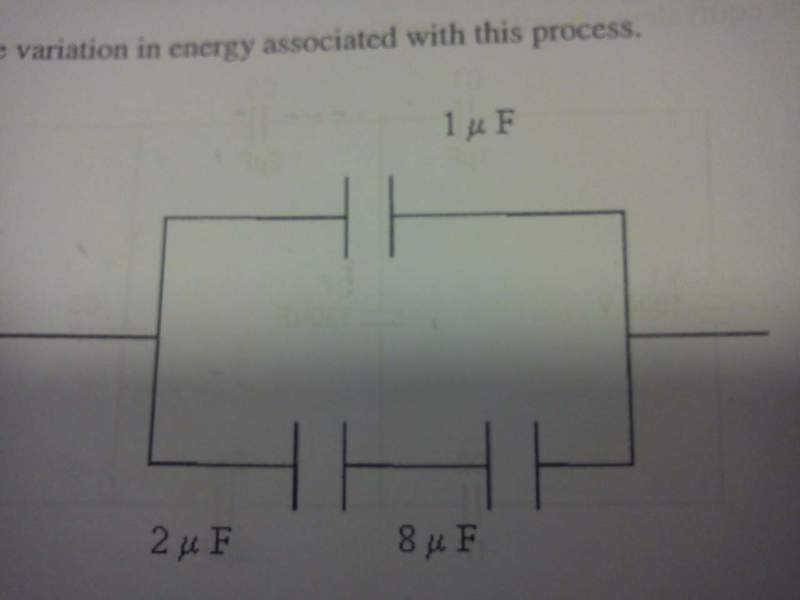
IMG_20120307_175338.jpg

a) Calculate the final voltage across the 1μF capacitor after connecting it to the two capcitors.
b) Calculate the variation of energy associated with this process."

For the first part am I supposed to act as if the three capacitors are in parallel or what? And for the second bit what is the variation of energy? Any help would be greatly appreciated.
 
Physics news on Phys.org
hi liam1992! :smile:
liam1992 said:
For the first part am I supposed to act as if the three capacitors are in parallel or what? And for the second bit what is the variation of energy? Any help would be greatly appreciated.

you can do KVL round the loop (ie in series)

and once you've found the voltage across each capacitor, use the usual formula for the energy :wink:
 
If you read this link: PDF, its shows why energy is not conserved, which is a pretty interesting fact that I think the problem is trying to expose you to.

The correct way to solve this problem is to solve for the voltage based on these two knowns:
1.) conservation of charge (the initial amount of charge in the charged capacitor will equal the number of charges distributed between the capacitors after discharging).
2.) KVL at steady state (when the capacitor has finished discharging into the uncharged capacitors), which implies the voltage across components in parallel are equal.

A first step is that you can combine the two uncharged capacitors in series as an equivalent capacitor. You now have 2 capacitors in parallel, where one is charged at 1000V and the other is uncharged.

Now, you know that the initial charge in the 1uF capacitor, q0, is equal to the sum of the final distributed charges between the 1uF capacitor, q1, and the equivalent uncharged capacitor, q2. So we can say:
q_{0} = q_{1} + q_{2}. This is based on the conservation of charge.

Next, since q = CV, we can say:
C_{0}V_{0} = C_{1}V_{1} + C_{2}V_{2}
Where the left hand side corresponds to the charged capacitor before discharging (1000V), and the right hand side corresponds to the charged capacitor and the other capacitor after the discharge.

But from our known that the voltage across the two capacitors must be the same after the discharge, we can say V_{1} = V_{2} = V. Now you just solve for V.


Like tiny-tim said, the energy can be calculated from the energy in a capacitor formula. Like the link I provded shows, you will see that the total energy has changed.
 
If you're going to do KVL or KCL you need to put an impedance between the 1 μF and the other two. The important point is to realize that some level of inductance and resistance (I dismiss the bit about superconductors occasionally mentioned) must obtain between the charged capacitor and the two uncharged ones.
 
Calculating the charge and energy stored on the original 1uF capacitor is straight forward I hope.
The 8uF and 2uF capacitors are in series so their equivalent capacitance can be found.
The 1uF capacitor is connected in parallel with the 8uF,2uF combination so you should be able to find the total capacitance when the connection is made.
The total charge is constant and therefore you should be able to get the voltage across the combination... that is the voltage across 1uF.
The final energy stored can be found and it will be less than the original stored.
Energy is 'lost' when capacitors charge and discharge.
 

Similar threads

  • · Replies 22 ·
Replies
22
Views
5K
  • · Replies 4 ·
Replies
4
Views
2K
Replies
6
Views
2K
Replies
20
Views
2K
  • · Replies 14 ·
Replies
14
Views
2K
  • · Replies 9 ·
Replies
9
Views
5K
  • · Replies 18 ·
Replies
18
Views
3K
  • · Replies 6 ·
Replies
6
Views
759
  • · Replies 1 ·
Replies
1
Views
1K
Replies
5
Views
1K