What Is Poynting's Vector and How Is It Calculated?

  • Thread starter Thread starter Jack_O
  • Start date Start date
  • Tags Tags
    Vector
Click For Summary
SUMMARY

Poynting's vector, denoted as S, is calculated using the formula S = E × H, where E is the electric field and H is the auxiliary magnetic field. In free space, the auxiliary magnetic field H can be expressed as H = B/μ₀, with B being the magnetic field and μ₀ the permeability of free space. To accurately evaluate vector cross products, it is essential to express the final answer as a vector. For further understanding, the Wikipedia article on Poynting vectors provides comprehensive insights into its relationship with wave intensity.

PREREQUISITES
  • Understanding of electromagnetic fields, specifically electric field (E) and magnetic field (B).
  • Familiarity with vector calculus, particularly vector cross products.
  • Knowledge of the permeability of free space (μ₀) and its significance in electromagnetism.
  • Basic understanding of wave intensity and its relation to electromagnetic waves.
NEXT STEPS
  • Study the derivation and applications of Poynting's vector in electromagnetic theory.
  • Learn about the relationship between Poynting's vector and wave intensity in different media.
  • Explore vector calculus techniques, focusing on cross products and their applications in physics.
  • Review the Wikipedia article on Poynting vectors for a deeper understanding and additional examples.
USEFUL FOR

Students and professionals in physics, particularly those specializing in electromagnetism, electrical engineers, and anyone interested in the principles of wave propagation and energy flow in electromagnetic fields.

Jack_O
Messages
64
Reaction score
0
Problem:

1.jpg


Attempt:

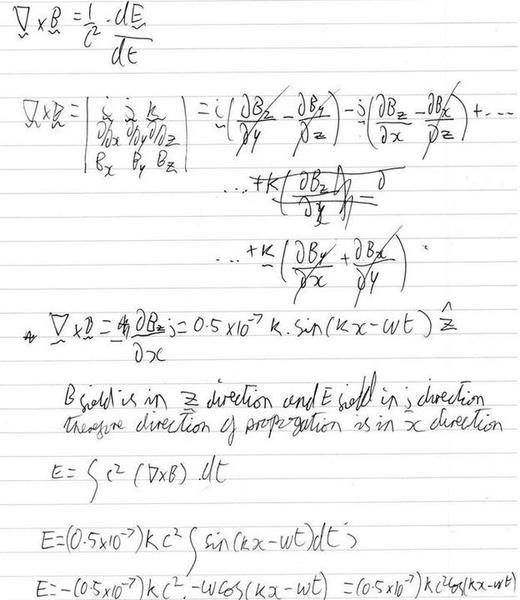
1a.jpg


I think I've done the first bit correctly (but I'm not certain). As for the second half of the question I'm at a loss. I have looked up poyntings vector and found S=ExH where H is the auxiliary magnetic field (i'm not sure what this means) and S=(1/u(0)) (ExB), but I'm not sure what to do with it.

Any help appreciated.
 
Physics news on Phys.org
In free space, the auxiliary field H is just B/\mu_0

Your answer to the first part is correct for the most part, however it is better to leave your final answer as a vector - that will help you evaluate vector cross products better. Please also check your integration step.

Wikipedia has an excellent article on the Poynting vectors, and how it is related to the intensity of the wave. You should look it up.
http://en.wikipedia.org/wiki/Poynting_vector
 

Similar threads

Replies
2
Views
2K
  • · Replies 1 ·
Replies
1
Views
1K
  • · Replies 4 ·
Replies
4
Views
880
  • · Replies 8 ·
Replies
8
Views
5K
  • · Replies 7 ·
Replies
7
Views
2K
  • · Replies 14 ·
Replies
14
Views
3K
  • · Replies 2 ·
Replies
2
Views
2K
  • · Replies 16 ·
Replies
16
Views
3K
Replies
2
Views
2K
  • · Replies 1 ·
Replies
1
Views
1K