wallace13
- 31
- 0
In the drawing, there are two blocks connected by a rope and pulley. One block is on the table while the other is hanging off of the table. Block A, with a weight of 396 N, is on the table. Block B is hanging off of the table, and has a weight of 180 N. Ignore all frictional effects and assume the pulley to be massless.
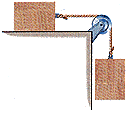
Find the acceleration of the two blocks.
T= ma
N-Fg= 0
T-Fg=-ma
I made an x and y chart for each of the blocks to show which forces pulled in which direction.
Block A- In the x-direction, there is no Fg or N, but there is T, and the ma is positive. So, I found the equation T= ma... In the y-direction Fg is negative, and there is an N, while ma=0. So I found the equation N-Fg=0.
Block B- There are no forces in the x-direction. In the y-direction, Fg is negative, there is T, and ma is negative, as well. So, I found the equation T- Fg= -ma
I found the mass of block B to be 18.349 kg (I divided 180 by 9.81).
And I substituted all of my known values into my equations...
T-180= -18.349a
I know that T= ma, so I substituted ma for T on the left side of the equation...
18.349a=-18.349a+180
I solved for acceleration and got 4.905, which is the incorrect answer.
Find the acceleration of the two blocks.
T= ma
N-Fg= 0
T-Fg=-ma
I made an x and y chart for each of the blocks to show which forces pulled in which direction.
Block A- In the x-direction, there is no Fg or N, but there is T, and the ma is positive. So, I found the equation T= ma... In the y-direction Fg is negative, and there is an N, while ma=0. So I found the equation N-Fg=0.
Block B- There are no forces in the x-direction. In the y-direction, Fg is negative, there is T, and ma is negative, as well. So, I found the equation T- Fg= -ma
I found the mass of block B to be 18.349 kg (I divided 180 by 9.81).
And I substituted all of my known values into my equations...
T-180= -18.349a
I know that T= ma, so I substituted ma for T on the left side of the equation...
18.349a=-18.349a+180
I solved for acceleration and got 4.905, which is the incorrect answer.