What is the acceleration of the crate?

Click For Summary

Homework Help Overview

The discussion revolves around a physics problem involving a 22.0-kg crate being pulled on a horizontal surface with a force of 300 N and a coefficient of friction of 0.270. Participants are exploring the dynamics of the system, particularly focusing on the forces acting on the crate and the pulley.

Discussion Character

  • Exploratory, Assumption checking, Problem interpretation

Approaches and Questions Raised

  • Participants discuss the relationship between the applied force, tension, and friction, questioning how to set up the equations of motion for both the crate and the pulley. There is confusion regarding the role of the applied force on the crate and how to determine the tension in the rope.

Discussion Status

There is ongoing exploration of the forces acting on the crate and pulley, with participants providing guidance on how to separate the forces and set up the equations. Some participants have expressed confusion about the tension and its impact on the system, while others have confirmed the correctness of certain approaches.

Contextual Notes

Participants mention variations in the problem, including different masses and coefficients of friction, which may affect their understanding and approach to the solution.

Sylvia
Messages
30
Reaction score
1
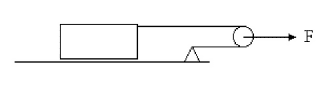
Problem: A 22.0-kg crate is pulled along a horizontal floor by the ideal arrangement
shown in figure below. The force F is 300 N. The coefficient of friction between the crate and
the floor is 0.270. What is the acceleration of the crate?
screen_shot_2014-12-07_at_12.45.54_am.png


Homework Equations


F = ma
Friction = (coefficient)(normal force)[/B]

The Attempt at a Solution


I tried F - Friction = ma, but I did not get the correct answer. Please help. [/B]
 
Physics news on Phys.org
Welcome to PF! :)

F acts on the pulley, not on the crate. The crate is connected to a rope. What is the force the rope pulls the crate with?
Note that the pulley is ideal, massless. What forces act on it, and what should be the resultant force?
 
Thank you! :)
That's the tension force, right? So would I set it up as F + T - Friction = ma?
I also wondered this at first, but I got confused because how would you know what the value of T is?
 
Sylvia said:
That's the tension force, right?
Yes.
Sylvia said:
So would I set it up as F + T - Friction = ma?
No. Consider the pulley and the crate separately. What forces act directly on the crate? (Hint: F does not.) What forces act on the pulley?
You can write a ##\Sigma F_x = m a_x## equation for each, but in the case of the pulley the mass is zero.
 
Sylvia said:
Thank you! :)
That's the tension force, right? So would I set it up as F + T - Friction = ma?
I also wondered this at first, but I got confused because how would you know what the value of T is?
F does not act on the crate. F is applied at the pulley. So what equations you have both for the crate and for the pulley?
 
haruspex said:
Yes.

No. Consider the pulley and the crate separately. What forces act directly on the crate? (Hint: F does not.) What forces act on the pulley?
You can write a ##\Sigma F_x = m a_x## equation for each, but in the case of the pulley the mass is zero.

See, that's where I'm confused. For the crate would I have -Friction + Tension = ma? And then for the pulley I would have F + Tension = ma? I'm not sure where the tension is playing a role.
 
Sylvia said:
See, that's where I'm confused. For the crate would I have -Friction + Tension = ma?

Correct.
Sylvia said:
And then for the pulley I would have F + Tension = ma? .
Think: There are two pieces of the string pulling the pulley. The tension is the same in both pieces. And what is the direction of force one string exerts on the pulley?
And the pulley is massless.
 
ehild said:
Correct.

Think: There are two pieces of the string pulling the pulley. The tension is the same in both piece.

Since the mass of the pulley is 0 and since the tension in both pieces is the same, I would get F - 2T = 0?
 
Sylvia said:
Since the mass of the pulley is 0 and since the tension in both pieces is the same, I would get F - 2T = 0?
Exactly! You can solve the problem now. :)
 
  • #10
Thank you very much for the help!
 
  • #11
You are welcome. What did you get for the acceleration?
 
  • #12
I actually had a different version of this question; I googled the question and found this version so I could copy and paste it (the question was the same, just the numbers were different). I had 24 kg and coeff. of friction was 0.290. But I ended up getting the right answer, which was 3.41 m/s^2 :)
 
  • #13
Correct! Good work.:)
 

Similar threads

Replies
6
Views
3K
Replies
13
Views
3K
  • · Replies 5 ·
Replies
5
Views
2K
  • · Replies 38 ·
2
Replies
38
Views
5K
  • · Replies 4 ·
Replies
4
Views
4K
Replies
6
Views
2K
  • · Replies 10 ·
Replies
10
Views
2K
Replies
10
Views
5K
  • · Replies 6 ·
Replies
6
Views
2K
Replies
3
Views
4K