Undergrad What is the Bremsstrahlung Spectrum function?

Click For Summary
SUMMARY

The Bremsstrahlung X-ray spectrum is characterized by a continuous distribution of X-ray energies resulting from the deceleration of charged particles, primarily electrons, when they interact with matter. The function that describes the shape of this spectrum curve, excluding characteristic spikes, is typically represented by the equation derived from quantum electrodynamics principles. This equation effectively models the intensity of emitted X-rays as a function of energy, providing insights into the underlying physics of X-ray production.

PREREQUISITES
  • Understanding of quantum electrodynamics principles
  • Familiarity with X-ray production mechanisms
  • Basic knowledge of spectrum analysis
  • Mathematical proficiency in interpreting equations
NEXT STEPS
  • Research the mathematical derivation of the Bremsstrahlung spectrum equation
  • Explore the role of electron acceleration in X-ray production
  • Study the impact of material composition on the Bremsstrahlung spectrum
  • Learn about experimental methods for measuring X-ray spectra
USEFUL FOR

Physicists, radiologists, and researchers in materials science who are studying X-ray production and its applications in various fields.
greswd
Messages
764
Reaction score
20
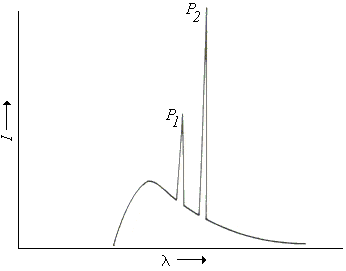
What is the function that describes the shape of this Bremsstrahlung X-ray spectrum curve?
Ignore the characteristic "spikes".

mcat-sample-questions-physical-science-passageIII-2.gif
 
Physics news on Phys.org
greswd said:
What is the function that describes the shape of this Bremsstrahlung X-ray spectrum curve?
Ignore the characteristic "spikes".

mcat-sample-questions-physical-science-passageIII-2.gif
Try equation 1 here.
 
Thank you!
I was having trouble finding it.
 
Thread 'Unexpected irregular reflection signal from a high-finesse cavity'
I am observing an irregular, aperiodic noise pattern in the reflection signal of a high-finesse optical cavity (finesse ≈ 20,000). The cavity is normally operated using a standard Pound–Drever–Hall (PDH) locking configuration, where an EOM provides phase modulation. The signals shown in the attached figures were recorded with the modulation turned off. Under these conditions, when scanning the laser frequency across a cavity resonance, I expected to observe a simple reflection dip. Instead...

Similar threads

  • · Replies 1 ·
Replies
1
Views
2K
  • · Replies 17 ·
Replies
17
Views
4K
  • · Replies 2 ·
Replies
2
Views
2K
  • · Replies 1 ·
Replies
1
Views
4K
  • · Replies 4 ·
Replies
4
Views
2K
  • · Replies 2 ·
Replies
2
Views
2K
  • · Replies 8 ·
Replies
8
Views
5K
  • · Replies 17 ·
Replies
17
Views
2K
  • · Replies 3 ·
Replies
3
Views
2K
  • · Replies 6 ·
Replies
6
Views
2K