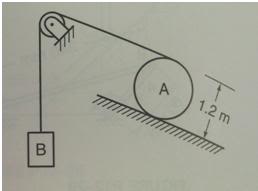
SUMMARY
The circumference of a circle with a diameter of 1.2 meters is calculated using the formula circumference = πd, resulting in approximately 3.77 meters. In the context of a cylinder rolling down a slope, the distance mass B is lifted is 10 meters, which is derived from the combined effects of the cylinder's movement and rotation. The discussion clarifies that the rope does not wind around the cylinder, simplifying the calculations. Understanding the relationship between the cylinder's descent and the lifting of mass B is essential for solving this problem.
PREREQUISITES
- Understanding of basic geometry, specifically the formula for circumference.
- Knowledge of the properties of cylinders and their motion.
- Familiarity with the concept of rotational motion.
- Basic grasp of Pythagorean theorem applications.
NEXT STEPS
- Study the relationship between linear and rotational motion in cylinders.
- Learn about the principles of torque and its effect on rolling objects.
- Explore advanced applications of the Pythagorean theorem in physics problems.
- Investigate the mechanics of pulleys and their impact on lifting systems.
USEFUL FOR
Students in physics, engineers working with mechanical systems, and anyone interested in understanding the dynamics of rolling objects and lifting mechanisms.