What is the coefficient of kinetic friction between the pig and the slide?

  • Thread starter Thread starter B-80
  • Start date Start date
  • Tags Tags
    Friction Slide
Click For Summary

Homework Help Overview

The problem involves a pig sliding down a 40° incline and seeks to determine the coefficient of kinetic friction between the pig and the slide. The context is rooted in dynamics and frictional forces.

Discussion Character

  • Exploratory, Assumption checking, Problem interpretation

Approaches and Questions Raised

  • Participants discuss the need to find the acceleration down the slide both with and without friction. There is a focus on the relationship between time, velocity, and acceleration, with some questioning the assumptions made about initial conditions and the use of variables.

Discussion Status

The discussion is ongoing, with participants offering guidance on how to approach the problem, including the importance of drawing diagrams and analyzing forces. Multiple interpretations of the problem are being explored, particularly regarding the calculations needed to find the coefficient of friction.

Contextual Notes

There is mention of constraints such as the angle of the incline and the initial conditions of the pig's motion. Participants express uncertainty about how to proceed with the calculations given the information provided.

B-80
Messages
73
Reaction score
1
A slide loving pig slides down a 40° incline (Fig. 6-24) in twice the time it would take to slide down a frictionless 40° incline. What is the coefficient of kinetic friction between the pig and the slide?
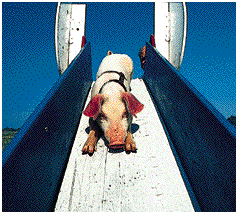
06_30pic.gif


F=ma ; a=(V-Vo)/t ; F=m((V-Vo)/t)

so m((V-Vo)/t) = m((V-Vo)/2t)F(friction)

m cancels V-Vo cancels t cancels which leaves 1/2F(friction) = 1

after solving for F(friction) I get 2, which is wrong, everything cancels pretty much. so I am at a loss
 

Attachments

  • 06_30pic.gif
    06_30pic.gif
    23.2 KB · Views: 616
Physics news on Phys.org
One cannot assume (V-Vo) is the same. If the pig starts at rest Vo = 0. Simply using V / t or 2t doesn't work.

Find the acceleration down the slide without friction, then find the acceleration with friction, and from that determine the coefficient of friction.
 
Perhaps there is an easier way of doing this problem, but I did it recently and it's a heckofa lot more work than you have there. Here's a clue, this is about the coefficient of friction, and what do you multiply the coefficient of friction with to get friction? You need to start by drawing diagrams and figure out your forces, start calculating...
 
Astronuc said:
One cannot assume (V-Vo) is the same. If the pig starts at rest Vo = 0. Simply using V / t or 2t doesn't work.

Find the acceleration down the slide without friction, then find the acceleration with friction, and from that determine the coefficient of friction.

how can I find either of these, all they gave me was the angle?
 
Amazingly enough, you can do it. It's a lot of chugging formulas, sines and cosines, solving for certain variables then substituting in other formulas etc. Start simply. Draw the picture of the frictionless slide, then figure out label the forces, split them into x and y, then do the calculations for those forces. You just have to calculate what you can, then keep looking to substitute. And be careful not to mix up sines, and cosines etc.
 

Similar threads

Replies
14
Views
3K
  • · Replies 4 ·
Replies
4
Views
3K
Replies
3
Views
4K
  • · Replies 16 ·
Replies
16
Views
6K
Replies
4
Views
4K
Replies
18
Views
3K
  • · Replies 45 ·
2
Replies
45
Views
8K
  • · Replies 8 ·
Replies
8
Views
4K
Replies
5
Views
3K
  • · Replies 2 ·
Replies
2
Views
2K