What Is the Correct Way to Calculate Resistance in This Circuit?

  • Thread starter Thread starter Lord Dark
  • Start date Start date
  • Tags Tags
    Circuit
Click For Summary
The discussion focuses on calculating resistance in a circuit, where the original poster's answers differ from their teacher's. They initially calculated 6.12 ohms for part (a) and 2.4 ohms for part (b), while the teacher provided 12 ohms and 6.667 ohms, respectively. Confusion arose regarding the addition of resistors in series and parallel configurations, particularly the treatment of certain resistors. After clarifying the circuit layout and voltage terminals, the poster adjusted their calculations for closed circuits, arriving at new values. Ultimately, the conversation highlights the importance of understanding circuit configurations for accurate resistance calculations.
Lord Dark
Messages
120
Reaction score
0
Resistance in a circuit ,,

Homework Statement


Hi guys ,, I have the following picture
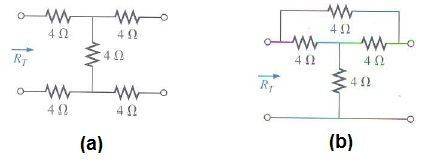
attachment.php?attachmentid=24434&stc=1&d=1268821144.jpg


The Attempt at a Solution


OK ,, I know it's easy but my answer's is not like my teacher's answer :

for (a) I get 6.12 ohm and for (b) I get 2.4 ohm

but my teacher's answer is :

a. Rt=4+4+4=12 ohm
b. Rt= (8//4)+4= 6.667 ohm

what I don't get for :

a. how can he just add them together ,, it's not like they are in series and 2 of them are in parallel .. and I don't know why adding only 3 resistors only ?? there are 5 ~.~ ,,

b.how come 8//4 and there is a resistor between 4 & 4 ,, so don't we have to take a parallel (4//4) then add with 4 then parallel them with the upper resistor ??

so can someone simplify circuits please -_- ,, (I usually use current direction to know whether they are in parallel or series)
 

Attachments

  • 123.jpg
    123.jpg
    6.8 KB · Views: 306
Last edited:
Physics news on Phys.org
Think about which wires in the circuit that would actually carry a current if you were to measure R_T by applying a voltage over the two left terminals. It may also help to redraw the diagram so you have the top-left terminal on the left and the bottom left terminal on the right.
 
aha ,, now I get it ,, so the arrow (Rt) in the diagram means where the voltage terminals are ,, I get it for (a) and (b) too ,, thanks very much filiplarsen ,, but question , if both circuits where closed my answers were right ??
 
If you by closed mean that the two terminals to the right are short-circuited, then I get
a) 4+(8//4)+4 = 10 2/3, and
b) 4//(4+(4//4)) = 4//6 = 2 2/5
So we have same result for b) but not a).
 
Lol,, got it :)

thanks very much m8
 
The book claims the answer is that all the magnitudes are the same because "the gravitational force on the penguin is the same". I'm having trouble understanding this. I thought the buoyant force was equal to the weight of the fluid displaced. Weight depends on mass which depends on density. Therefore, due to the differing densities the buoyant force will be different in each case? Is this incorrect?

Similar threads

  • · Replies 3 ·
Replies
3
Views
821
  • · Replies 14 ·
Replies
14
Views
1K
  • · Replies 42 ·
2
Replies
42
Views
5K
  • · Replies 6 ·
Replies
6
Views
2K
Replies
6
Views
2K
Replies
5
Views
2K
  • · Replies 3 ·
Replies
3
Views
2K
  • · Replies 10 ·
Replies
10
Views
3K
Replies
9
Views
2K
Replies
9
Views
3K